
Chapter 4 · Keeping up the CRT · Case 14
CRT drop and low-amplitude atrial events
Patient and episode
Patient
- MOMENTUM X4 CRT-D, remote transmission 21 months after implant with a low BiV % alert; DDDR 60-130 bpm, BiV with LV offset −50 ms, paced AV delay 180-280 ms, sensed AV delay 115-180 ms, PVARP 240-280 ms; atrial sensitivity AGC 0.15 mV
- Second patient: AUTOGEN CRT-D, remote transmission 6 years after implant with the same alert; DDD 55-130 bpm, LV offset 0 ms, paced AV delay 120-160 ms; atrial sensitivity AGC 0.25 mV
The recording
Tap a number on the trace, or an entry in the list below
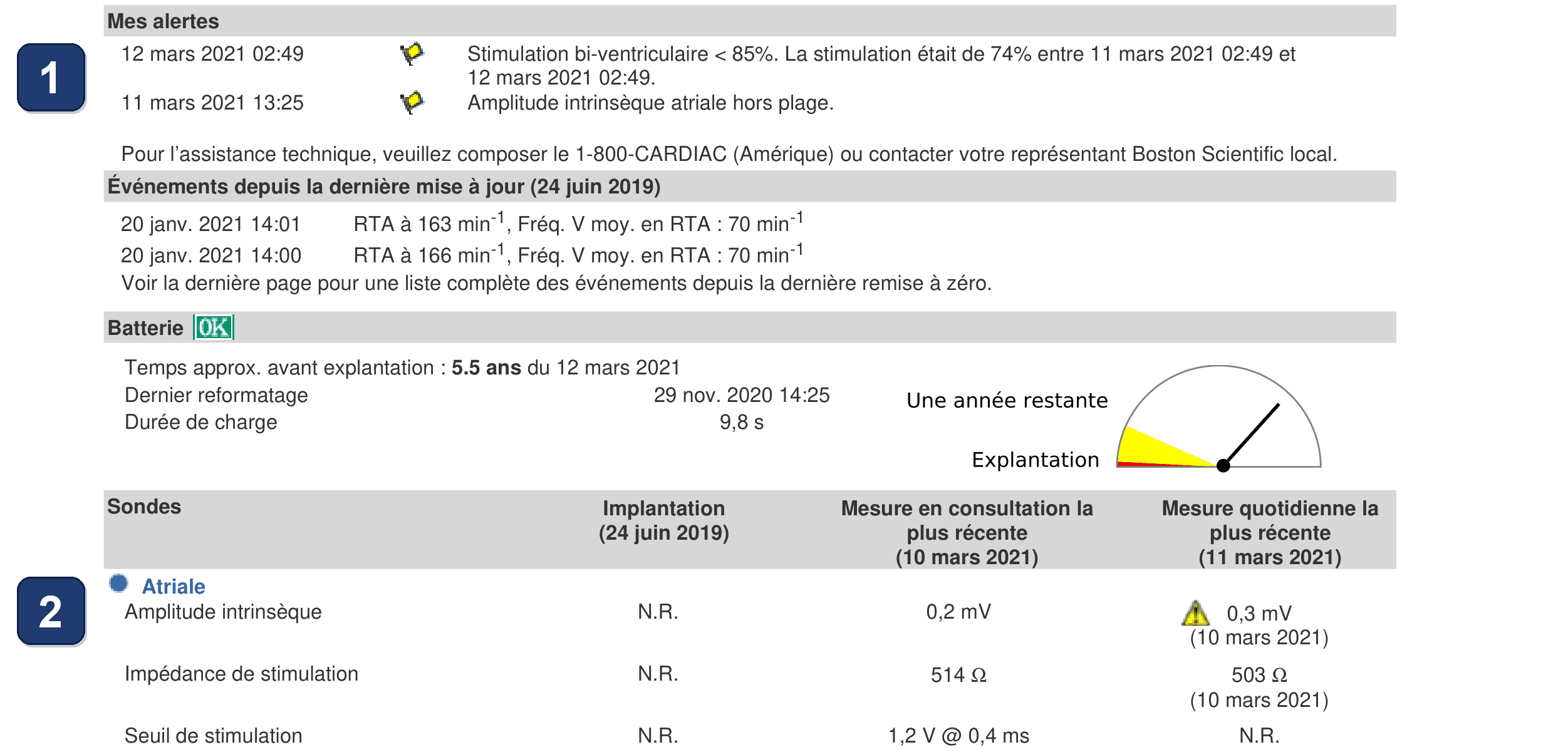

- Remote report, two alerts: biventricular pacing < 85% (74% over the last 24 hours) and atrial intrinsic amplitude out of range. The daily LV pacing had varied between 42 and 95% over the previous month
- Atrial lead: intrinsic atrial amplitude of 0.2 mV in office two days earlier and 0.3 mV on the daily measurement (warning sign), with the atrial sensitivity at AGC 0.15 mV: very little margin. Atrial impedance (503-514 Ω) and threshold (1.2 V @ 0.4 ms) are unremarkable
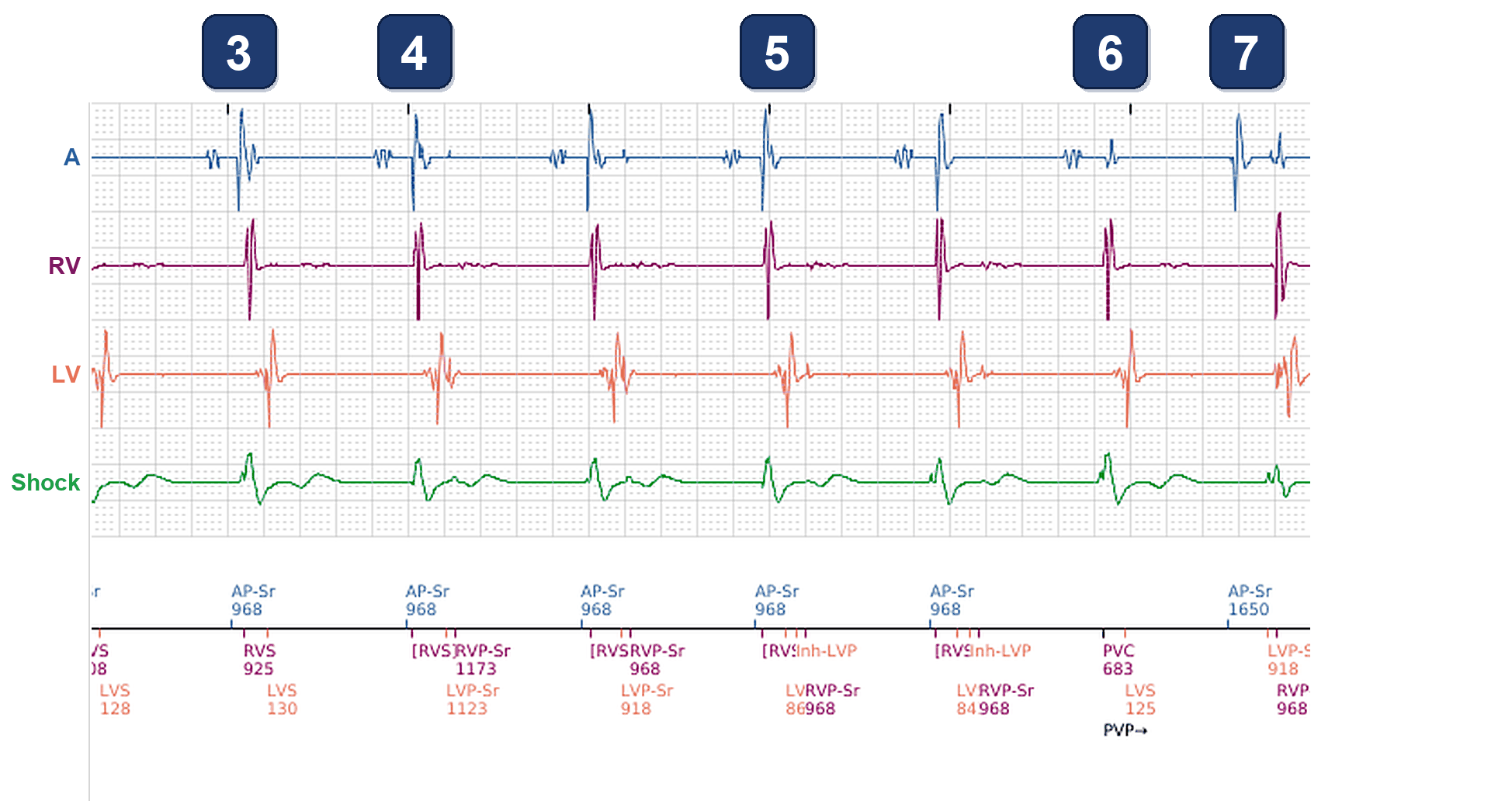
- Real-time EGM of the transmission. A low-amplitude atrial event, just before the large atrial pacing spike, is not sensed; the sensor-driven atrial pace (AP-Sr 968) falls just after it and the atrial event conducts: RVS 925, the LV sensed 130 ms later (LVS 130) = the patient’s own conducted beat, RV first and LV late, no CRT
- Next beat: the conducted ventricular activation reaches the RV 30 ms after the atrial pace, in the noise window that follows it: [RVS] in brackets, which does not inhibit pacing. LVP-Sr and RVP-Sr follow 220 and 270 ms after the atrial pace (paced AV delay, LV offset −50 ms), into a ventricular activation already under way: the shock EGM is that of the conducted beats
- Here the LV is sensed (LVS) 130 ms after the [RVS]: the LV pace due 220 ms after the atrial pace is withheld (Inh-LVP, LV protection period), and the RV is paced anyway (RVP-Sr 968) into the conducted beat: no LV pacing on this beat
- Another low-amplitude atrial event is missed and conducts, this time before the next atrial pace was due: an RV sense with no atrial event before it is a PVC for the device (PVC 683, LVS 125). PVARP is extended for one cycle (PVP→) and the next atrial pace is timed from this “PVC”
- AP-Sr 690 ms after the “PVC” (1650 ms after the previous atrial pace), followed by LVP-Sr and RVP-Sr at the end of the paced AV delay: a BiV paced beat, and the shock EGM changes
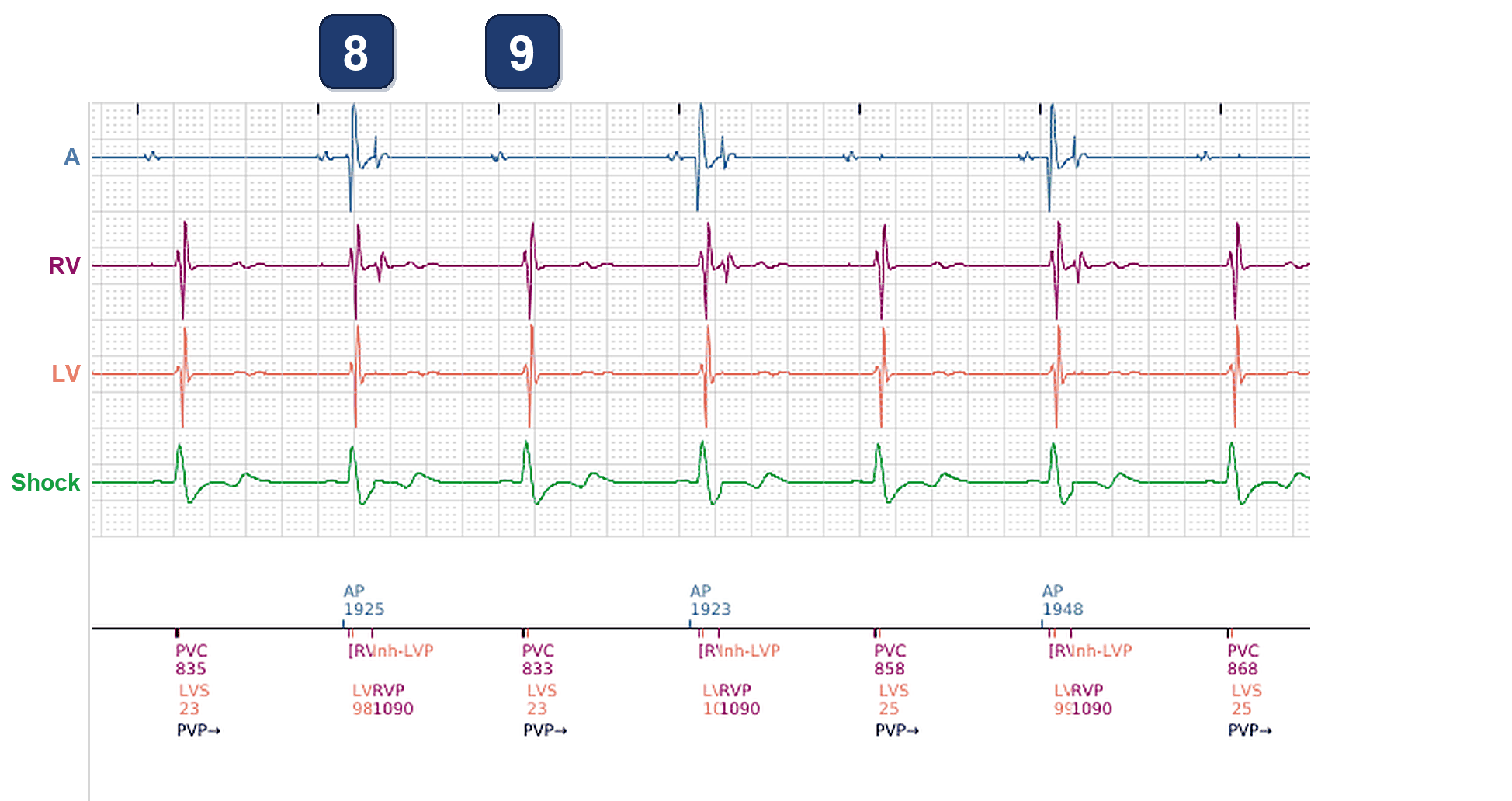
- Second patient (AUTOGEN): BiV pacing < 85% alert (76%), intrinsic atrial amplitude 0.4 mV against 1.0 mV at implant. Not one atrial event is sensed in the 30-s EGM: the atrial pace (AP) falls just after a tiny atrial event whose conducted ventricular activation is sensed at once ([RVS], LVS): the LV pace is withheld (Inh-LVP) and the RV is paced into it (RVP 1090)
- The next atrial event is missed too and its conducted beat, with no atrial event before it, is a “PVC” (833 ms, PVP→). The next atrial pace is timed from it at the lower rate (RVP 1090 ms = 55 bpm) and again falls just after an atrial event: the loop repeats every two beats, without a single BiV beat
Points to remember
- In sinus rhythm, a low BiV pacing alert calls for a look at atrial sensing. Atrial events close to the sensing limit (here 0.2-0.3 mV for a sensitivity of 0.15 mV) are sensed on some beats and missed on others: BiV pacing comes and goes, 42 to 95% a day
- Check the intrinsic atrial amplitude in the lead table even without an atrial alert: in the second patient only the BiV alert fired, but the atrial amplitude had fallen from 1.0 to 0.4 mV
- On the EGM, look for atrial events with no atrial marker and for atrial paces that fall just after them. Pacing markers do not prove CRT: with a pace delivered into a ventricular activation already under way, or an LV pace withheld after an LV sense (Inh-LVP), the beat stays the patient’s own
- A conducted beat with no atrial event before it is taken for a PVC, and the next atrial pace is timed from it: missed atrial events can set up a loop, here every two beats in the second patient, with not one BiV beat on the EGM
Summary
- Low-amplitude atrial events (0.2-0.3 mV) are intermittently undersensed: each missed atrial event conducts, the device paces into the conducted ventricular activation or calls it a PVC, and BiV pacing falls to 74%. Same mechanism in the second patient, whose intrinsic atrial amplitude has fallen to 0.4 mV
Clinical pearl
When BiV pacing falls in sinus rhythm, think of the atrial lead, not only of the LV lead. An atrial event that is not sensed is not tracked: it conducts, and that beat gets no CRT, even when pacing markers follow it
Practice out loud
Just describe the tracing. What do you think is going on? Describing the numbers can help.
00:00
0%
—
From Boston Scientific CRT — clinical cases by M. Strik. Published by Cardiocases. Every numbered marker on a recording is explained in the list beneath it; tap a marker on the trace or an entry in the list.