
Chapter 1 · Counters · Case 13
Fast VT and the combined counter
Patient and episode
Patient
- Male implanted with a dual-chamber defibrillator (Cobalt DR) for ischaemic cardiomyopathy.
The recording
Tap a number on the trace, or an entry in the list below
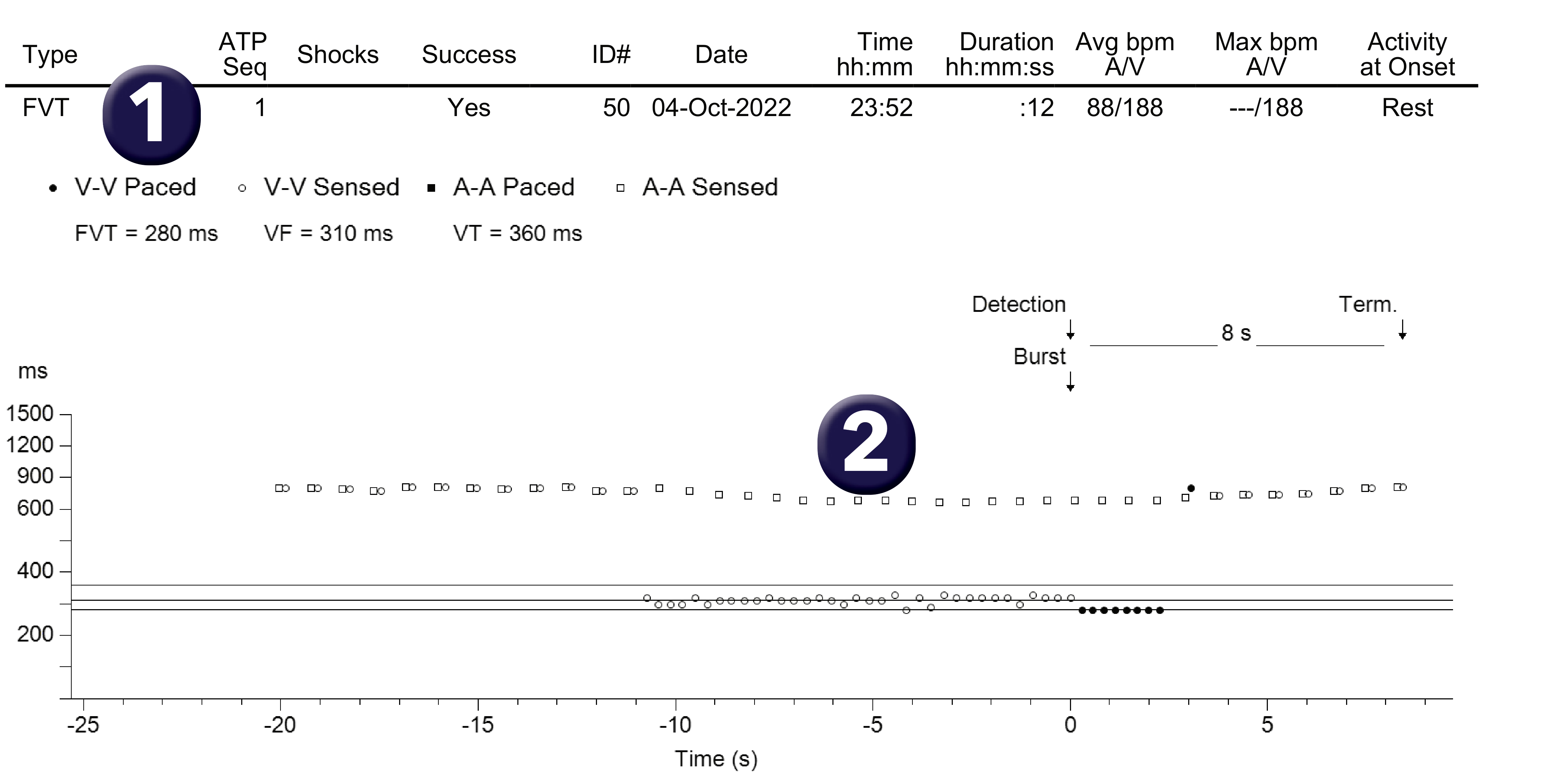
Rate / interval plot
EGM

From the interrogation

- What diagnosis is suggested by the interval plot? Three detection zones were programmed: a VT zone from 360 ms, a FVT zone from 310 ms and a VF zone from 280 ms; the episode was classified as FVT by the device (1); the plot shows probable VT with atrioventricular dissociation (2) with cycles oscillating between the limit of the VT-FVT zones; a burst is used to terminate the arrhythmia.
- What is your diagnosis? The EGM shows a regular, monomorphic tachycardia, alternately detected in the VT zone and the FVT zone; the combined counter is full, with 35 cycles classified as TS or TF. (7/6 of 30 cycles); analysis of the last 8 cycles before diagnosis shows at least one cycle classified as TF leading to the diagnosis of FVT; the first therapy in the VF zone (a burst) is delivered with termination of the arrhythmia.
- What is the diagnosis made by the system? The diagnosis is that of FVT via the combined counter.
Points to remember
- This plot shows another example of how the combined counter works.
- The tachycardia oscillates between the VT zone and the FVT zone programmed via VF; therefore the 2 VT and VF counters increment in parallel.
- The combined counter has been developed to avoid delaying therapy in this scenario.
- When the combined counter is filled (35 TS or TF cycles in this example), the device analyses the last 8 intervals; here, no cycle is classified as FS, but at least one of the cycles is classified as TF, leading to a diagnosis of FVT.
Practice out loud
Just describe the tracing. What do you think is going on? Describing the numbers can help.
00:00
0%
—
From Medtronic ICD — clinical cases by P. Bordachar, A. Thiyagarajah, L. Fontagne, M. Strik, S. Ploux. Published by Cardiocases. Every numbered marker on a recording is explained in the list beneath it; tap a marker on the trace or an entry in the list.
Order hardcopyon Amazon