
Chapter 1 · Counters · Case 10
Zone limits and the VT counter
Patient and episode
Patient
- Male implanted with a dual-chamber defibrillator (Evera XT DR) for dilated cardiomyopathy.
The recording
Tap a number on the trace, or an entry in the list below
Rate / interval plot
EGM

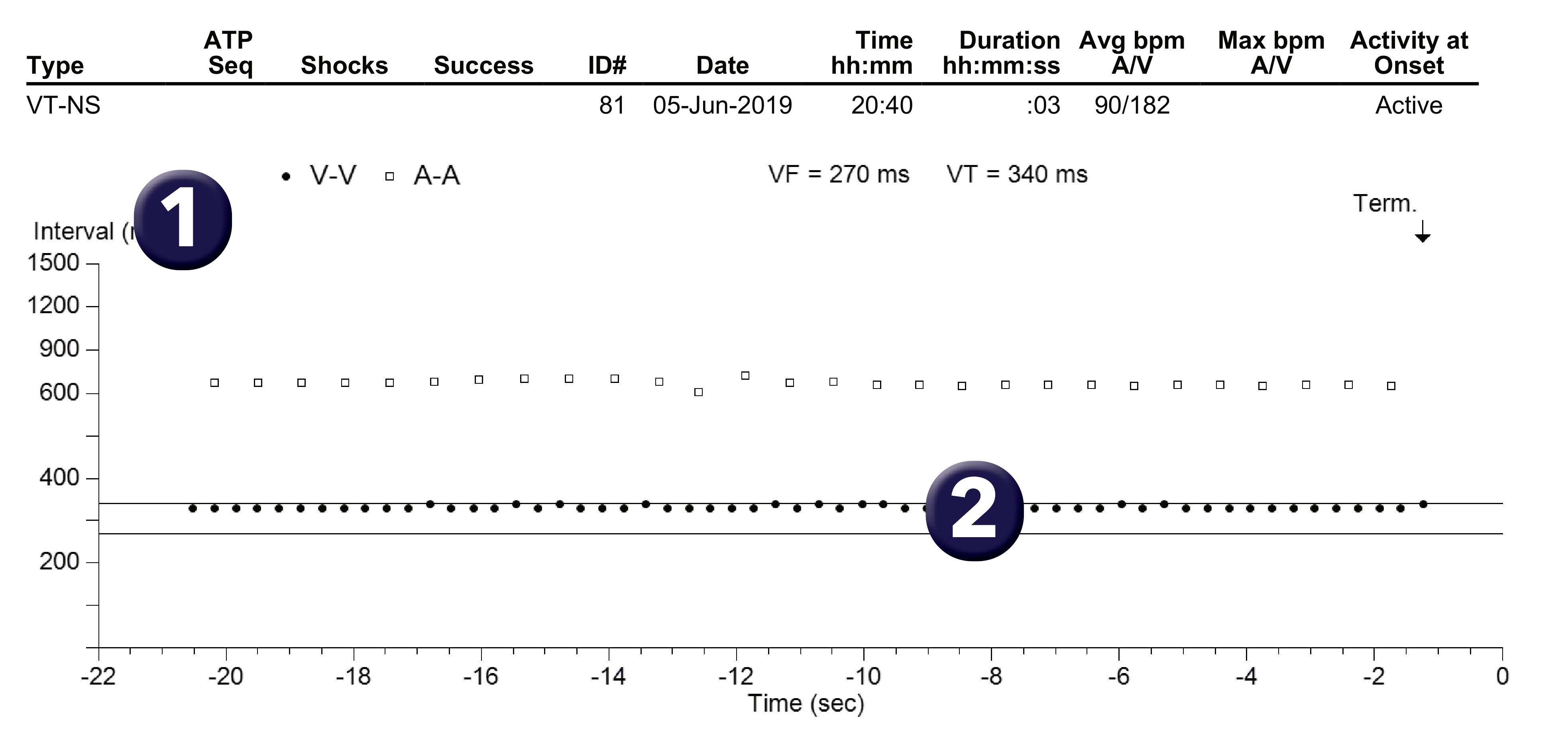
- What diagnosis is suggested by the interval plot? The episode was classified as VT-NS by the device (1); the plot shows atrioventricular dissociation with cycles oscillating around the VT zone (2).
- What is your diagnosis? The EGM shows VT (ventricular rate > atrial rate); some cycles are classified as TS, others as VS; cycles classified as VS reset the VT counter to 0.
Points to remember
- This plot shows one of the possible limitations of the VT counter, which requires a programmable number of consecutive cycles classified as TS, and highlights the importance of programming the lower limit of the VT zone.
- In this patient, the diagnosis of VT is indisputable, with obvious atrioventricular dissociation; however, there is a delay in diagnosis due to specificity in the operation of this counter; the tachycardia oscillates around the lower limit of the VT zone; when a cycle is classified as VS, the VT counter is reset to 0 even if, as in this case, the diagnosis of VT is obvious.
- It is therefore essential to program a sufficient margin based on the rate of the clinical tachycardia to avoid this type of problem; it is usual to program the VT zone 10 to 20 beats/minute slower than the clinical VT, this margin should probably be slightly higher for MedtronicTM devices, since the occurrence of a cycle classified as VS has different consequences compared to defibrillators of competing devices.
- This specificity also means that VT counters are generally not used for tachycardias above 200 beats/minute, as the risk of intermittent undersensing is increased (more frequently with polymorphic tachycardias), resulting in delayed or non-diagnosis and delayed or withheld treatment; the probabilistic VF counter seems more appropriate for this type of tachycardia.
- In the latest recommendations, there are marked differences in terms of programming the detection zone boundaries depending on the manufacturer; the different operation of the counters explains some of these differences (in primary prevention, MedtronicTM recommends a single VF zone from 188-200 beats/minute, compared with a VT zone up to approximately 230 beats/minute followed by a VF zone for the other manufacturers).
Practice out loud
Just describe the tracing. What do you think is going on? Describing the numbers can help.
00:00
0%
—
From Medtronic ICD — clinical cases by P. Bordachar, A. Thiyagarajah, L. Fontagne, M. Strik, S. Ploux. Published by Cardiocases. Every numbered marker on a recording is explained in the list beneath it; tap a marker on the trace or an entry in the list.
Order hardcopyon Amazon