
Chapter 3 · Oversensing · Case 7
Electric shock during a barbecue
Patient and episode
Patient
- Male with ischaemic cardiomyopathy implanted with a single-chamber defibrillator (Visia AF MRI XT VR) who received an electric shock during a barbecue.
The recording
Tap a number on the trace, or an entry in the list below
Rate / interval plot
EGM
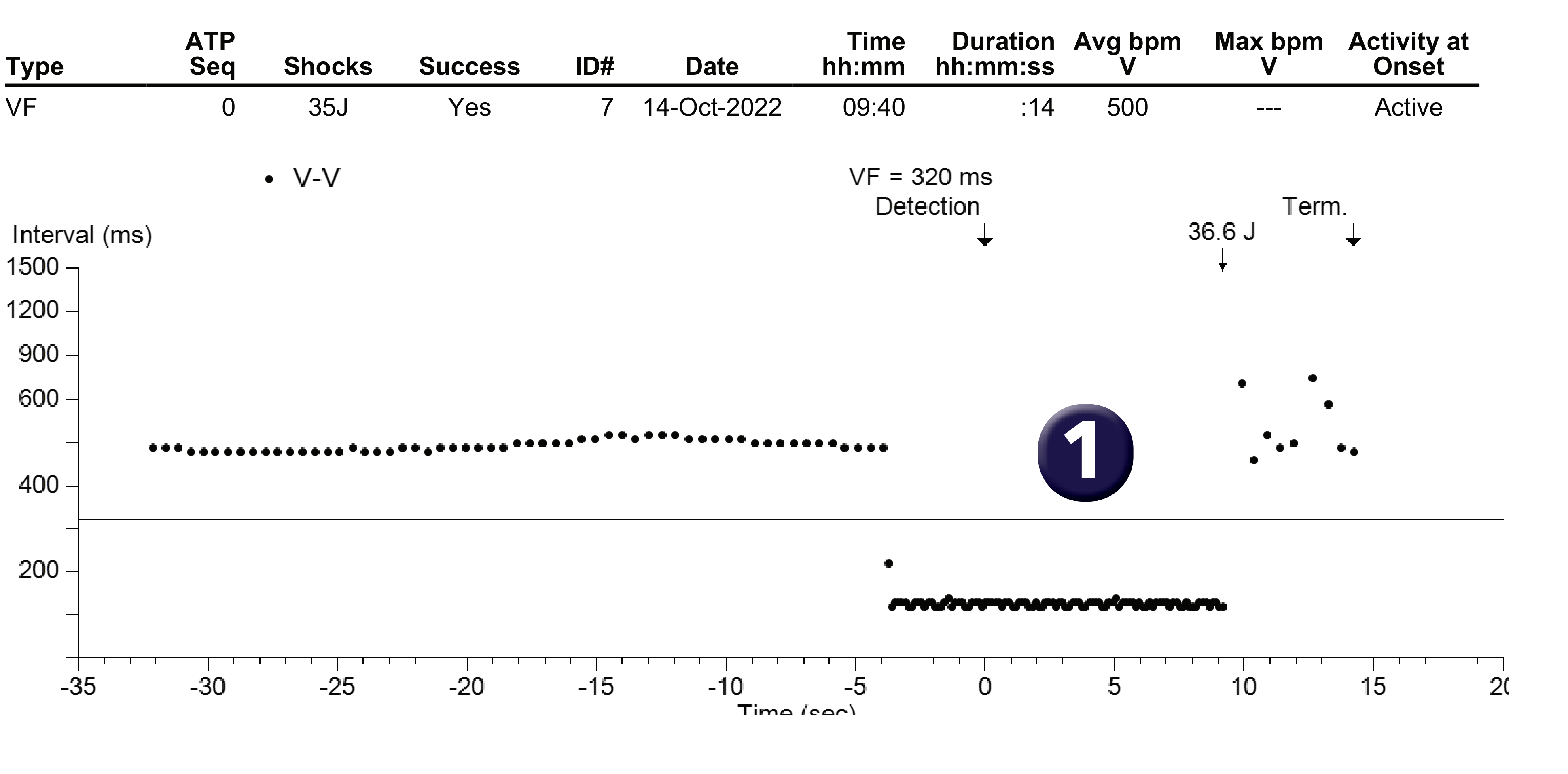
- Does the interval plot suggest a ventricular rhythm disorder or a problem with oversensing? The plot shows a sudden shortening of the ventricular cycle length which becomes very short, falling into the VF zone at the limit of the programmed blanking value (around 120 ms); the existence of these very short cycles makes it unlikely that this episode is physiological and related to a true episode of ventricular arrhythmia; the most likely diagnosis is therefore that of oversensing with an electric shock that interrupts oversensing.
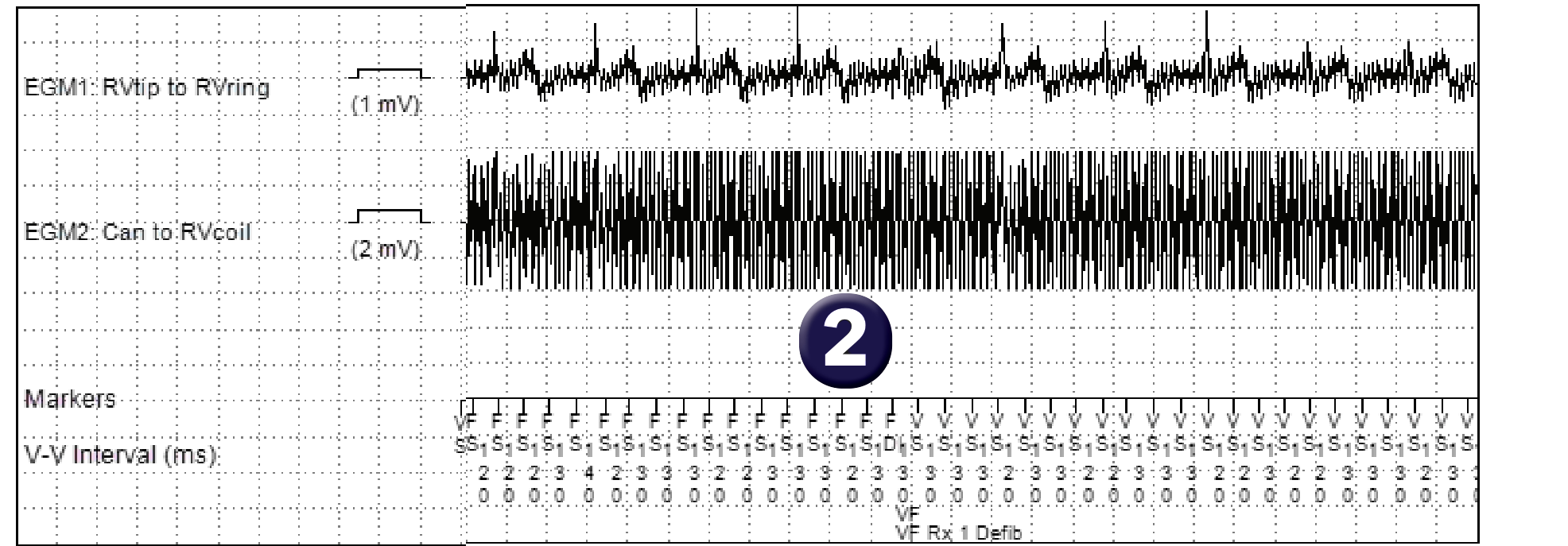
- What is your diagnosis? The EGM shows saturation of the baseline on the 2 channels (bipolar channel and shock channel), the signals observed on the shock channel being of higher amplitude; this is characteristic of oversensing due to electromagnetic interference (50 Hz); these signals are detected as “FS” by the defibrillator; when the FS counter is reached (probabilistic counter 30/40), the device charges its capacitors and delivers a shock after confirming that at least 2/5 cycles are fast; after the shock sinus rhythm reappears.
Points to remember
- The risk of electromagnetic interference with an implantable defibrillator has been frequently described in the hospital environment, in the patient’s home or during professional activities; interference can occur by conduction if the patient is in direct contact with the emitting source or by radiation if the patient is located within an electromagnetic field.
- The newest defibrillators are protected against most sources of interference that patients may encounter in their daily lives; interfering signals are typically filtered, with analysis restricted to a narrow bandwidth corresponding to physiological signals (high-pass and low-pass filters); however, the high adaptive sensitivity required in a defibrillator for correct detection of signals during ventricular fibrillation may favour detection of non-physiological signals falling within the same bandwidth.
- Signals due to electromagnetic interference may not be filtered appropriately with consequences of varying severity, ranging from occurrence of inappropriate therapies, inhibition of pacing in a dependent patient, inappropriate fallback due to incorrect diagnosis of supraventricular arrhythmia, rapid ventricular pacing synchronised to atrial oversensing, suspension of therapy detection or fallback to an asynchronous mode; in exceptional cases, interference with a high-intensity field can cause permanent circuit damage.
- The diagnosis of electromagnetic interference is based on confirmation of exposure to a source at the time of the episode and oversensing of characteristic signals (fast, regular and saturating the baseline).
- If the oversensing is prolonged, a single electric shock is usually sufficient to interrupt the oversensing, as the patient usually stops the offending activity immediately.
- Electromagnetic interference is more frequent with an integrated bipolar lead than with «true» bipolar detection, as the detection antenna is wider; the characteristic high-frequency signals, which are obviously non-physiological, are detected on available atrial and ventricular channels (possible diagnoses of bi-tachycardia or AF + VF) and are generally of greater amplitude on the shock channel than on the sensing channel.
Practice out loud
Just describe the tracing. What do you think is going on? Describing the numbers can help.
00:00
0%
—
From Medtronic ICD — clinical cases by P. Bordachar, A. Thiyagarajah, L. Fontagne, M. Strik, S. Ploux. Published by Cardiocases. Every numbered marker on a recording is explained in the list beneath it; tap a marker on the trace or an entry in the list.
Order hardcopyon Amazon