
Chapter 3 · Oversensing · Case 11
Telemedicine monitoring to avoid disasters
Patient and episode
Patient
- Man implanted with a triple-chamber defibrillator (Viva XT CRT-D), hospitalised for multiple electric shocks in the absence of prior symptoms.
The recording
Tap a number on the trace, or an entry in the list below
Rate / interval plot
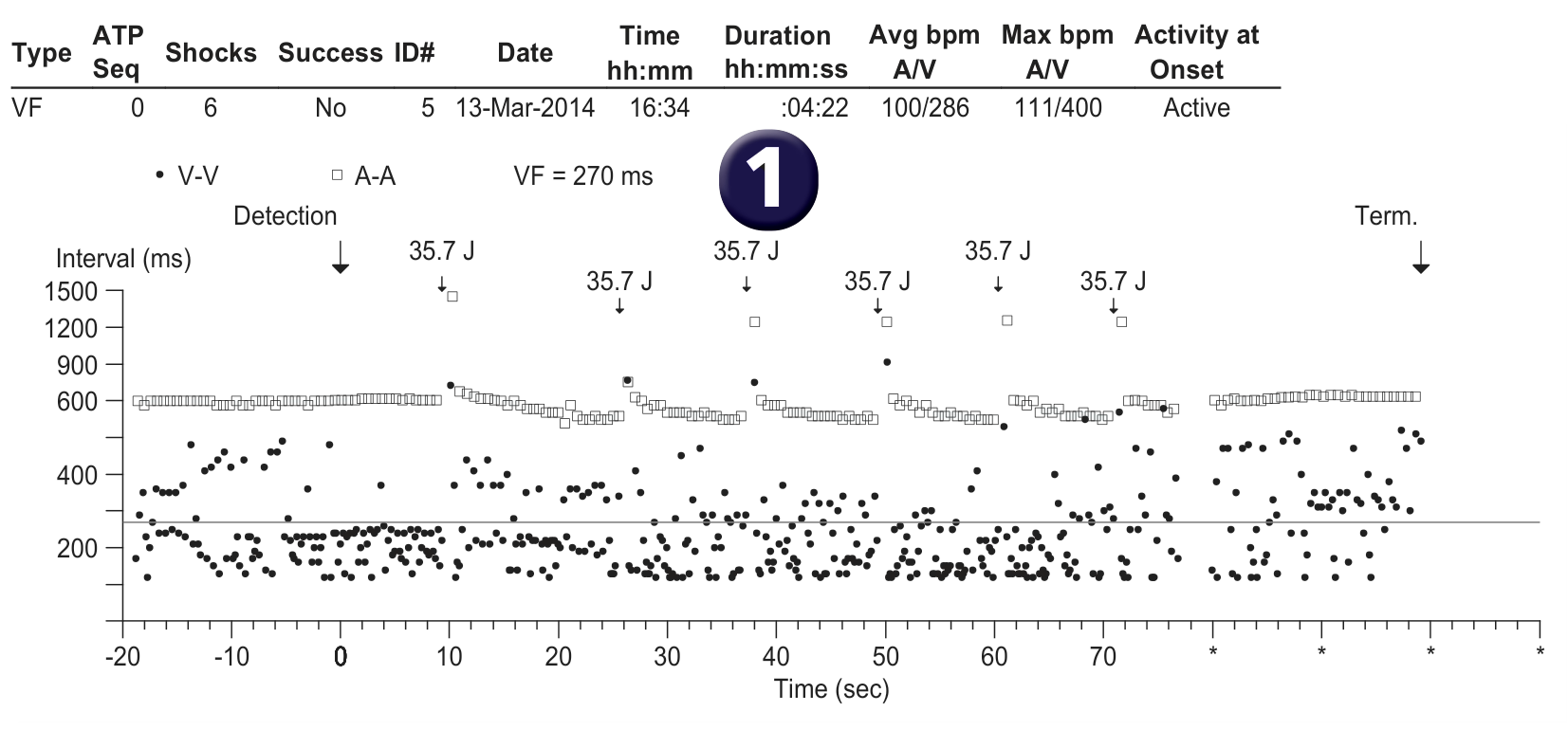
EGM

- What do you think of this interval plot? The plot shows a characteristic feature of lead dysfunction with a cloud of points (very high cycle-to-cycle variability) and very short ventricular cycles at the limit of the blanking value; 6 maximum electric shocks were delivered with no significant impact on the sensed ventricular rate.
- What do you think of the EGM? The EGM is highly suggestive of lead dysfunction, with evidence of chaotic signals that vary in amplitude and frequency, with no relation to the QRS complexes. Some signals saturate the amplifiers and some cycles border on the programmed blanking interval.
- What do you think of the appearance of the impedance curves? The impedance curve for bipolar stimulation (between the distal and proximal electrodes) shows a very clear break with normal values followed by a sharp increase to a measurement above 3000 Ohms; in contrast the impedance curve measured in integrated bipolar (between the distal electrode and the coil) returns normal values; this suggests the existence of a break in the proximal electrode.
- What do you think of the appearance of the threshold and ventricular detection curves? The right ventricular threshold curve shows an abrupt increase in measurements with a progressive decrease in R wave amplitude (from 10 to 5 mV).
Points to remember
- This example illustrates the successive stages usually observed in «historical» lead dysfunction: firstly, the device’s memory showed multiple episodes of non-sustained VT without any lead measurement anomalies; secondly, a clear break in the various impedance, threshold and right ventricular sensing curves was observed; in the absence of a diagnosis of lead dysfunction, the patient underwent the traumatic experience of receiving multiple electric shocks.
- This patient was not monitored by telemedicine, which prevented an early diagnosis before the shocks occurred; reducing the number of inappropriate shocks is a priority in the programming and monitoring of implanted patients; telemedicine has shown to be effective in this context, presently receiving a class I indication; it should therefore be offered systematically to all patients with a defibrillator.
- This type of episode also demonstrates the value of limiting the number of therapies delivered for a single episode, as the occurrence of successive inappropriate shocks is a traumatic ordeal for the patient.
Practice out loud
Just describe the tracing. What do you think is going on? Describing the numbers can help.
00:00
0%
—
From Medtronic ICD — clinical cases by P. Bordachar, A. Thiyagarajah, L. Fontagne, M. Strik, S. Ploux. Published by Cardiocases. Every numbered marker on a recording is explained in the list beneath it; tap a marker on the trace or an entry in the list.
Order hardcopyon Amazon