
Chapter 3 · Oversensing · Case 5
Use of a specific algorithm
Patient and episode
Patient
- Male implanted with a single-chamber defibrillator (Cobalt VR) for primary prevention of ischaemic cardiomyopathy. (same patient as above).
The recording
Tap a number on the trace, or an entry in the list below
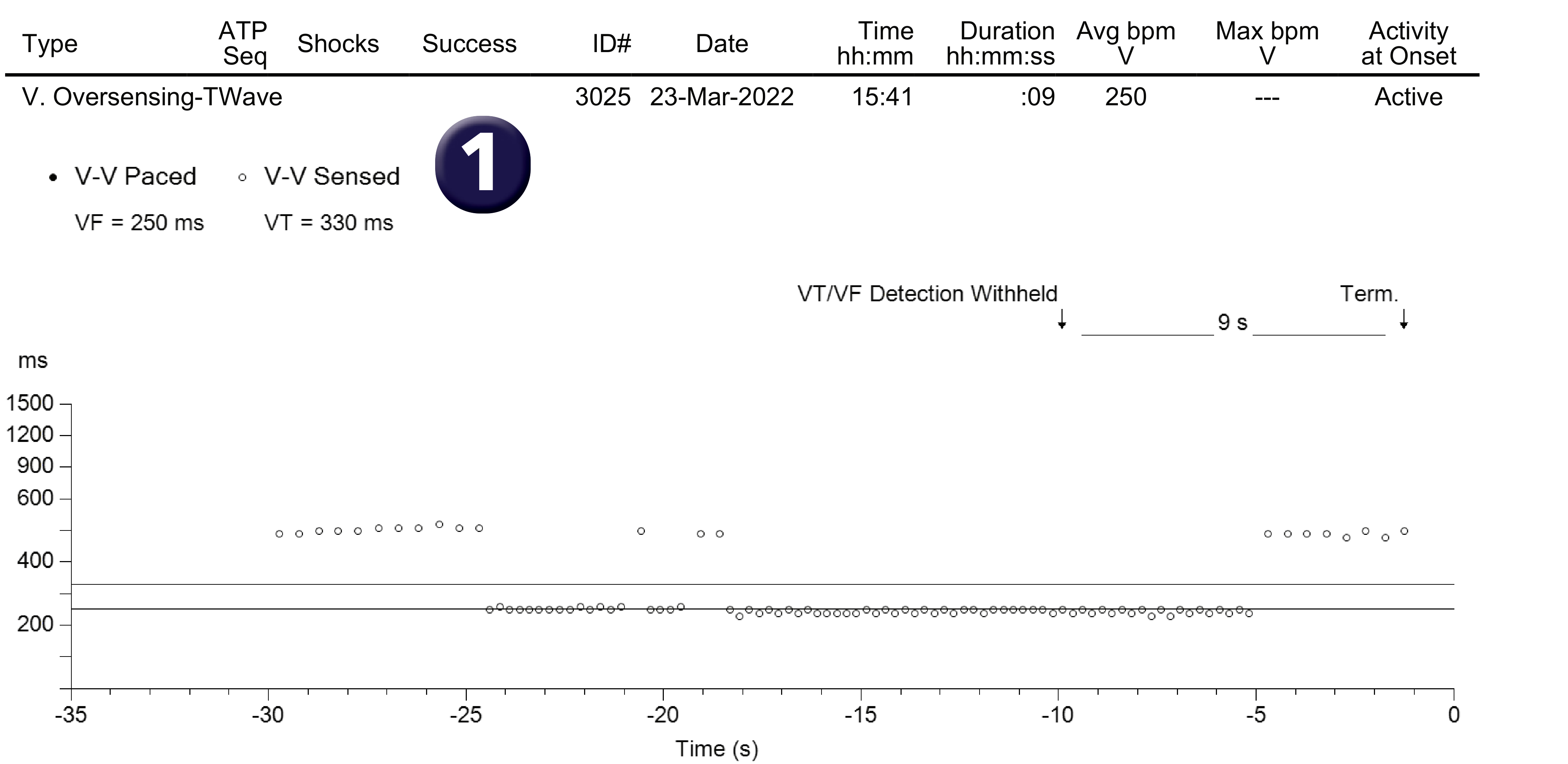
Rate / interval plot
EGM

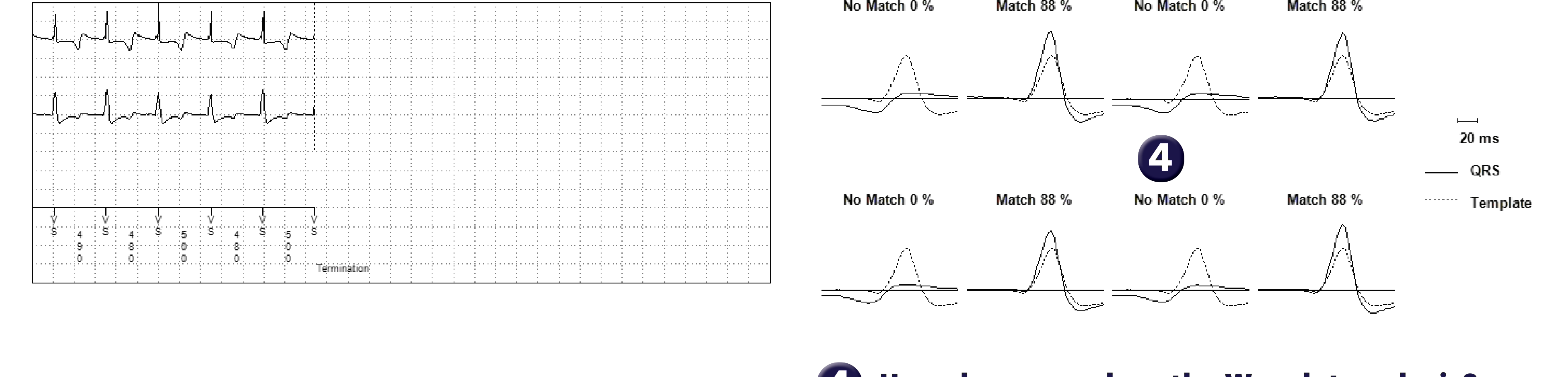
- How was this episode classified? This episode was classified as T wave oversensing.
- What is your diagnosis? This is an episode of T wave oversensing.
- Has therapy been provided? When the combined counter is full (35 cycles classified as VT or VF), the defibrillator concludes that the T wave has been oversensed and inhibits therapies; the analysis then continues cycle by cycle with inhibition (T wave marker).
- How do you analyse the Wavelet analysis? Wavelet would have concluded the diagnosis of SVT (50% of cycles considered similar); as previously indicated, Wavelet was not used as the ventricular cycles were too short (faster than the programmed SVT limit of 260 ms).
Points to remember
- In this episode of T wave oversensing delivery of therapies is inhibited following intervention by an algorithm specifically designed for this purpose.
- Visually, making the diagnosis of T wave oversensing is not very difficult for a clinician, given the alternation between 2 signals with different appearances and fixed coupling; this algorithm present on MedtronicTM defibrillators is based on this principal.
- R waves and T waves are differentiated by means of a differential filter which amplifies the difference between the 2 signals; the algorithm recognises T wave oversensing by identifying the repetition of sequences alternating between 2 signals of differing frequency (a high frequency signal, a softer signal) with fixed intervals (fixed RT intervals, fixed TR intervals); various parameters are therefore analysed and if the diagnostic criteria are met over 6 consecutive intervals, the T wave oversensing counter is incremented by +1 ; if a criterion is not met, all 6 consecutive intervals are classified as normal; the next group of 6 intervals is then assessed using a sliding window; as long as 4 of the last 20 sequences meet the T wave discrimination criterion, the device retains the diagnosis of T wave oversensing and the therapies are not delivered.
- This algorithm is nominally programmed on.
- This algorithm works even if the detected frequency exceeds the programmed SVT limit (unlike Wavelet or PR Logic).
Practice out loud
Just describe the tracing. What do you think is going on? Describing the numbers can help.
00:00
0%
—
From Medtronic ICD — clinical cases by P. Bordachar, A. Thiyagarajah, L. Fontagne, M. Strik, S. Ploux. Published by Cardiocases. Every numbered marker on a recording is explained in the list beneath it; tap a marker on the trace or an entry in the list.
Order hardcopyon Amazon