
Chapter 3 · Oversensing · Case 3
Which programming option should be used if the T wave is oversensed?
Patient and episode
Patient
- Patient implanted with a single-chamber defibrillator for Brugada syndrome; episodes of T wave oversensing recorded in memory.
The recording
Tap a number on the trace, or an entry in the list below
From the interrogation
EGM

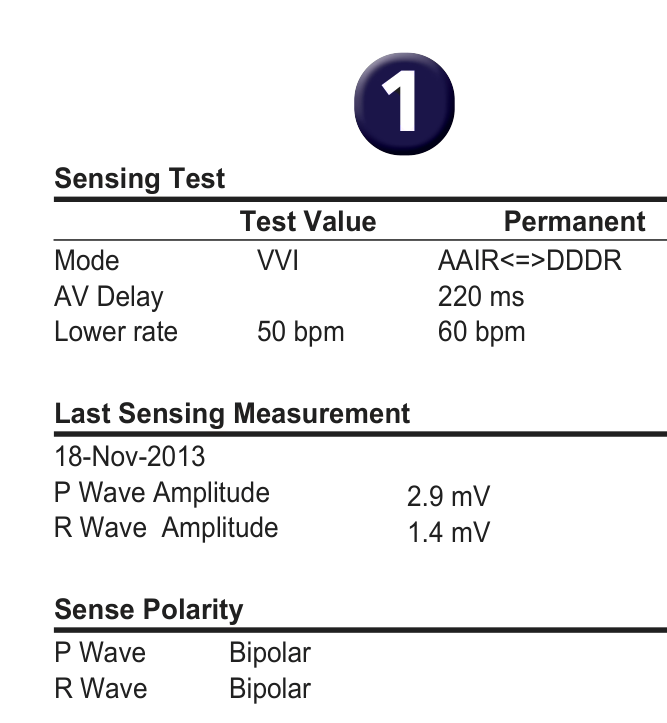
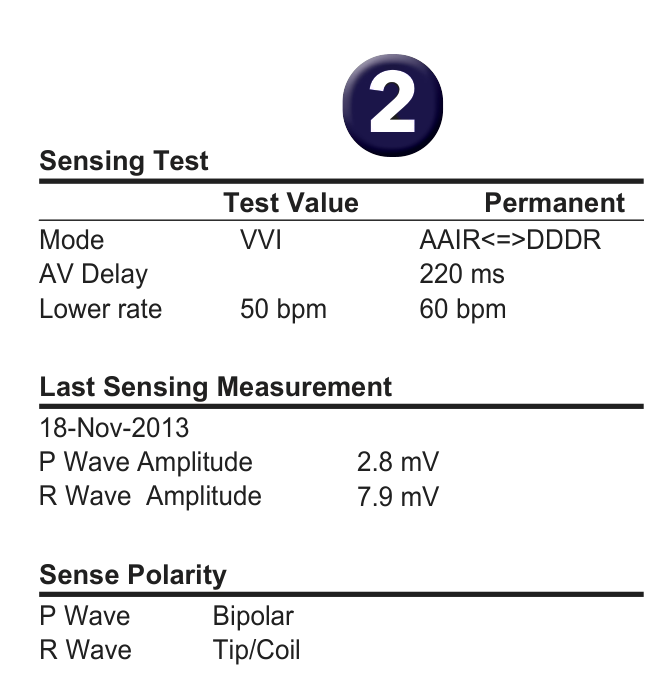
- What do you think of the sensing values measured in this patient? When the device is programmed in traditional bipolar mode, the amplitude of the R waves is low (1.3 mV), which explains the increased risk of T wave oversensing; in fact, the sensitivity profile in a defibrillator is said to be adaptive, with a sensitivity value that initially adapts to the amplitude of the QRS complex; when, the measured amplitude of the R wave is low, the defibrillator is permanently very sensitive (low sensitivity value throughout the cardiac cycle), with an increased risk of oversensing of extra- or intra-cardiac signals.
- Which parameter has been changed? Sensitivity programming has been changed from bipolar to Tip/Coil (which corresponds to integrated bipolar sensing).
- What was the effect of this change in programming? There was a significant and sustained increase in the amplitude of the R wave, with measured values of between 6 and 8 mV.
Points to remember
- In this example, T wave oversensing occurs in the presence of suboptimal ventricular sensing with small amplitude R waves; T wave oversensing is a problem often associated with poor quality R wave sensing.
- In this context, any modification of ventricular sensitivity (reprogramming the sensitivity from 0.3 mV to 0.6 or 0.9 mV) is inappropriate and even dangerous, with a significant possibility of undersensing of VF episodes.
- There is a specific programming feature in MedtronicTM defibrillators which may enable resolution of this difficult situation in certain patients and avoid repositioning the lead; it is possible to program ventricular sensing in either «true» bipolar mode (detection between the 2 distal electrodes) or in integrated bipolar mode (detection between the distal electrode and the right ventricular coil). In a large number of patients, the amplitude of the R wave measured is not significantly different between the 2 configurations; there is therefore no guarantee that the amplitude will be systematically greater in integrated bipolar; however, in certain patients presenting with a low amplitude R wave in a true bipolar configuration, reprogramming RV sensing vector to integrated bipolar sensing can significantly increase the size of the R wave and thus resolve the problem of T wave oversensing (better ratio of R wave amplitude to T wave amplitude); this is a major competitive advantage, since at present, MedtronicTM is the only company offering this feature.
- In this patient, this programming change enabled us to obtain a more acceptable R wave that allowed the device to function properly and prevented further episodes of T wave oversensing.
Practice out loud
Just describe the tracing. What do you think is going on? Describing the numbers can help.
00:00
0%
—
From Medtronic ICD — clinical cases by P. Bordachar, A. Thiyagarajah, L. Fontagne, M. Strik, S. Ploux. Published by Cardiocases. Every numbered marker on a recording is explained in the list beneath it; tap a marker on the trace or an entry in the list.
Order hardcopyon Amazon