
Chapter 2 · Therapies · Case 8
Acceleration after several sequences of anti-tachycardia pacing
Patient and episode
Patient
- Male implanted with a single-chamber defibrillator (Visia XT VR) for ischaemic cardiomyopathy.
The recording
Tap a number on the trace, or an entry in the list below
Rate / interval plot
EGM



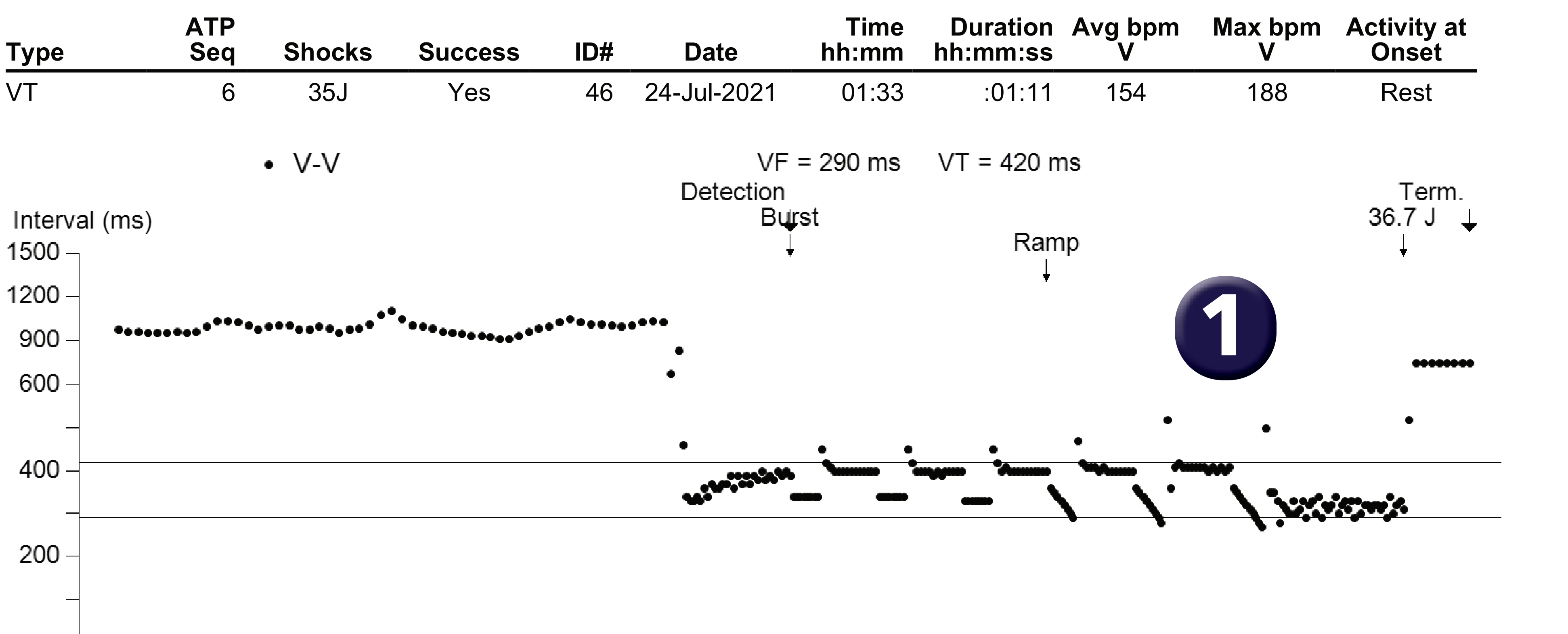
- What diagnosis is suggested by the interval plot? The plot shows a probable arrhythmic episode with sudden acceleration into the VT zone; the first 3 bursts and the first 2 ramps do not terminate the arrhythmia; the third ramp accelerates the arrhythmia which remains in the VT zone; a maximum output shock terminates the arrhythmia.
- What is your final diagnosis? This is a regular, monomorphic tachycardia with wide QRS complexes on the shock channel compatible with VT; the first 3 bursts (treatment 1) and the first 2 ramps (treatment 2) are ineffective; the third ramp accelerates the arrhythmia without significantly changing the morphology; a shock (treatment 3) terminates the arrhythmia.
Points to remember
- Programming ramps after bursts is not systematically undertaken for this heart rate range, because this more aggressive therapy is associated with an increased risk of tachycardia acceleration, as in this example.
- Acceleration of VT and degradation into VF or rapid VT are well described complications following ATP with an incidence of around 1 to 5%; the efficacy and safety of ATP are inversely related; a greater number of tachycardias can be reverted with a more aggressive protocol (short coupling intervals, more cycles per sequence, more sequences) but with an increased risk of acceleration.
- There are 3 reasons why a shock may be delivered following the detection of an arrhythmia in the VT zone: 1) the shock is the first therapy programmed in the VT zone; 2) previous therapies (ATP) have proved ineffective; 3) an ATP sequence accelerates the tachycardia into the VF zone.
Practice out loud
Just describe the tracing. What do you think is going on? Describing the numbers can help.
00:00
0%
—
From Medtronic ICD — clinical cases by P. Bordachar, A. Thiyagarajah, L. Fontagne, M. Strik, S. Ploux. Published by Cardiocases. Every numbered marker on a recording is explained in the list beneath it; tap a marker on the trace or an entry in the list.
Order hardcopyon Amazon