
Chapter 4 · Oversensing · Case 4
Oversensing of the P waves
This case is even rarer, namely P-wave oversensing by the defibrillation lead. This is a routine follow-up examination in an asymptomatic patient implanted with an integrated bipolar defibrillation lead, in which the shock electrode of the ventricular defibrillation lead is involved in the ventricular detection of the defibrillator. « Non-sustained » tachycardias are recorded in the device memory.
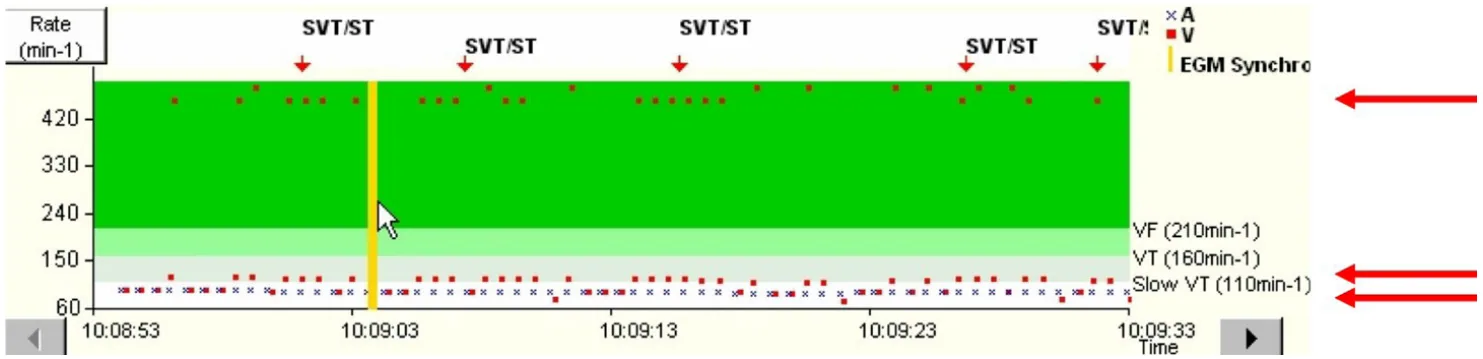
The tachogram exhibits a characteristic triple railroad track pattern with RR, PR, and RP intervals.
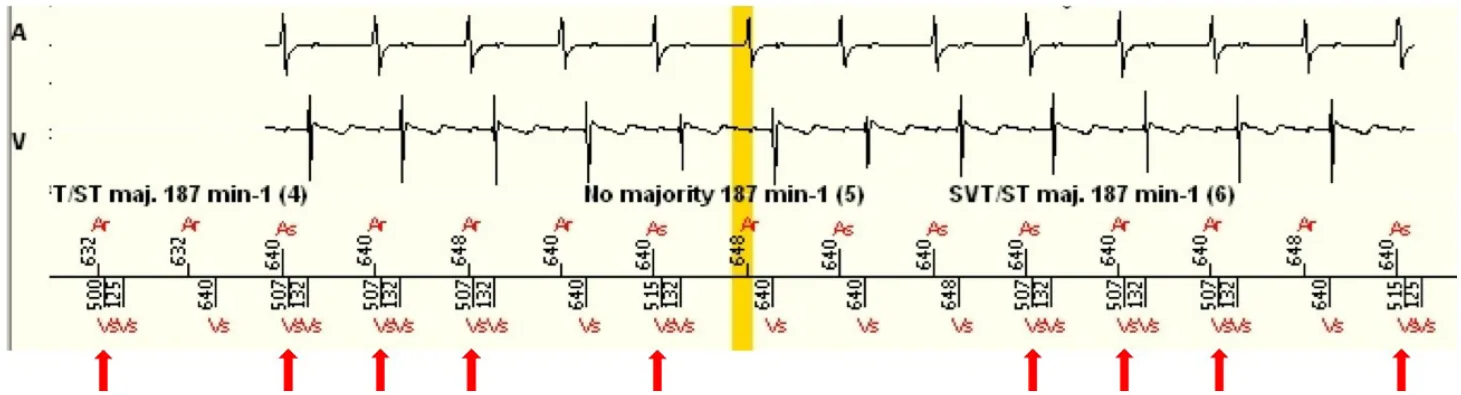
The EGM reveals the cause of this oversensing.
- The concordance between the ventricular markers and the visible P waves can readily be seen on the ventricular electrogram, the latter of which correspond well with the P waves of the atrial electrogram.
- For this integrated bipolar defibrillation lead, this phenomenon is related to a positioning of the shock electrode of the defibrillator ventricular lead that is too close to the tricuspid valve, and thus able to « pick up » the atrial signals.
- This risk is all the more significant if the right ventricle is small, and the distal end of the defibrillation lead is placed in the anterior or infundibular septal area. The proximal part of the shock electrode is therefore straddling the tricuspid ring.
- Here again, in the event of sinus acceleration and of atrial rhythm disturbances, false VT/VF diagnoses may occur and trigger dangerous inappropriate therapies.
- This problem can be solved by decreasing the ventricular sensitivity, but at the risk of under-detection of ventricular fibrillation. If the sensitivity is decreased, we recommend performing a VF induction to verify the proper VF detection quality in this downgraded configuration.
Take-home message
When placing a ventricular defibrillation lead, the absence of oversensing of signals other than QRS, P-waves and T-waves should be controlled, which would thus require a repositioning of the defibrillation lead, which is difficult to perform later during the follow-up.
Practice out loud
Just describe the tracing. What do you think is going on? Describing the numbers can help.
—
From Implantable Cardioverter Defibrillator — Clinical cases from patients with MicroPort™ ICDs by M. Strik, A. Thiyagarajah, S. Ploux, P. Bordachar, P. Ritter. Published by Cardiocases. Each case is a question on real device interrogations: pick your answer, check it, then read the authors’ interpretation. Tap any figure to open it full screen.