
Chapter 5 · Remote monitoring · Transmission 5
Atrial lead impedance
You receive the following transmission
Your turn
Which statement is correct?
- The patient had episodes of paroxysmal atrial fibrillation
- There is worsening of atrial lead dysfunction.
- There is new atrial lead dysfunction
- This patient is pacemaker dependant.
Explications
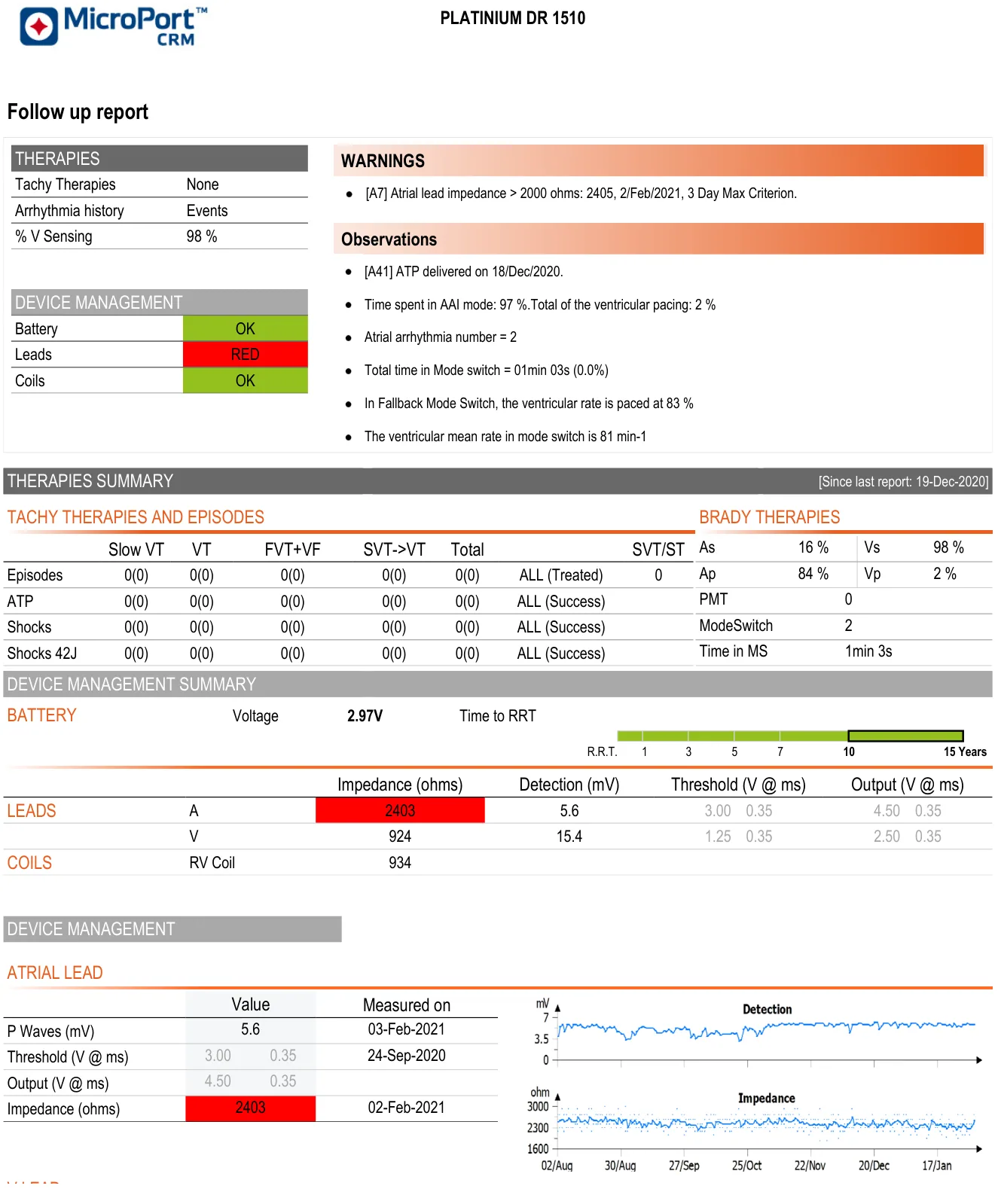
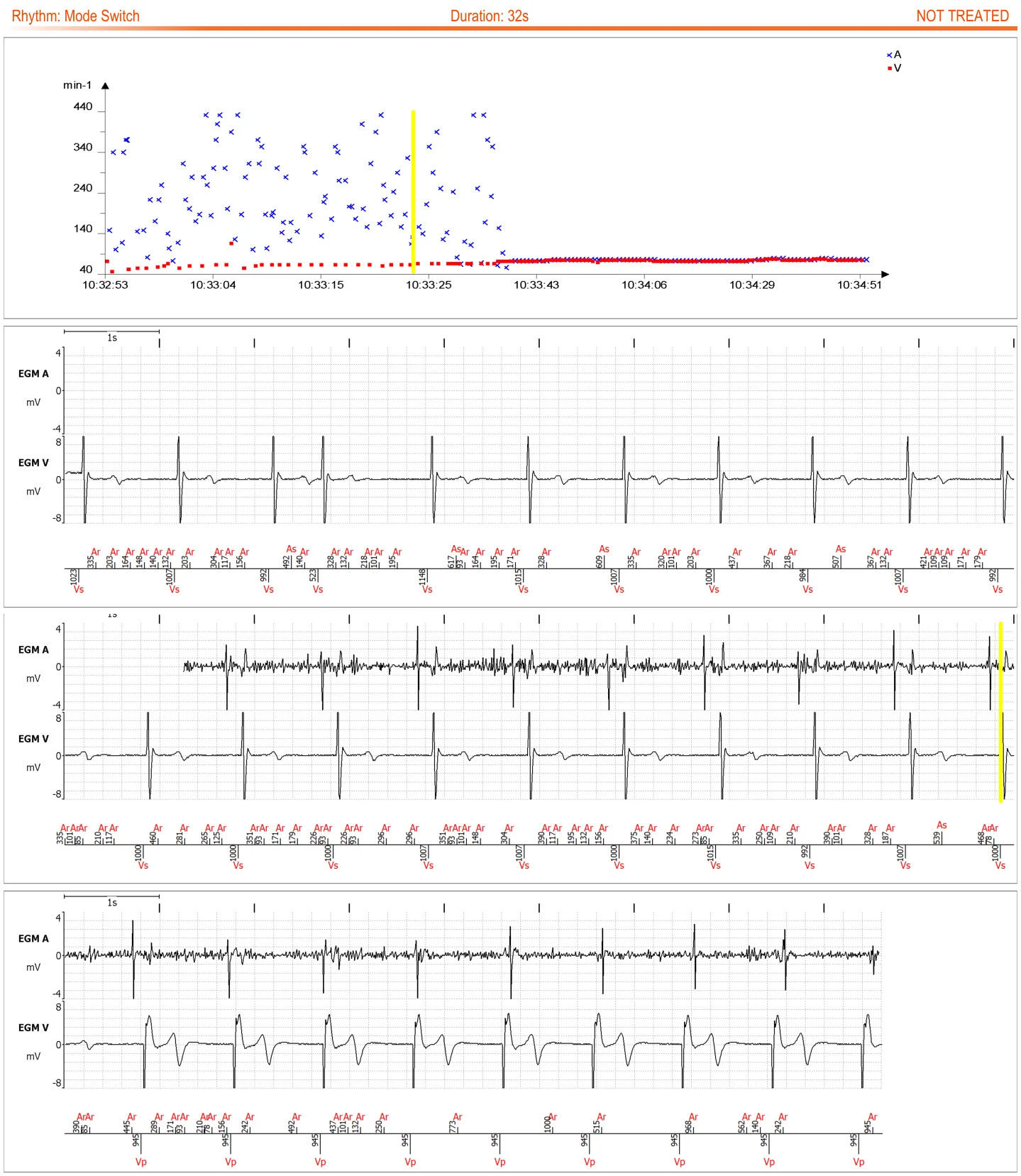
This transmission shows an “Atrial lead impedance” alert, which is triggered when the atrial lead impedance is below 200 Ohms or above 2000 Ohms. The last atrial impedance was 2403 Ohms. While a completely severed lead would result in an impedance of > 3000 Ohms, the value of 2403 Ohms is also clearly outside of the normal range (< 1000 Ohms). When looking at the trends, the high impedance has been around this value and stable for a few months. While sensing shows good values (5.6 mV), the atrial pacing threshold is very high (3V at 0.35ms). In this transmission, there are two Mode Switch episodes which show intermittent oversensing on the atrial channel. The oversensed signals are chaotic, with large amplitudes and are non-physiologic in nature. Together with the increased impedance and high pacing threshold, the lead noise confirms the diagnosis of atrial lead dysfunction.
Next steps
In patients with signs of atrial lead dysfunction, the diagnosis is often difficult as the lead still functions nearly all of the time and does not cause any symptoms. The clinical risks of an atrial lead dysfunction are obviously a lot lower than a dysfonctioning ventricular lead which is associated with multiple inappropriate therapies and syncope due to loss of ventricular capture. In ICDs, the atrial lead is often used for atrial pacing in patients with slow sinus rates or chronotropic incompetency, often aggravated by medical therapy in the context of their cardiomyopathy. This is also the case in this patient, who is paced in the atrium 84% of the time, mostly sensor-driven in Safer-R mode. Importantly, in ICD patients, proper functioning of the atrial lead is also important as it is part of the discrimination algorithm which differentiates between supraventricular and ventricular arrhythmias. In case of atrial lead dysfunction, tachycardias may be wrongly classified as ventricular or supraventricular. It is recommended to reprogram the discrimination algorithm (de-activate PARAD+) in case of suspected atrial lead dysfunction. The patient should be seen in-clinic to confirm the diagnosis (noise exacerbation maneuvers and X-ray), perform programming changes and discuss intervention. In this case, it was decided to add a new atrial lead and abandon the existing one (which is 18 years old).
Practice out loud
Just describe the tracing. What do you think is going on? Describing the numbers can help.
—
From Implantable Cardioverter Defibrillator — Clinical cases from patients with MicroPort™ ICDs by M. Strik, A. Thiyagarajah, S. Ploux, P. Bordachar, P. Ritter. Published by Cardiocases. Each case is a question on real device interrogations: pick your answer, check it, then read the authors’ interpretation. Tap any figure to open it full screen.