
Chapter 1 · Counters · Case 1
Classification of cycles, tachycardia counters and evolution of guideline recommendations
Patient and episode
Patient
- Female with Brugada syndrome implanted with a single-chamber Ellipse defibrillator for primary prevention. These three traces highlight the basic operation of Abbott devices, including the specificities of cycle classification and the evolution of programming recommendations with respect to initial tachycardia detection
Summary
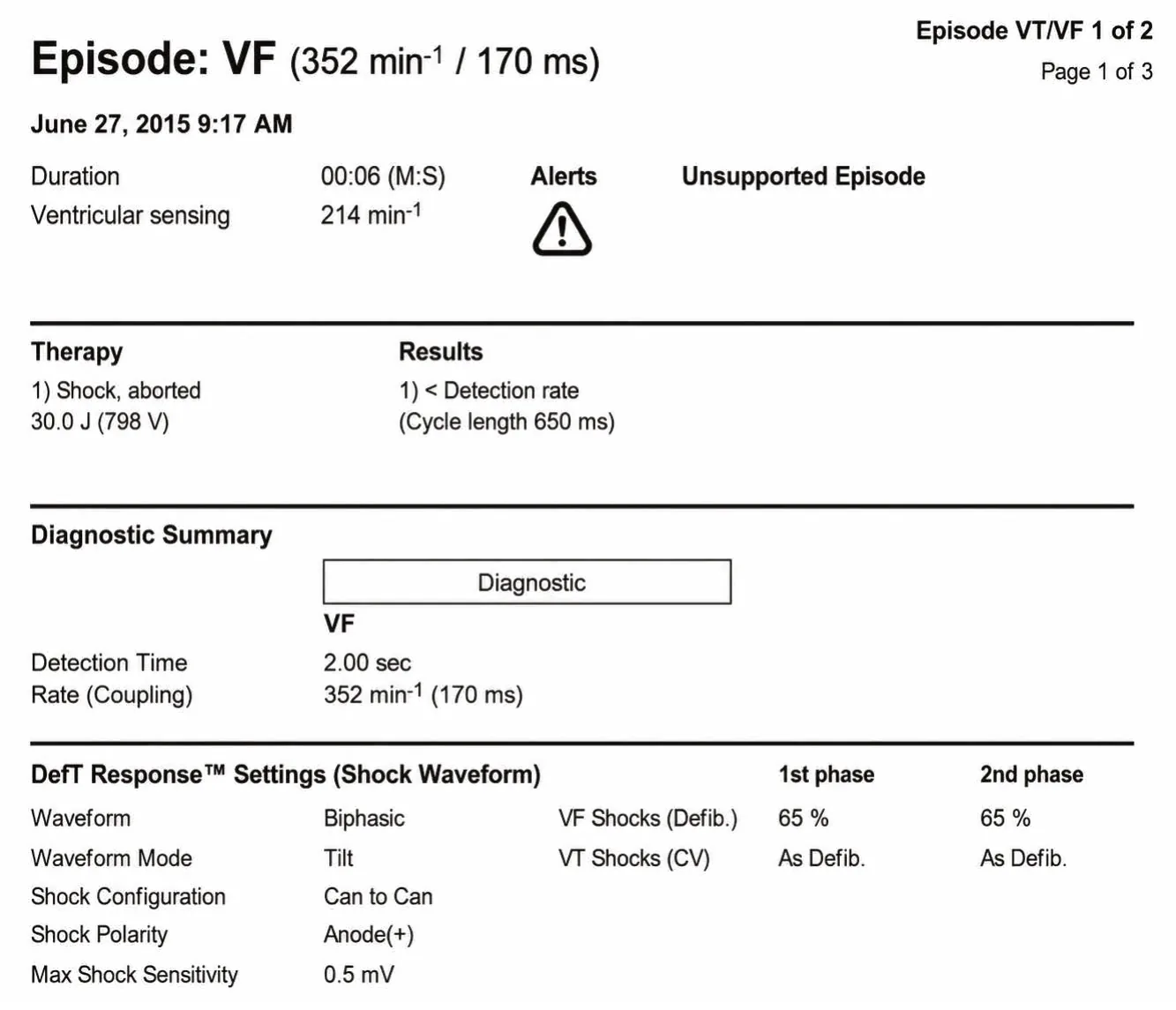
- Episode recorded in June 2015 Non-sustained episode (2 seconds) classified in the VF zone with a diverted charge
- Non-sustained tachycardia episode recorded in March 2017 following a programming change (35 cycles for initial detection in the VF zone) undertaken due to several episodes of diverted capacitor charging and the publication of international consensus recommendations for defibrillator programming
- Non-sustained tachycardia episode recorded in March 2017 following a programming change (35 cycles for initial detection in the VF zone) undertaken due to several episodes of diverted capacitor charging and the publication of international consensus recommendations for defibrillator programming
The recording
Tap a number on the trace, or an entry in the list below
Episode 1
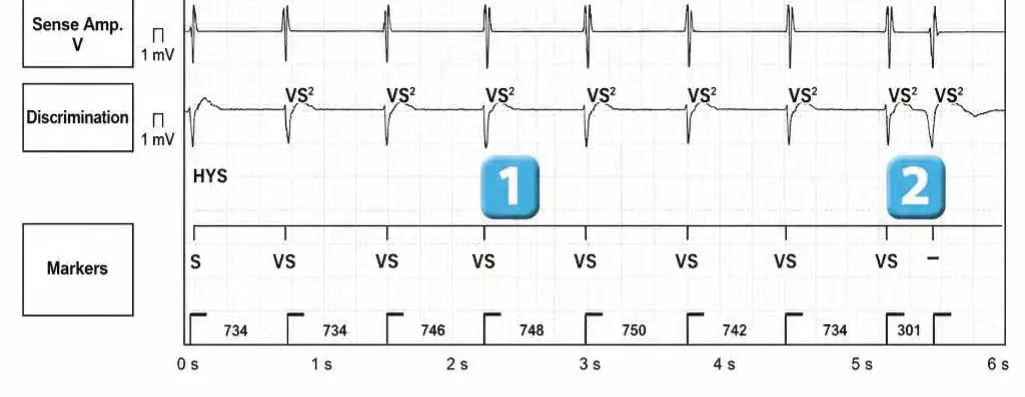
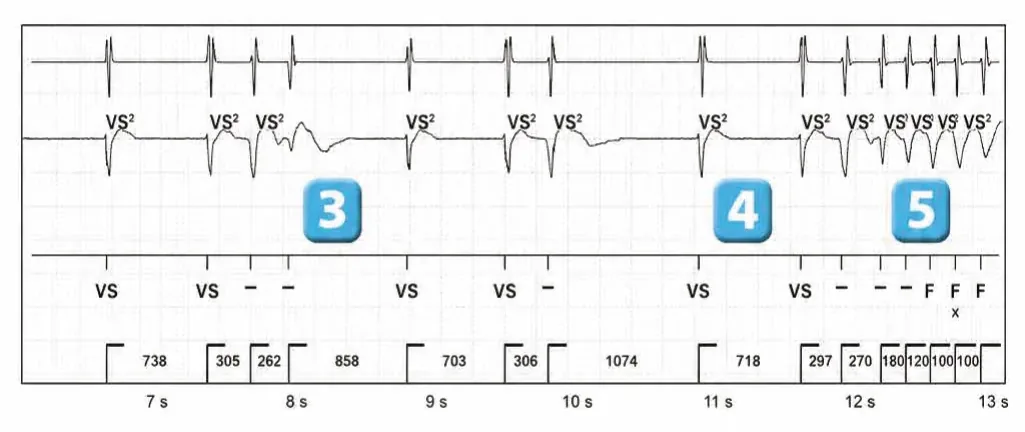
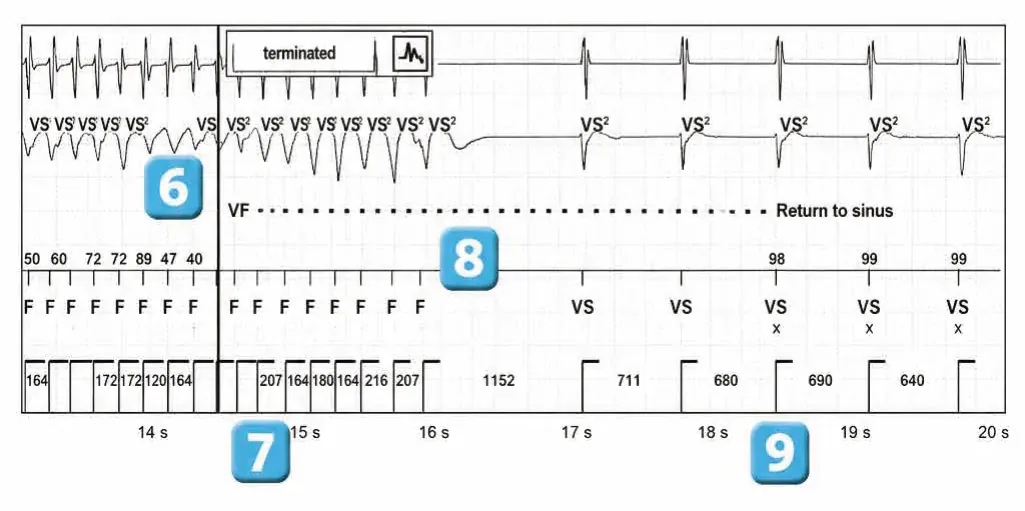
- Sinus rhythm with VS markers on the bipolar channel and VS2 markers on the discrimination channel (the specifics of the discrimination channel are detailed in the chapter on oversensing). Ventricular refractory periods are displayed at the bottom of the trace. The bold horizontal line represents the ventricular refractory period post-ventricular sensing which is an absolute refractory period.
- Ventricular extrasystole. This cycle is classified as (-) due to discordance between the current interval (corresponding to a tachycardia zone) and the average of the 4 preceding ventricular intervals (corresponding to a sinus zone)
- Ventricular couplet
- Onset of polymorphic ventricular arrhythmia. The first 3 cycles are ‘unclassified’ / discarded (-) due to a discrepancy between the current interval and a 4 interval average, comprising the present interval and the 3 preceding intervals
- This is the first cycle classified as ‘F’, since there is now concordance between the current interval and the 4 interval average
- An episode of VF is detected after 12 cycles in the VF zone which triggers recording of the EGM (Trigger).
- Capacitor charging (*). During charging, confirmation of the arrhythmia is indicated by the presence of an underlined F marker.
- Spontaneous termination.
- After 3 VS cycles (a programmable parameter) a ‘return to sinus’ is diagnosed.
Episode 2
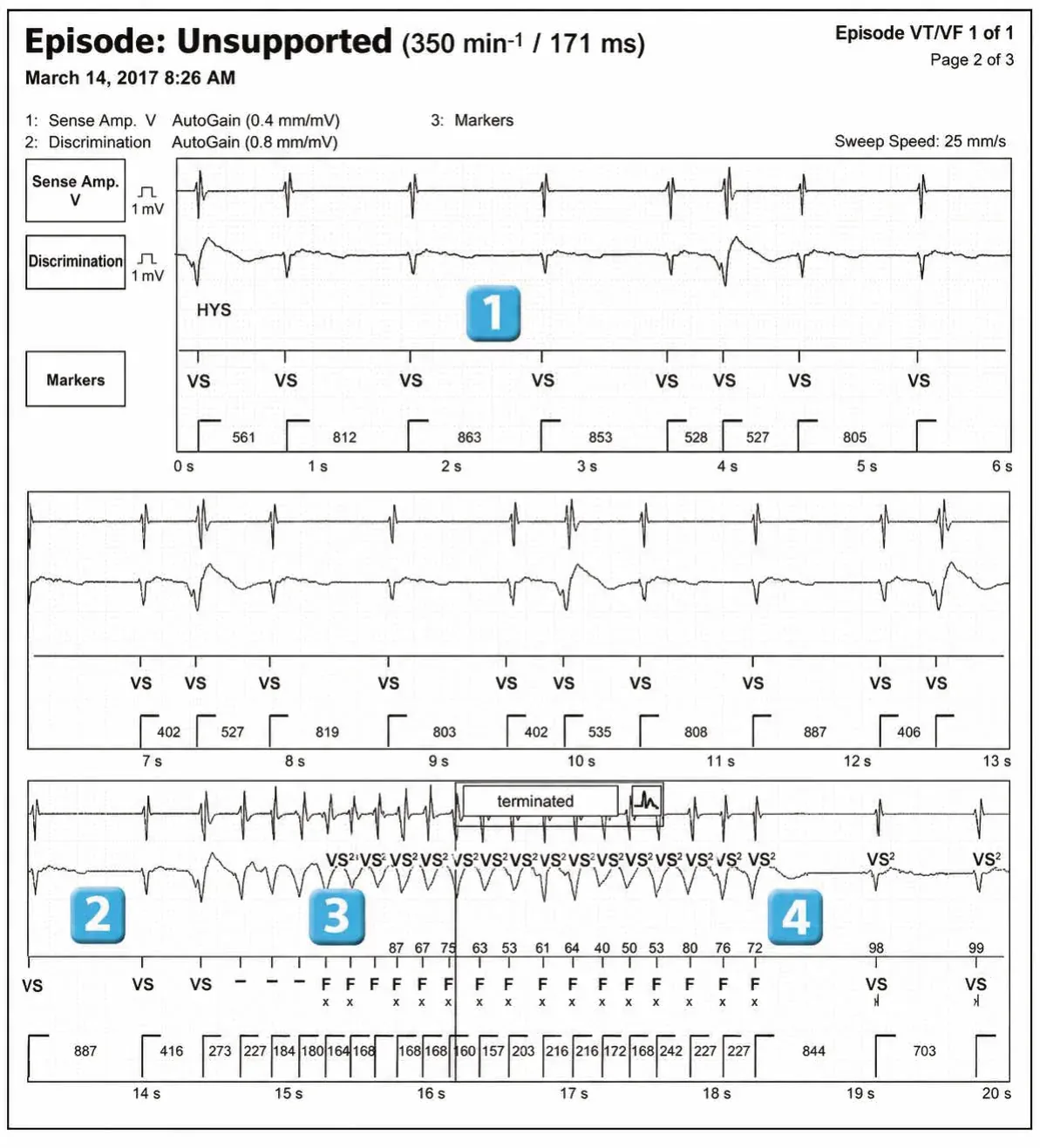
- Sinus rhythm
- Onset of polymorphic ventricular arrhythmia. The first 3 cycles are unclassified due to a discrepancy between the current interval and the 4 interval average.
- The first cycle classified as ‘F’ due to concordance between the current interval and the 4 interval average.
- Spontaneous termination of arrhythmia before the VF counter is filled. An episode is stored as an NSVT episode because 6 cycles have been classified in the same tachycardia zone (no discriminators are applied)
- VF episode recorded in February 2018 and treated with a 30-joules electric shock.
- The shock impedance is 64 Ohms, which is normal for a single coil lead and the charge time is 8.5 seconds.
Episode 3
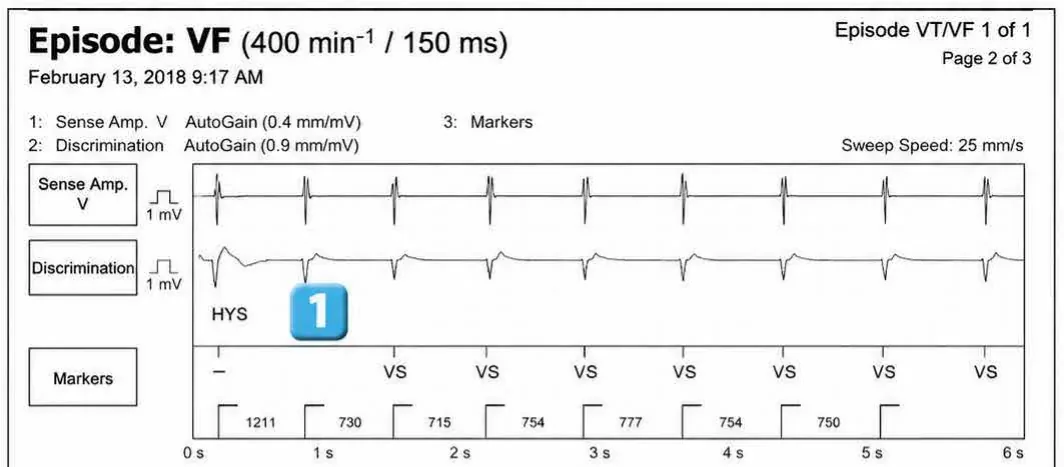
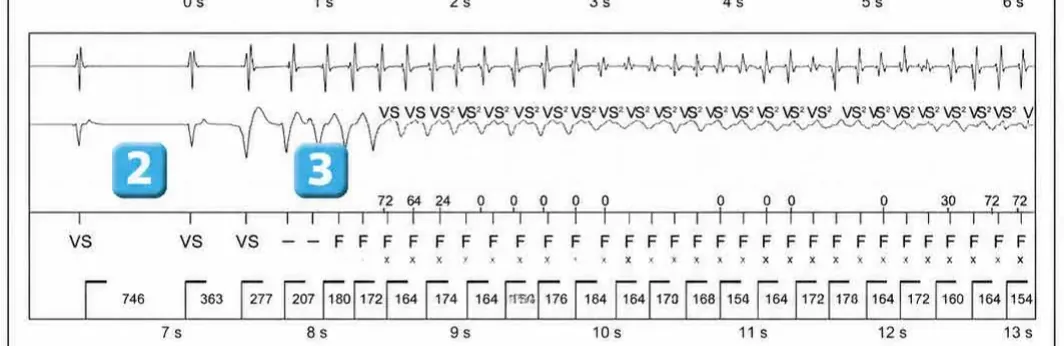
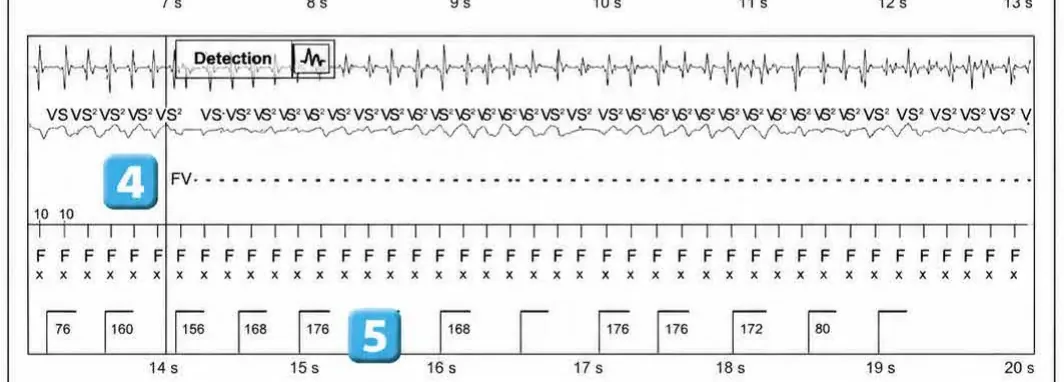
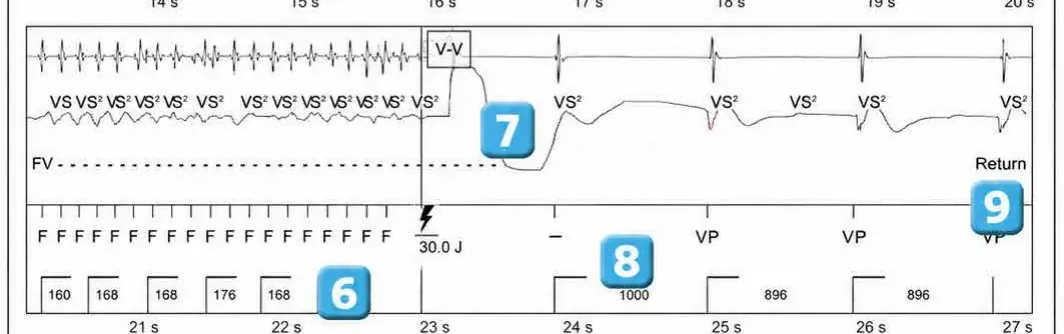
- sinus rhythm
- Onset of polymorphic ventricular arrhythmia; the first two cycles are classified as transitional (discrepancy between the current interval and the average of the previous four cycles).
- first cycle classified as F (concordance between the current cycle and the averaged cycle)
- after 35 cycles classified as F, detection of a VF episode (VF counter completed)
- start of capacitor charging
- end of charging
- 30 joules electric shock (HV: High Voltage) synchronized with the R wave
- 1-second blanking after the shock during which no detection is possible
- termination of arrhythmia; after 3 VP cycles, the device diagnoses a return to sinus rhythm and switches to post-shock mode (DDD) for a specified period (30 seconds nominally) before returning to the programmed permanent mode
From the interrogation
Points to remember
- Each of these three traces illustrates important aspects of implantable cardioverter defibrillator (ICD) functioning during an episode of ventricular fibrillation:
- An episode is classified as non-sustained if it resolves spontaneously before the initial detection counter is filled (Trace 1).
- Capacitor charging is diverted if the episode resolves spontaneously during charging (Trace 2).
- Treatment with an electric shock occurs if the episode does not resolve spontaneously (Trace 3).
- Each recorded episode includes an EGM and a summary of important information (date, episode duration, tachycardia zone, heart rate at the time of diagnosis, therapy(ies) delivered, application of discriminators for episodes classified as VT or SVT, programmed parameters). It should be noted that unlike other manufacturers, an interval plot is not included with the episode. Although the device serial number and patient name also appear on the episode, examples in this book have been anonymized
- The maximum defibrillation capacity of an Abbott defibrillator is indicated in its model number. E.g. for an Ellipse VR 1277-36 ICD, the number 36 indicates a maximum output of 36 joules is possible.
- When a trace is analyzed with a programmer, modifying the scroll speed (nominally 25 mm/s), can be useful in some cases. For example, to confirm oversensing of a 50 Hz external signal, a scroll speed of 100 mm/s will highlight a sinusoidal pattern with 20 ms between peaks; The scale is automatically adjusted by the device but can also be modified using the programmer to facilitate manual measurements of signal amplitude.
- For a single-chamber defibrillator, 2 channels as well as markers and intervals are available with each trace:
- The V sense amp channel shows the filtered signal that is analysed by the defibrillator (for detection, classification of cycles e.t.c.).
- The discrimination channel which senses between the ventricular coil and the device is used for discrimination (differentiation of ventricular tachycardia from supraventricular tachycardia) and by the SecureSense™ algorithm (differentiation of physiological signals from lead noise or other types of oversensing)
- These traces also illustrate how cycles are classified (-, VS, T1, T2, or F) in Abbott devices. Cycle classification is fundamentally different from other manufacturers where cycles are classified using only the current RR interval. In Abbott devices, cycle classification is based on a comparison between the current RR interval and the average of the last 4 intervals:
- If the current cycle falls in the same zone as the average of the last 4 RR intervals, the cycle is classified in that zone (e.g., VS for the current interval and VS for the 4 cycle average interval results in classification of the current cycle as VS)
- If the current cycle and the 4 cycle average interval fall in two different tachycardia zones (VT-1, VT-2, or VF), the classification of the current cycle is assigned to the faster zone (e.g., T2 for the current interval and F for the 4-cycle average, or F for the current interval and T2 for the 4 cycle average results in the current cycle being classified as ‘F’)
- If either the current or 4 cycle average interval is in the sinus or a monitor zone, and the other is in a tachycardia zone (VT-1, VT-2, or VF), the cycle is not classified with a specific «-»marker (E.g. Current interval T1 monitor and 4 cycle average T2 or current interval T2 and 4 cycle average VS (or vice versa), results in the current cycle being unclassified as a transition cycle with the marker «-»). Observing a transition marker is very common during the first few cycles of a tachycardia or after tachycardia termination.
Practice out loud
Just describe the tracing. What do you think is going on? Describing the numbers can help.
00:00
0%
—
From Implantable Cardioverter Defibrillator — clinical cases based on tracings by P. Bordachar, M. Strik, A. Thiyagarajah, S. Ploux. Published by Cardiocases. Every numbered marker on a recording is explained in the list beneath it; tap a marker on the trace or an entry in the list.