
Chapter 3 · Discrimination · Case 7
Double chamber and branch discrimination V = A
Patient and episode
Patient
- Simulator-generated atrial tachycardia trace on a Gallant dual-chamber defibrillator
Summary
- VT2 in the V=A branch Both discriminants (morphology and onset of arrhythmia) are consistent with VT
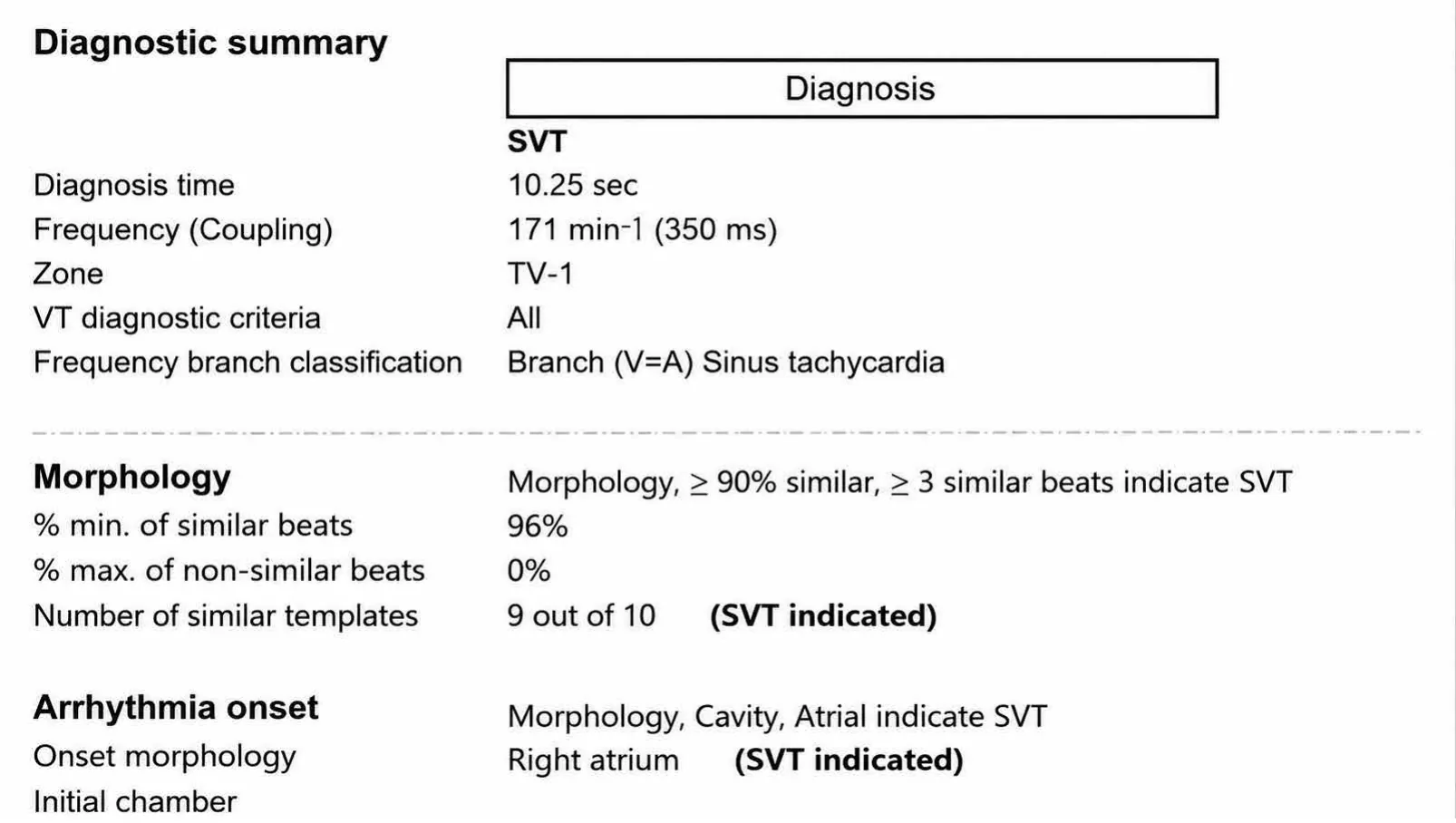
- SVT in the V=A branch Both discriminants (morphology and onset of arrhythmia) are consistent with SVT
- SVT in the V=A branch Both discriminants (morphology and onset of arrhythmia) are consistent with SVT
The recording
Tap a number on the trace, or an entry in the list below
Episode 1
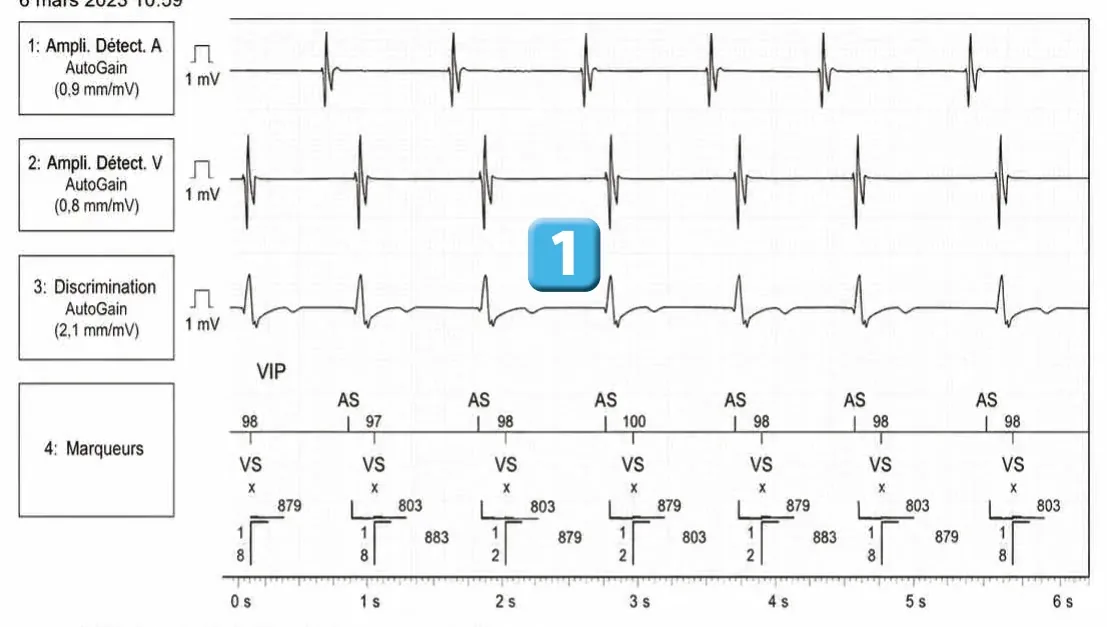
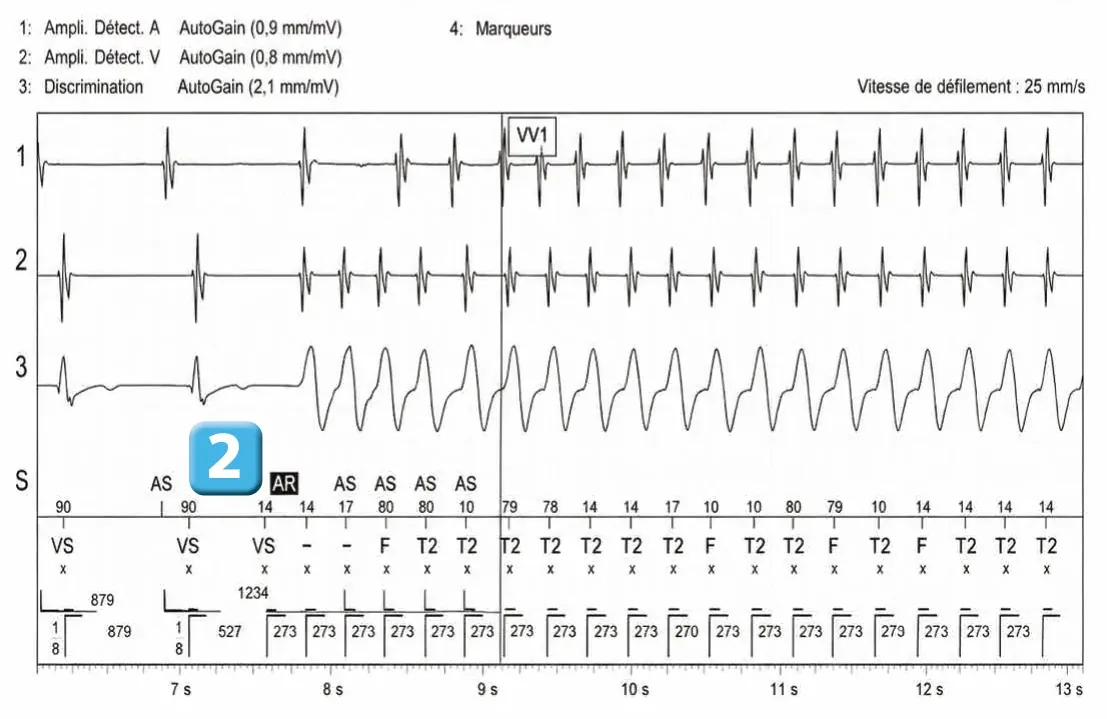
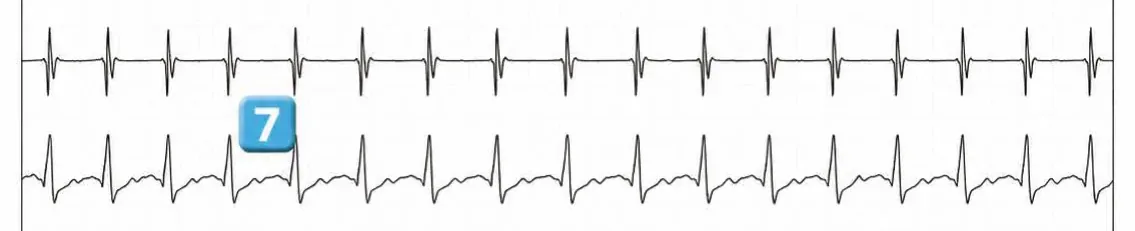
- Atrial detection and ventricular sensing
- onset of wide QRS, regular, monomorphic tachycardia with 1:1 atrioventricular conduction; the first rapid cycle is ventricular
- VT2 counter completed; effective burst
- Effective burst and diagnosis of end of episode
Episode 2
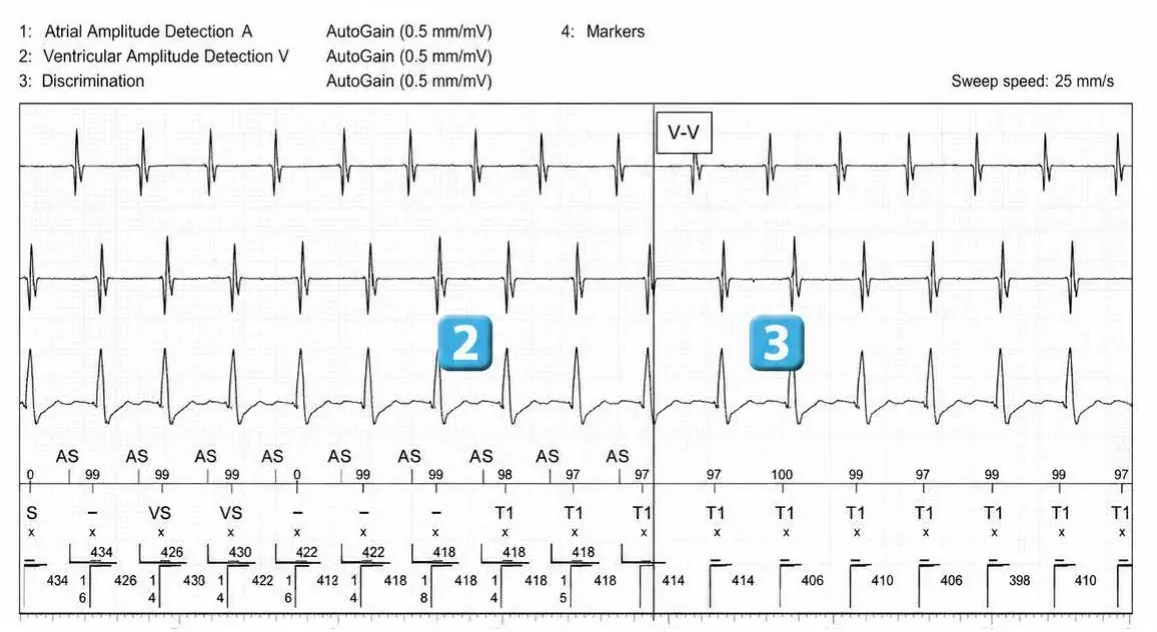
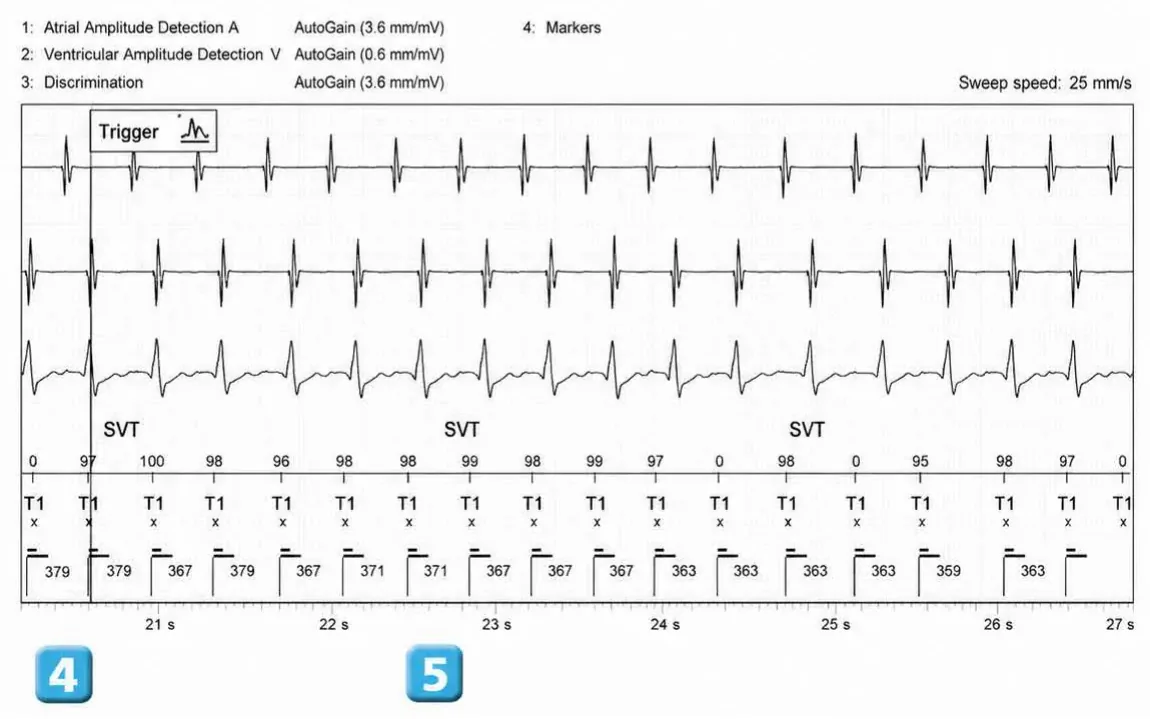
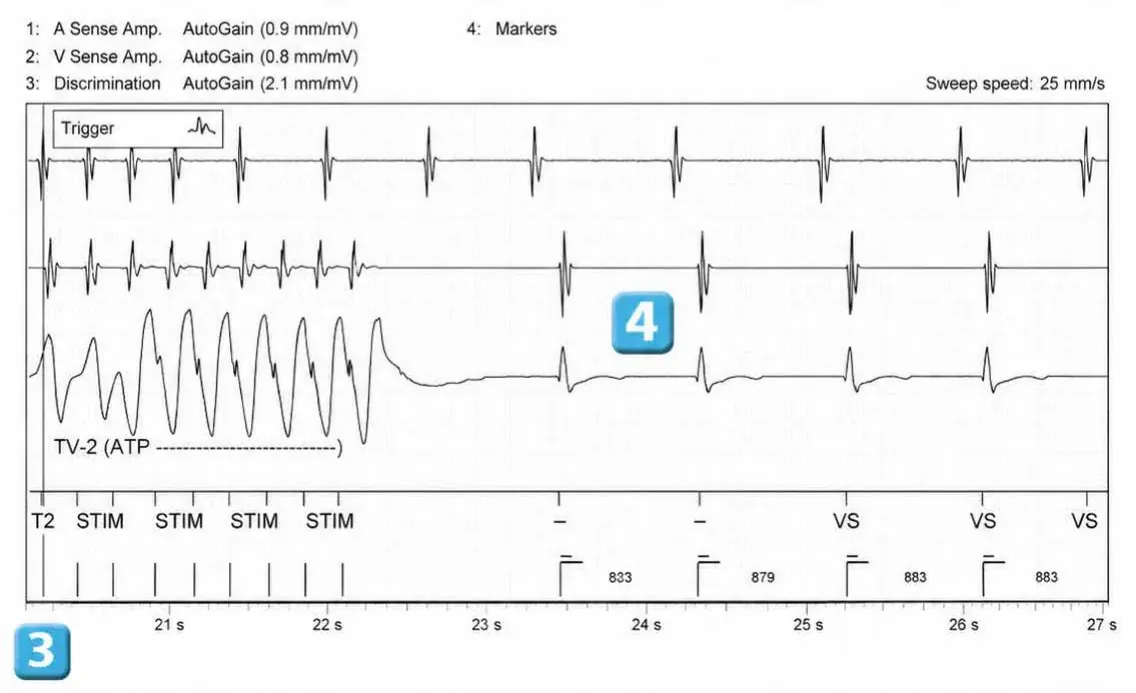
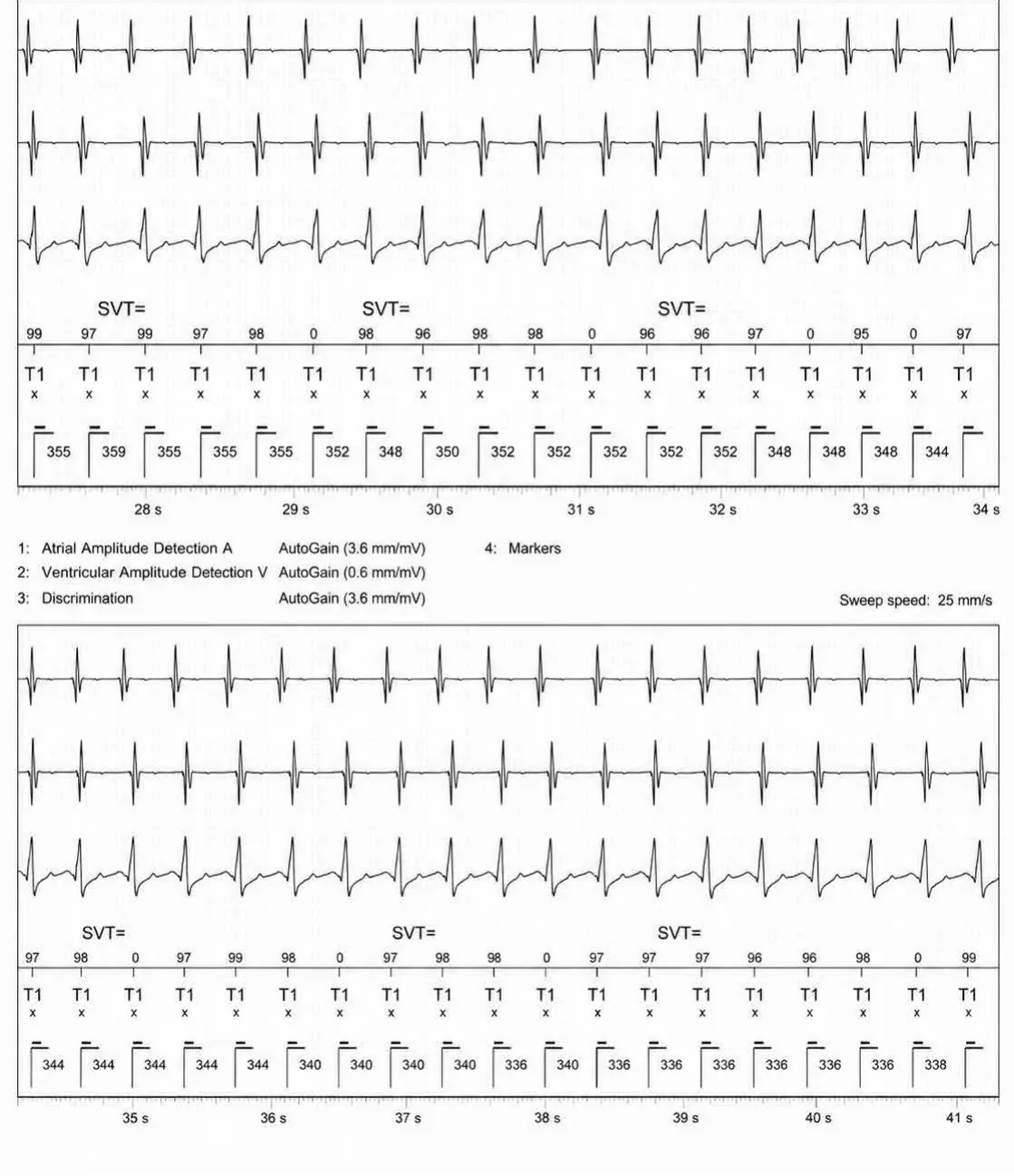
- Atrial detection and ventricular sensing
- acceleration of tachycardia with cycles classified as T1; most ventricular cycles have a correlation percentage greater than the programmed threshold
- after 3 cycles classified as T1, switches to episode mode (VVI), atrial markers are no longer displayed on the trace
- VT1 counter completed; diagnosis of SVT
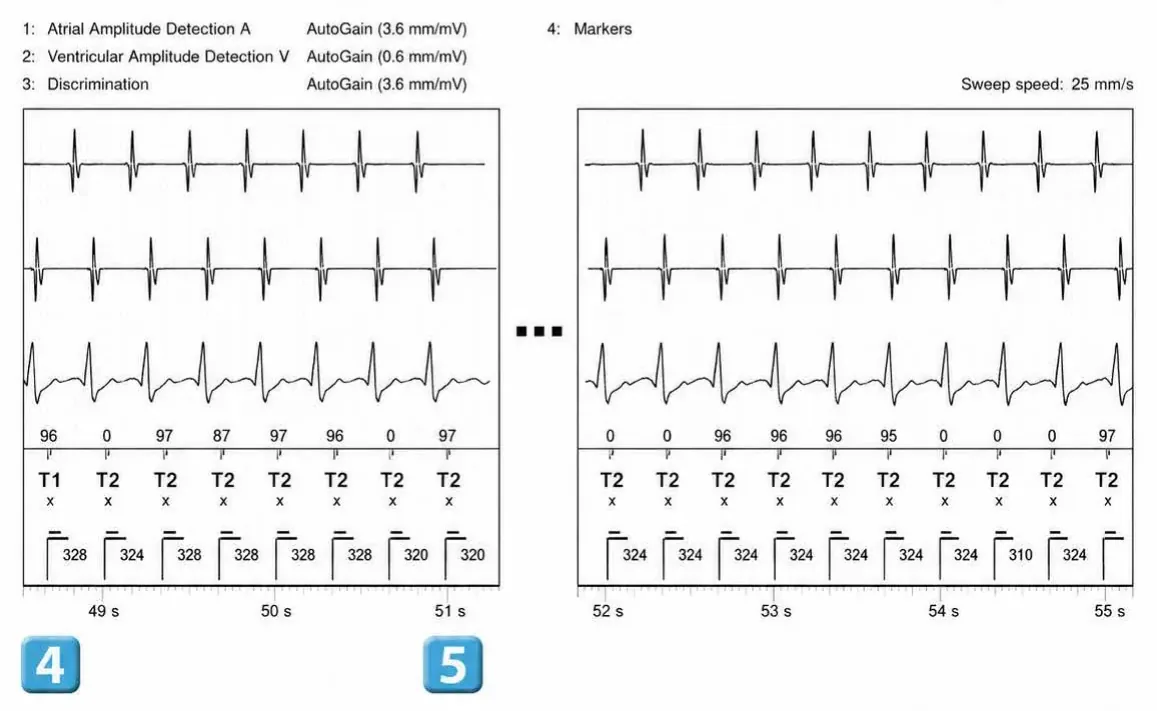
- after 6 cycles classified as T1, SVT redetection
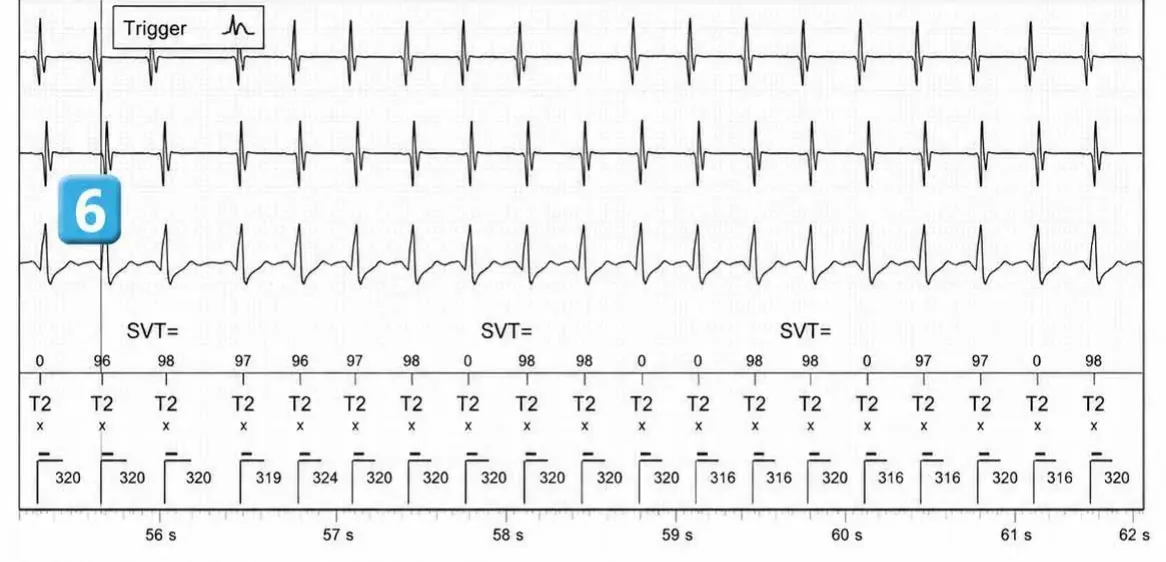
- acceleration of tachycardia with cycles classified as T2; confirmation of the diagnosis of SVT
- slowing in the VT1 zone
- slowing and diagnosis of end of episode
Episode 3
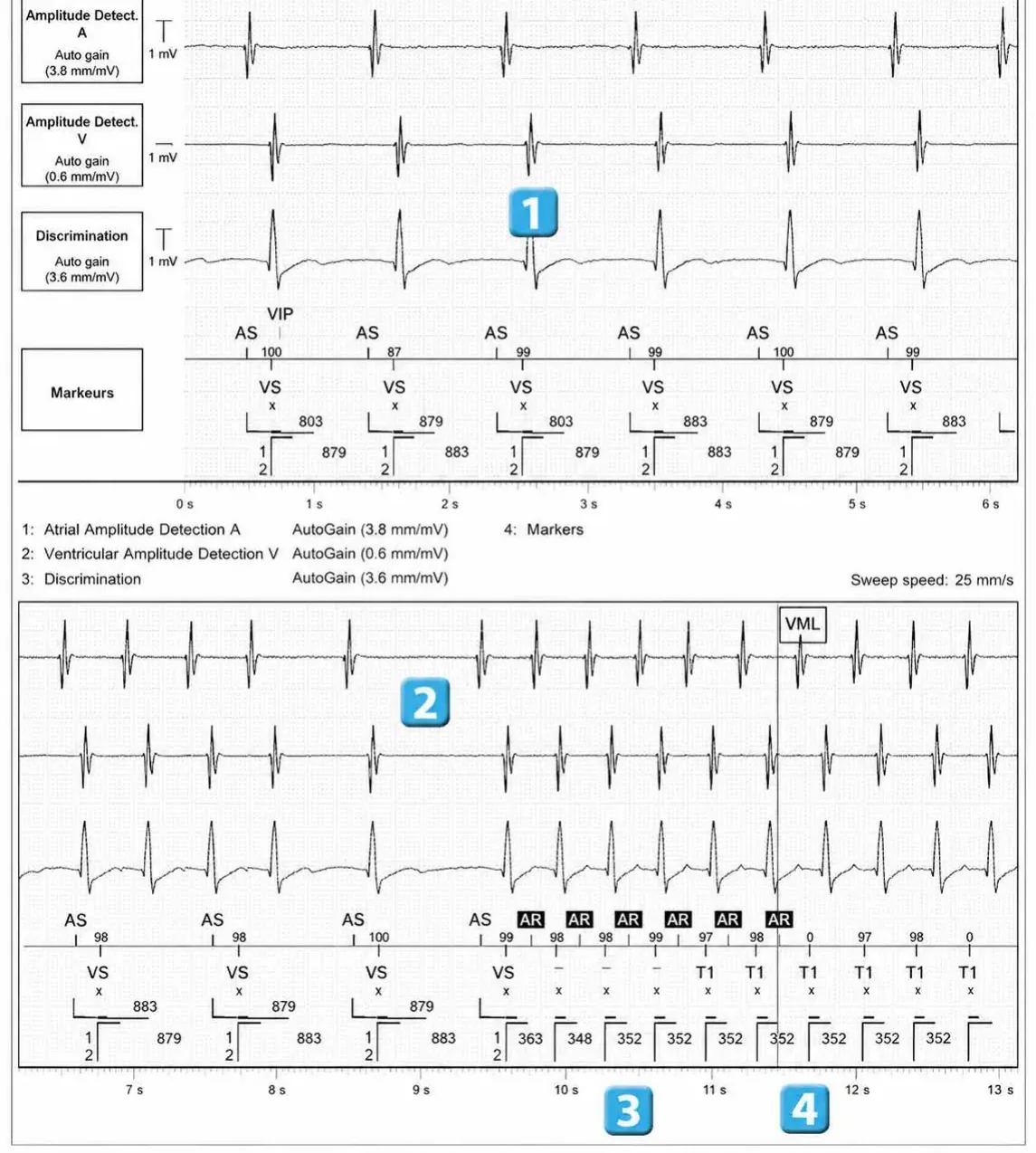
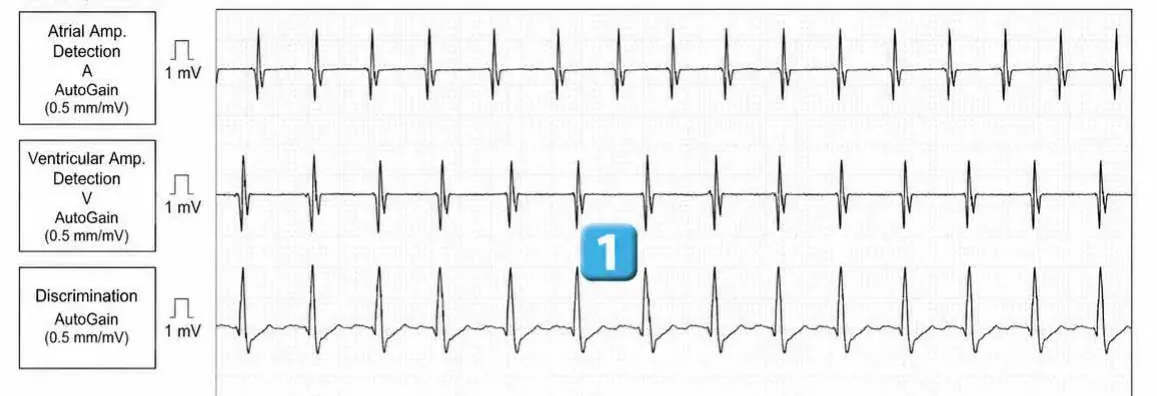
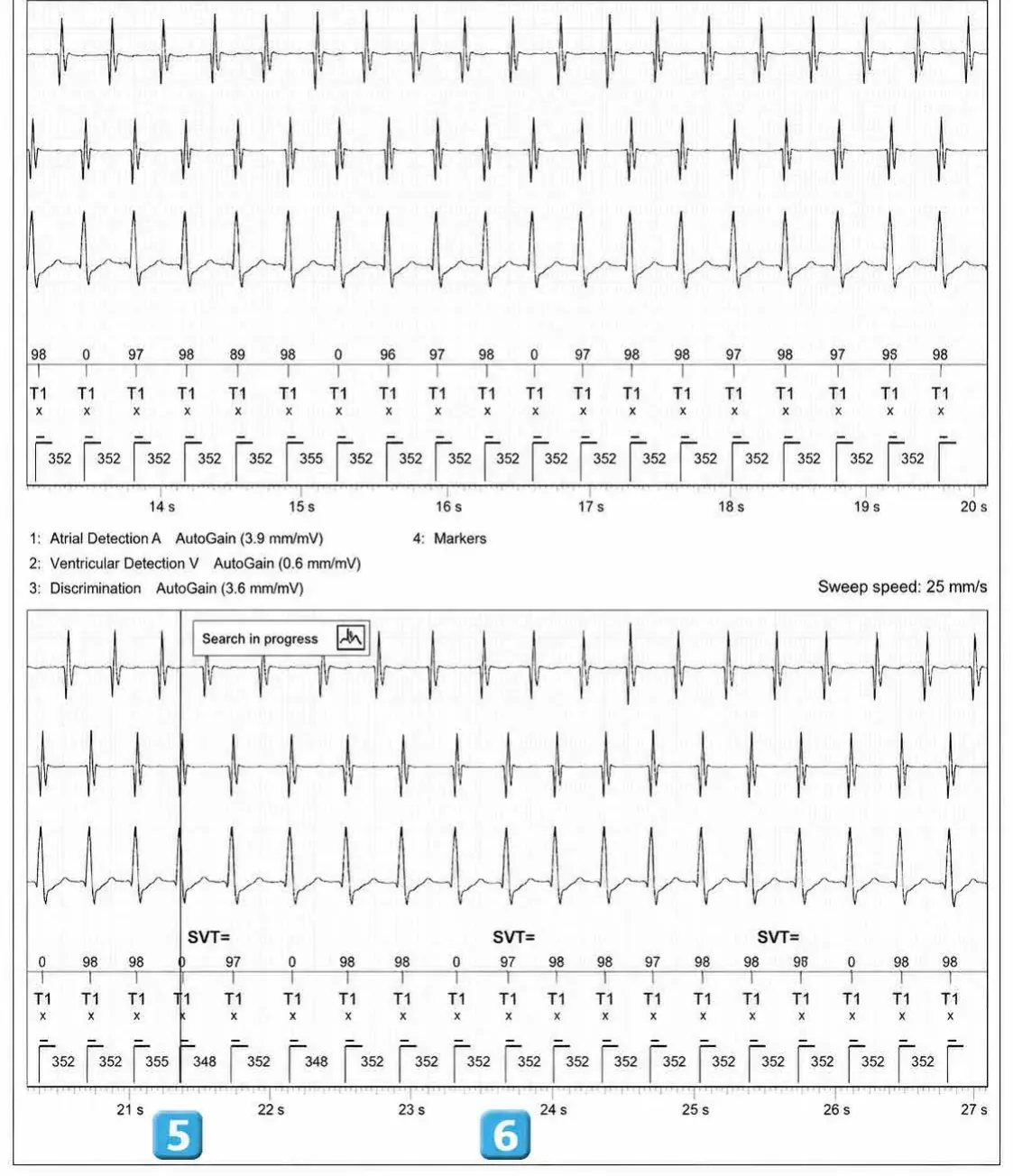
- Atrial detection and ventricular sensing
- starting on an atrial extrasystole of a 1/1 tachycardia
- cycles classified as T1; most ventricular cycles have a correlation percentage greater than the programmed threshold
- after 3 cycles classified as T1, switches to episode mode (VVI), atrial markers are no longer displayed on the trace
- VT1 counter completed; diagnosis of SVT
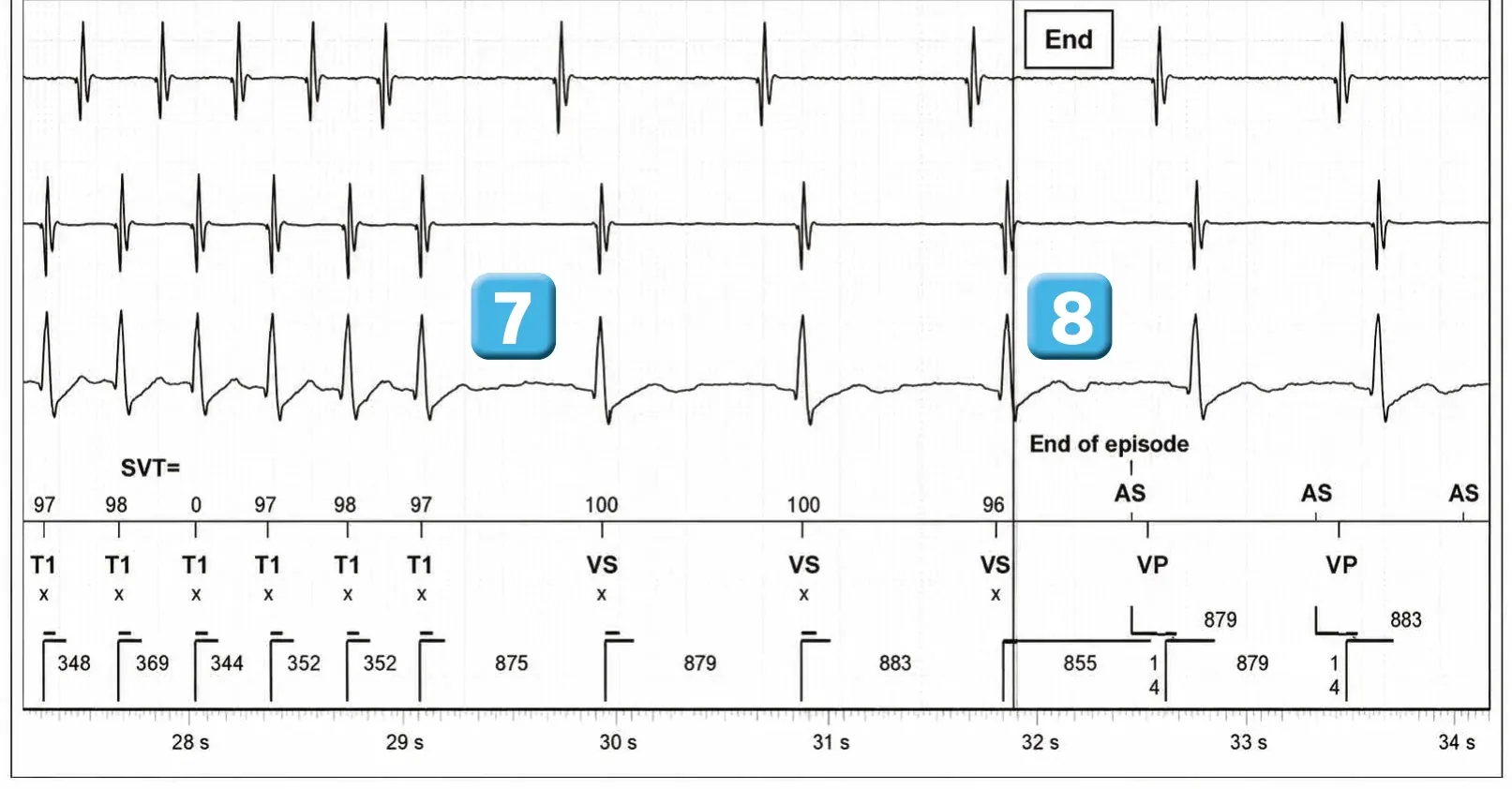
- after 6 cycles classified as T1, VTS redetection
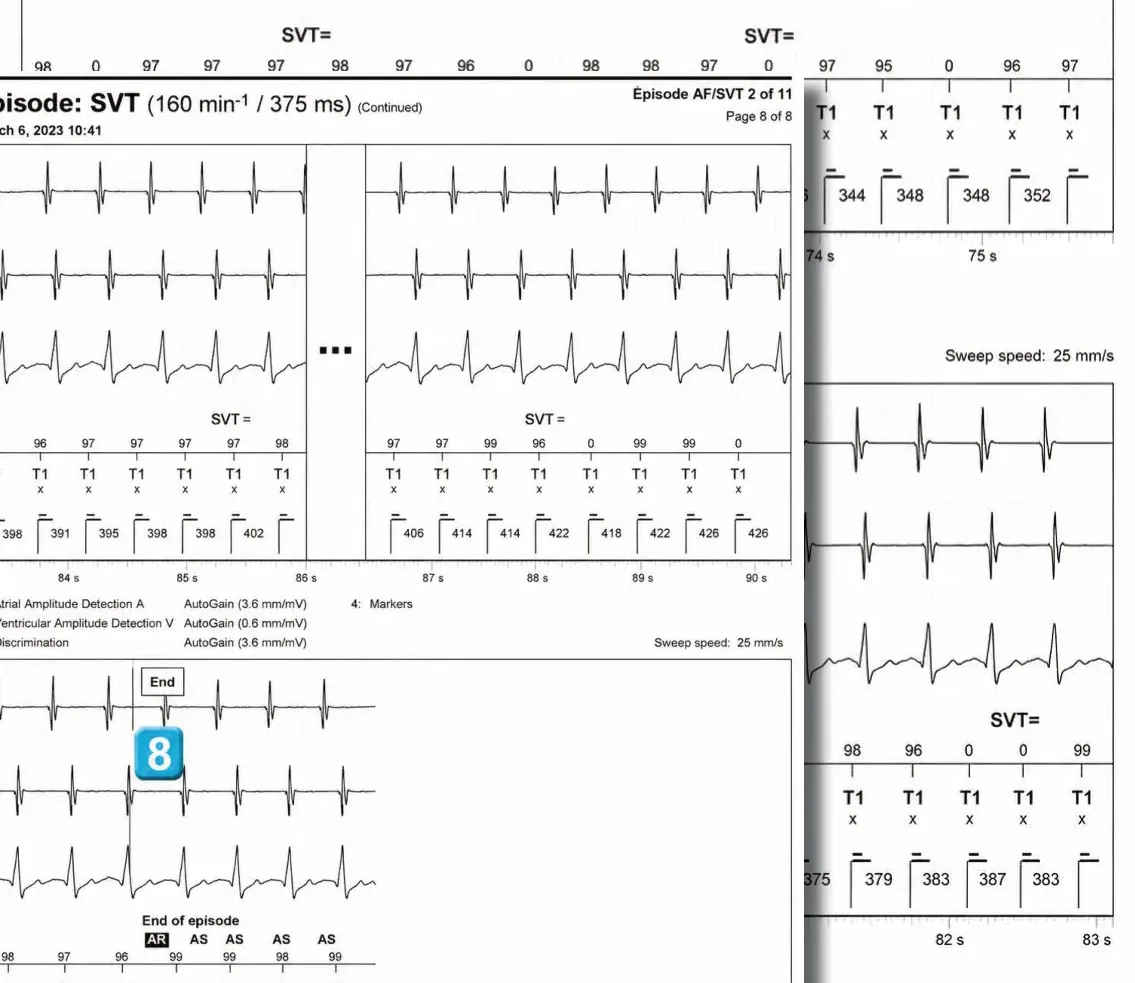
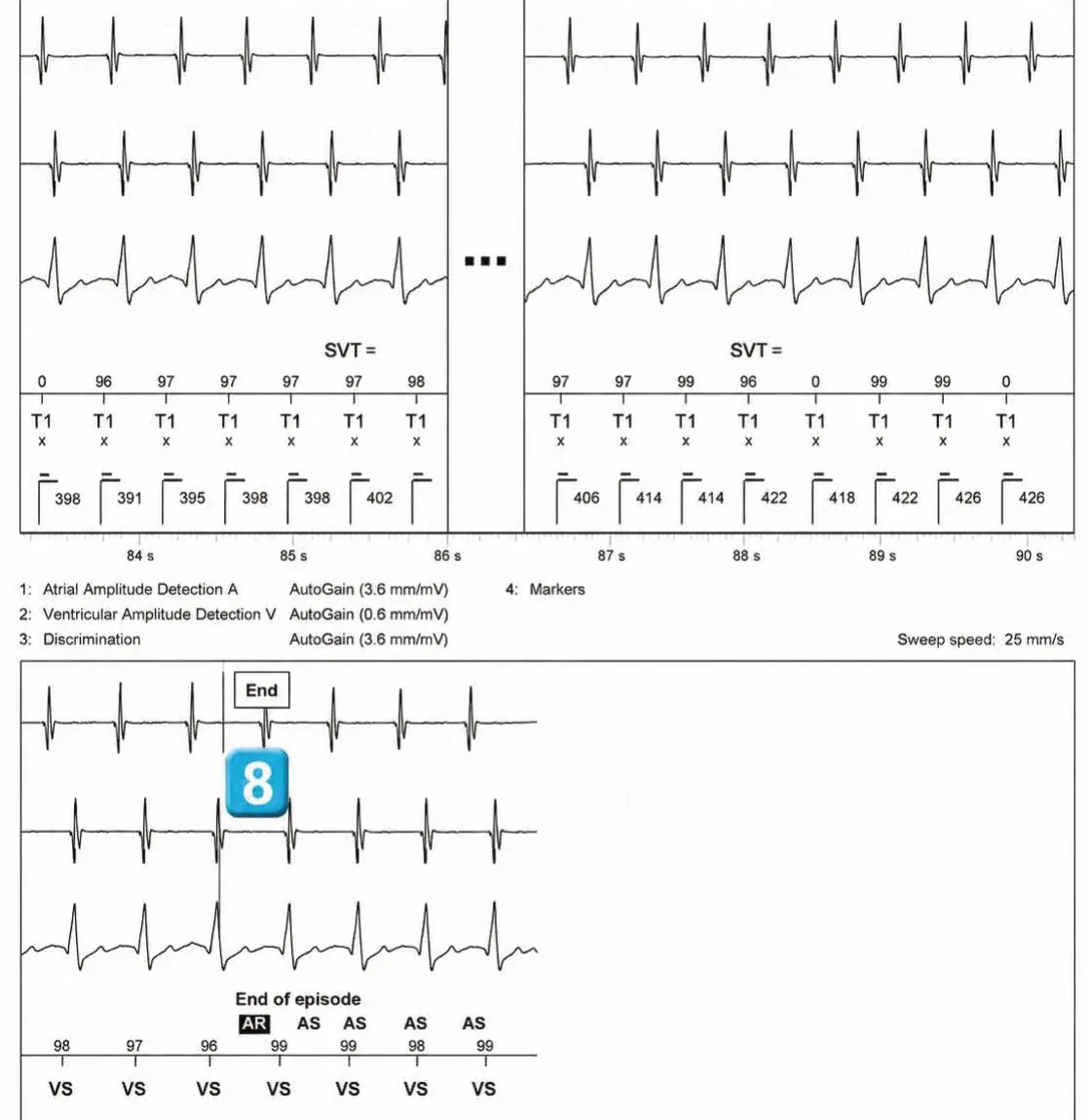
- spontaneous reduction on a ventricular complex
- end-of-episode diagnosis
From the interrogation
Points to remember
- In the presence of 1/1 tachycardia, various diagnoses are possible (VT with retrograde conduction, sinus tachycardia, 1/1 atrial tachycardia, junctional tachycardia).
- In the V=A branch, two discriminants are used: morphology and onset of arrhythmia; these two criteria function in the same way as described for single-chamber discrimination; they may or may not be associated: “One of” or “All” criteria; on recent platforms, the initial cavity criterion has replaced abrupt onset as the nominal criterion.
- It is a different algorithm that also analyzes the sudden onset, but in a different way than the old sudden onset alone present in the single chamber; in fact, the analysis of the onset alone (sudden or gradual) allowed for the discrimination of sinus tachycardias but not atrial tachycardias; the analysis of the initial cavity allows this limitation to be addressed.
- The arrhythmia onset/initial cavity discriminant analyzes both the atrial and ventricular channels, assessing whether there was a sudden onset in both cavities and whether the arrhythmia began in the atrium or ventricle.
- if the onset of arrhythmia is considered gradual, the discriminant favors SVT; if the onset is considered sudden and the initial cavity is the atrium, the discriminant favors SVT; if the onset is considered sudden and the initial cavity is the ventricle, the discriminant favors VT
- the first tracing corresponds to VT with 1:1 retrograde conduction; the tachycardia starts on a premature ventricular complex; the two discriminants (morphology and onset of arrhythmia) favor VT; indeed, the appearance of the ventriculograms is clearly different in tachycardia compared to sinus rhythm, and the onset of tachycardia is abrupt with a first premature ventricular complex
- the second trace corresponds to a well-defined episode of sinus tachycardia; the two discriminating factors (morphology and onset of arrhythmia) are consistent with SVT; the gradual acceleration followed by deceleration are consistent with a diagnosis of sinus tachycardia
- The third trace corresponds to a clearly distinguished episode of atrial tachycardia; the two discriminating factors (morphology and onset of arrhythmia) point to SVT; indeed,the appearance of the ventriculograms is clearly similar in tachycardia compared to sinus rhythm, the onset of tachycardia is sudden with a first premature atrial complex; the tachycardia stops spontaneously on a ventricle
Practice out loud
Just describe the tracing. What do you think is going on? Describing the numbers can help.
00:00
0%
—
From Implantable Cardioverter Defibrillator — clinical cases based on tracings by P. Bordachar, M. Strik, A. Thiyagarajah, S. Ploux. Published by Cardiocases. Every numbered marker on a recording is explained in the list beneath it; tap a marker on the trace or an entry in the list.