
Chapter 3 · Discrimination · Case 6
Discrimination between double chamber and branch V > A
Patient and episode
Patient
- Simulator-generated ventricular tachycardia trace on a Gallant dual-chamber
Summary
- VT2 in V>A branch
The recording
Tap a number on the trace, or an entry in the list below
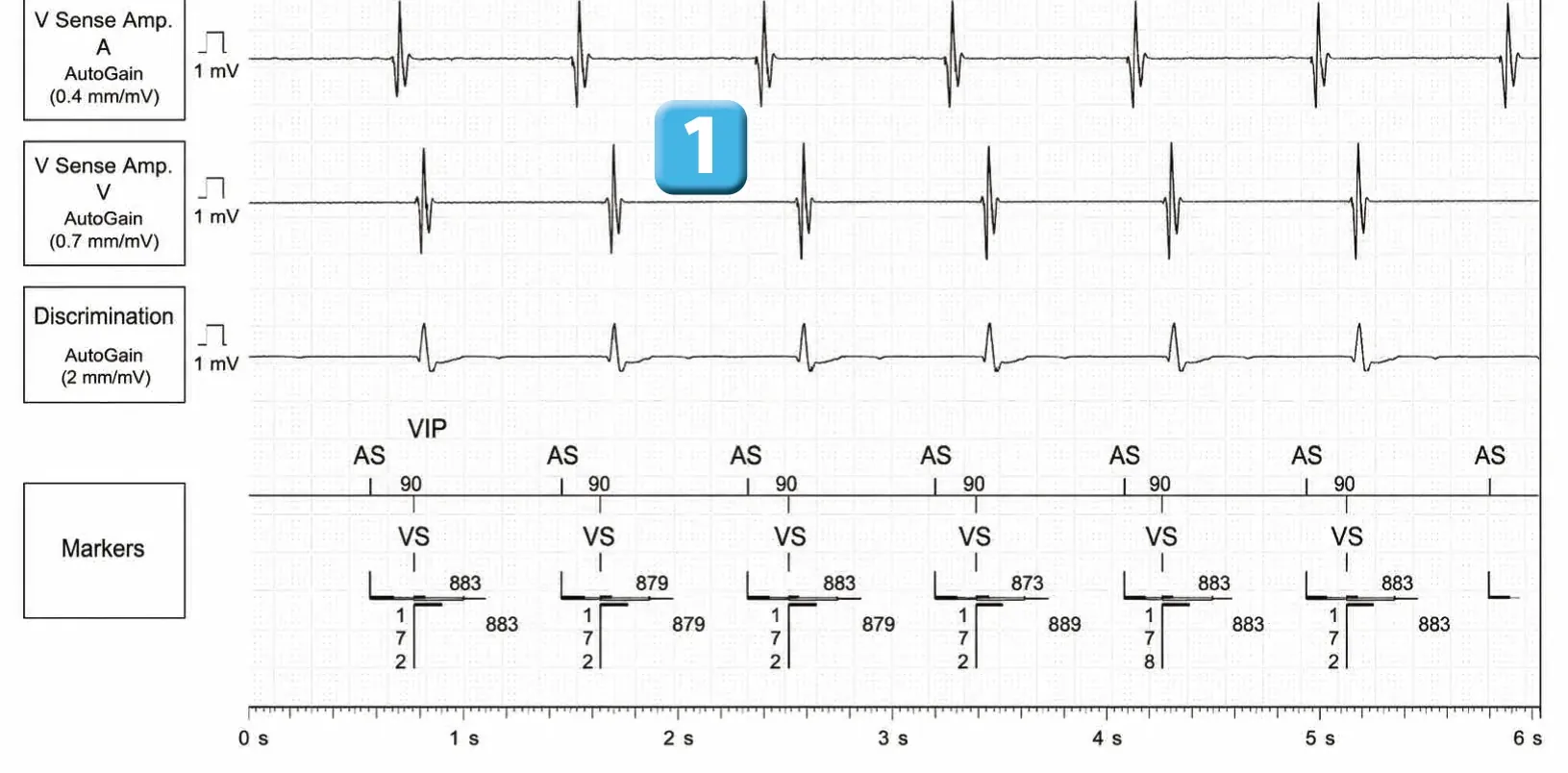
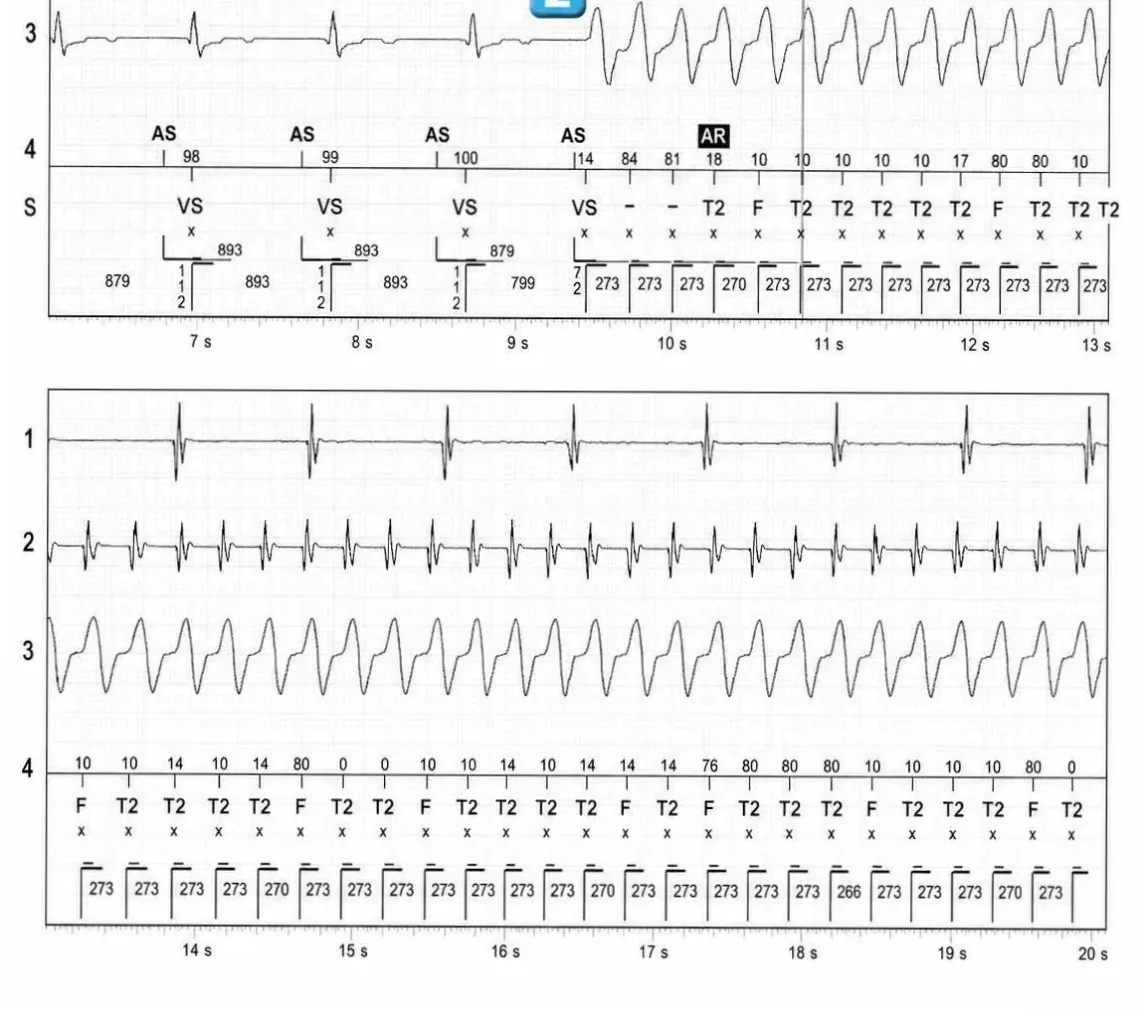
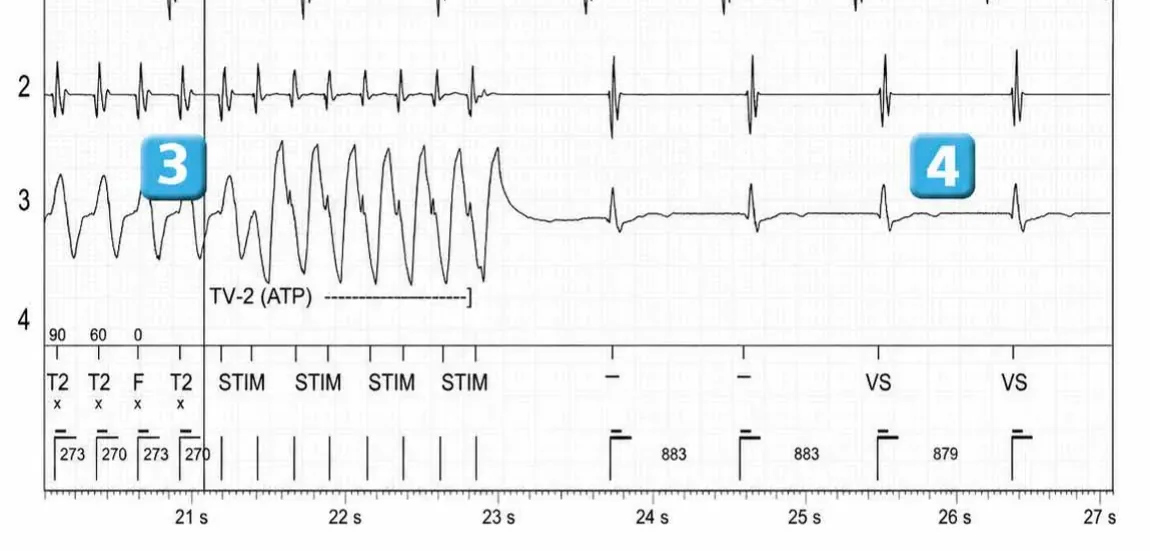
- Atrial detection and ventricular sensing
- onset of a wide QRS, regular, monomorphic tachycardia with atrioventricular dissociation
- VT2 counter completed; effective burst
- Effective burst and diagnosis of end of episode
Points to remember
- In a dual- or triple-chamber defibrillator, the presence of the atrial lead allows for continuous comparison of atrial and ventricular rates.
- The first step in dual-chamber discrimination is therefore to classify the episode into one of three categories: V>A, V<A, or V=A (a margin of 16 ms is allowed for the V=A category).
- Correct detection in both chambers is essential for the proper functioning of dual-chamber discrimination algorithms. A classification error occurs in the presence of atrial lead displacement, cross-listening with oversensing of the R wave in the atrium, or undersensing of atrial activity related to microvolt activity in AF or atria in PAF (2:1 flutter, TJ).
- The single-chamber discriminants described above (with the exception of sinus interval history) are used variably depending on the AV relationship branch in which the defibrillator has classified the arrhythmia (V>A, V<A, V=A).
- For the physician and the defibrillator, the existence of a ventricular rhythm faster than the atrial rhythm confirms the ventricular origin of the tachycardia; if this condition is true (V>A), it overrides all other programmed discriminators and the diagnosis of VT is made.
- When, as in this trace, the ventricular rate (corresponding to the median ventricular interval of the last 16 cycles before the VT counter is completed) is higher than the atrial rate (corresponding to the median atrial interval of the last 16 cycles before the VT counter is completed), the tachycardia is classified as VT and no other additional discrimination criteria are taken into account.
- Since Gallant, the default episode mode is VVI and no longer DDI. The aim is to limit the risk of crosstalk in post-shock mode (amplitude 7.5V and 1.5 ms) on dependent patients. If atrial markers are desired, the post-shock mode can be set to DDI and, for example, the amplitude and duration of the atrial pacing pulse in post-shock mode can be reduced to limit the risk of crosstalk.
Practice out loud
Just describe the tracing. What do you think is going on? Describing the numbers can help.
00:00
0%
—
From Implantable Cardioverter Defibrillator — clinical cases based on tracings by P. Bordachar, M. Strik, A. Thiyagarajah, S. Ploux. Published by Cardiocases. Every numbered marker on a recording is explained in the list beneath it; tap a marker on the trace or an entry in the list.