
Chapter 3 · Discrimination · Case 1
VT episode and single chamber discrimination
Patient and episode
Summary
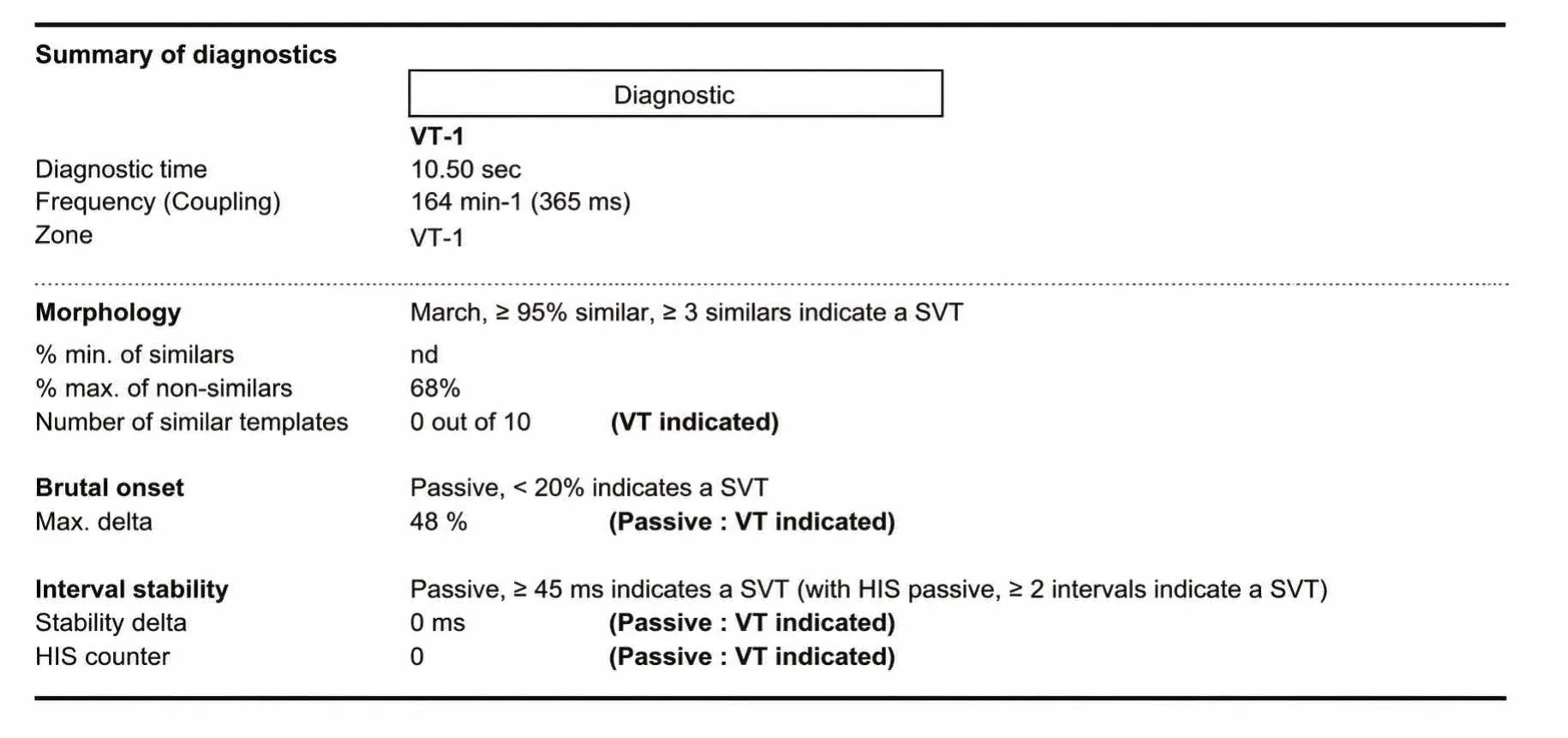
- Simulator-generated monomorphic VT tracing on a single-chamber defibrillator Gallant chamber VT diagnosis with a delivered burst The three programmed discrimination parameters favor VT: morphology (number of similar cycles: 0 out of 10), stability delta (0 ms) with His counter at 0 and abrupt onset (max delta at 48%)
The recording
Tap a number on the trace, or an entry in the list below
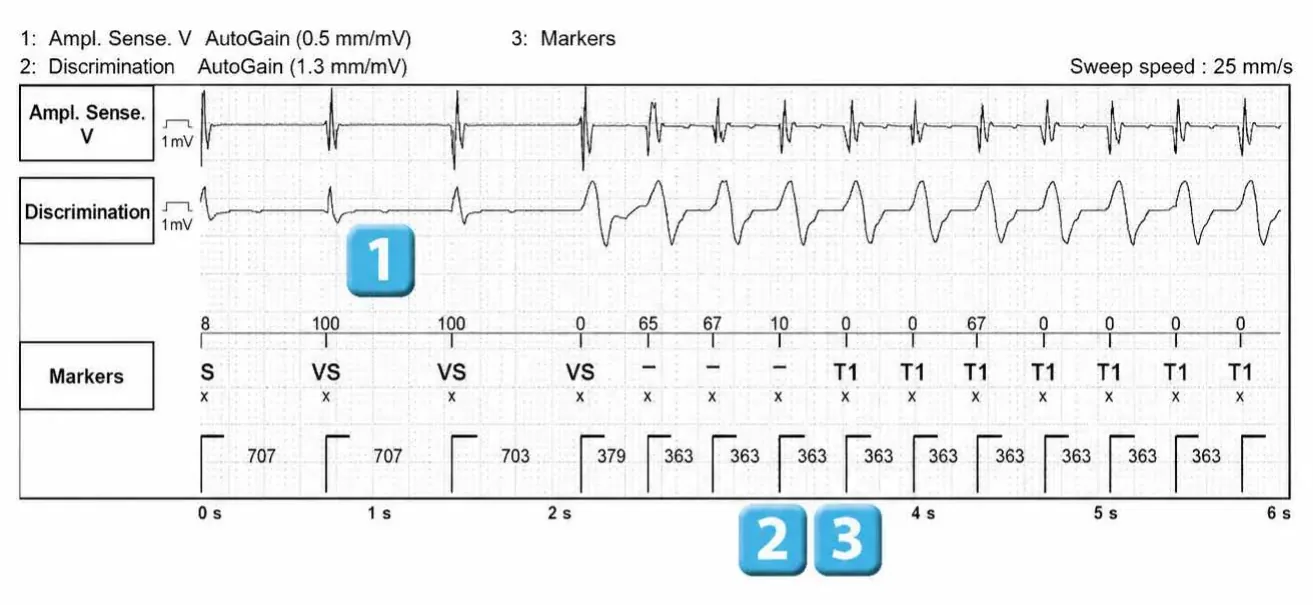
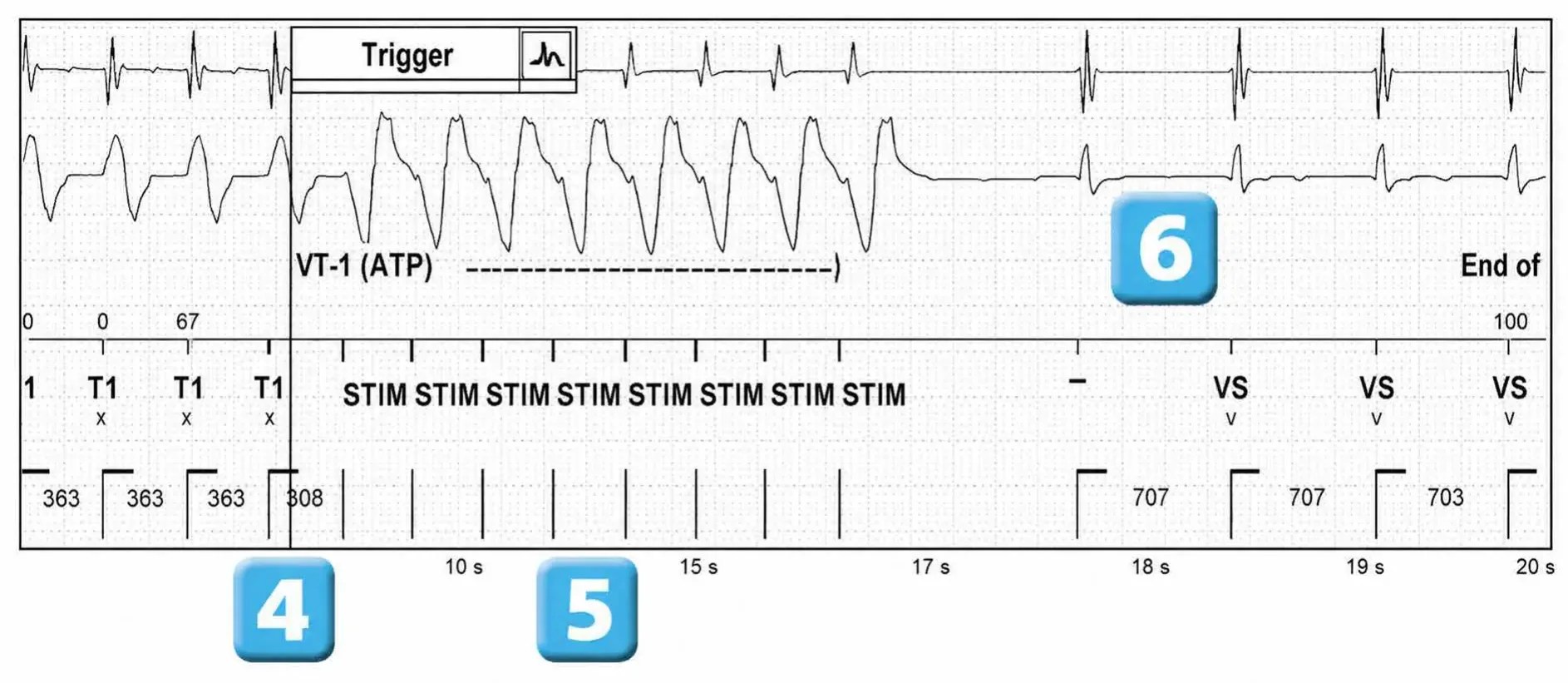
- 1 sinus rhythm with fine QRS
- 2 onset of wide QRS tachycardia; the first 3 cycles are unclassified
- first classified cycle T: it is on this first pivotal cycle that the criterion of sudden onset is analyzed; the sudden onset of tachycardia is evident in this example
- VT diagnosis after 30 cycles classified as T1 and discrimination in favor of VT; stability analysis is performed on the 12 cycles preceding the VT diagnosis (stability value at 0 ms); morphological analysis is performed on the 10 complexes preceding the VT diagnosis; for these 10 complexes, x markers are noted, indicating a lack of similarity with the reference morphology (percentage of similarity less than 95%, the programmed threshold value)
- burst 8 stimuli
- Effective burst and end-of-episode diagnosis after 3 consecutive VS; morphology analysis continues after reduction; ventricular morphology is then similar to that of the reference ventricles (greater than the programmed threshold value with a v marker)
From the interrogation
Points to remember
- The detection of an arrhythmia episode, whether supraventricular or ventricular, triggers the storage of an intracavitary EGM that can be accessed when the defibrillator is interrogated, allowing for critical analysis of the defibrillator’s diagnostic conclusions and possible reprogramming in the event of a tachycardia classification error.
- The performance of a discrimination algorithm is assessed on its sensitivity (ability to correctly diagnose VT; it must be as close to 100% as possible; a sensitivity of 95% means that 5% of VTs will be misdiagnosed as SVT) and its specificity (ability to inhibit therapies on an episode of SVT; it must be as high as possible without compromising sensitivity)
- In Abbott™single-chamber defibrillators, three criteria can be programmed to discriminate the origin of arrhythmias: sudden onset, frequency stability associated with sinus interval history, and ventricular complex morphology.
- Each criterion can be set to «On,» «Off,» or «Passive.» Passive mode allows the performance of a criterion to be evaluated without it being taken into account for discrimination; if all criteria are set to «Passive» or «Off,» discrimination is disabled and therapy is delivered regardless of the origin of the tachycardia; depending on the programming, each parameter can be made more or less sensitive, more or less specific.
- In this example of appropriate therapy for VT, only the morphology criterion is set to On; the difference in morphology is evident between sinus rhythm and tachycardia rhythm; all vectors in tachycardia were deemed uncorrelated, explaining the VT diagnosis and the decision to treat.
Practice out loud
Just describe the tracing. What do you think is going on? Describing the numbers can help.
00:00
0%
—
From Implantable Cardioverter Defibrillator — clinical cases based on tracings by P. Bordachar, M. Strik, A. Thiyagarajah, S. Ploux. Published by Cardiocases. Every numbered marker on a recording is explained in the list beneath it; tap a marker on the trace or an entry in the list.