
Chapter 4 · Oversensing · Case 8
Double counting of the R wave on an older model
Patient and episode
Patient
- 58-year-old man implanted with an Atlas™ triple-chamber defibrillator for severe primary dilated cardiomyopathy with left bundle branch block; consultation for electric shock at rest, without feeling unwell or experiencing tachycardia
Summary
- Episode diagnosed as VF treated with a maximum electric shock of 36 joules.
The recording
Tap a number on the trace, or an entry in the list below
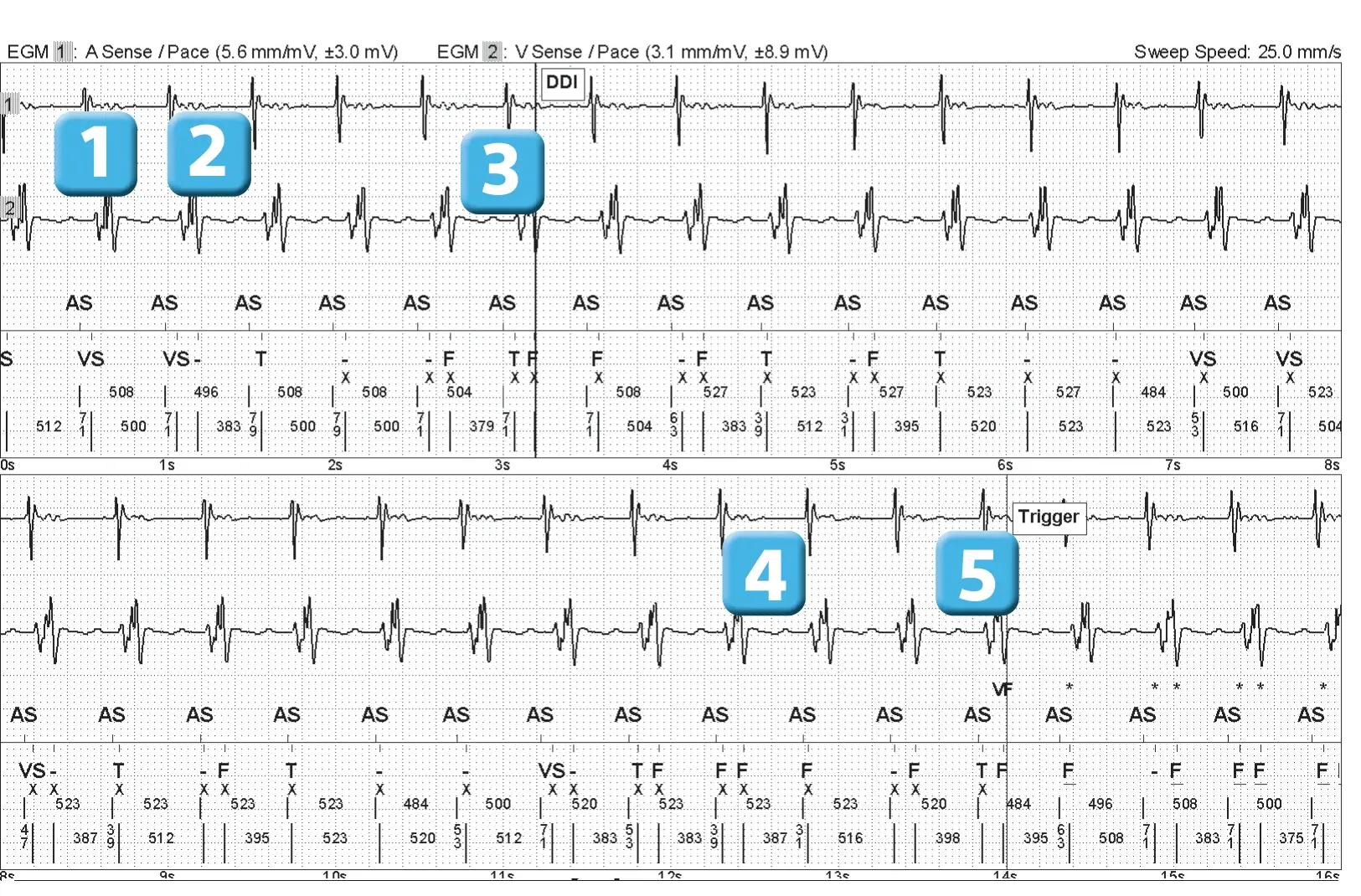
- Tachycardia at 120 beats/minute 1/1 (1 atrium for 1 ventricle)
- For the same ventricular complex, two ventriculograms are detected; the first is classified as VS, the second is unclassified (-) at the end of the ventricular refractory period; probable double counting of the ventricle on sinus tachycardia, atrial tachycardia, or VT with retrograde conduction
- episode mode (DDI) after 4 T or F cycles; in the rest of the trace, no diagnosis of sinus return because F or T cycles classified as VS are interspersed
- more frequent double counting
- detection of an episode of VF (12 cycles classified as F) and start of capacitor charging
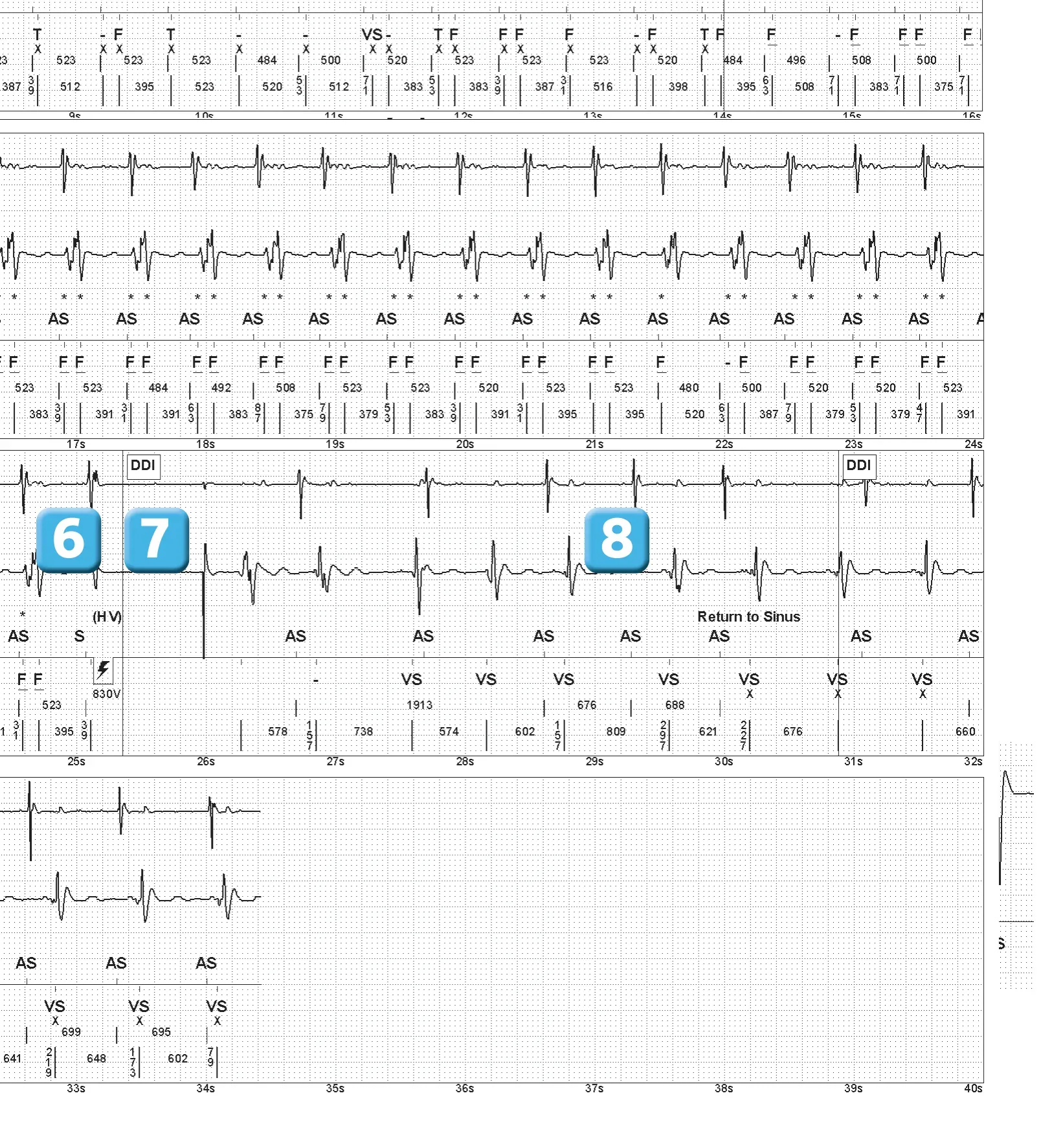
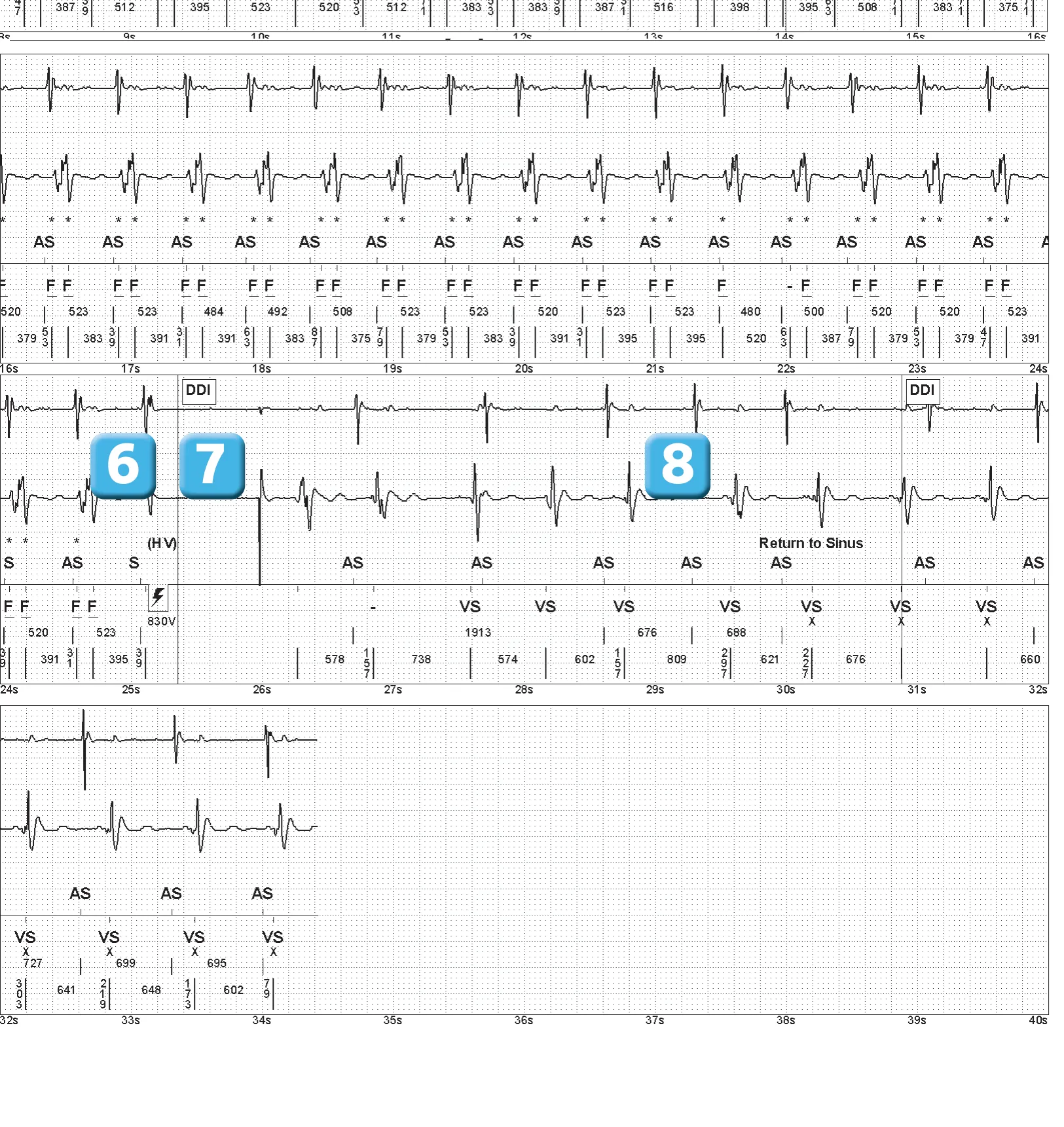
- Quasi-permanent detection of two signals for the same cycle during charging; end of charging and confirmation before shock at the second cycle after charging
- 36 joules electric shock;
- marked slowing of the atrial rate; this allows sinus tachycardia to be ruled out as the initial diagnosis; the differential diagnosis between atrial and ventricular tachycardia remains difficult; diagnosis of sinus return
From the interrogation
Points to remember
- The initial 1:1 tachycardia may correspond to sinus tachycardia, atrial tachycardia, junctional tachycardia, or ventricular tachycardia with retrograde conduction. A resting heart rate of 120 beats per minute is not consistent with sinus tachycardia or junctional tachycardia. Oversensing occurs when the atrial signal and ventricular signal are almost simultaneous. Each ventricular cycle is detected twice; it is difficult to differentiate between oversensing of atrial activity by the ventricular channel and double counting of the R wave; it is likely that this double counting in the ventricular channel corresponds to the summation of the atrial signal and a very wide ventriculogram.
- Double counting of the R wave can occur when ventricular conduction is very slow and the duration of the ventricular endocavitary signal is longer than the ventricular refractory period. Antiarrhythmic treatments, such as flecainide, which prolong the duration of the QRS, promote its occurrence, particularly at high heart rates. Double counting can occur on a QRS in sinus rhythm or during an episode of VT. Double counting of the R wave can be resolved by lengthening the ventricular refractory period or decreasing sensitivity. In this patient, lengthening the ventricular refractory period to 157 ms eliminated this double counting.
Practice out loud
Just describe the tracing. What do you think is going on? Describing the numbers can help.
00:00
0%
—
From Implantable Cardioverter Defibrillator — clinical cases based on tracings by P. Bordachar, M. Strik, A. Thiyagarajah, S. Ploux. Published by Cardiocases. Every numbered marker on a recording is explained in the list beneath it; tap a marker on the trace or an entry in the list.