
Chapter 4 · Oversensing · Case 7
Recent device, P wave oversensing, and SecureSense™ algorithm
Patient and episode
Patient
- Male patient implanted with a single-chamber Abbott defibrillator; episodes of unsustained V oversensing recorded in memory; SecureSense™ algorithm ON (VD coil to housing)
Summary
- episode of non-sustained ventricular oversensing
The recording
Tap a number on the trace, or an entry in the list below
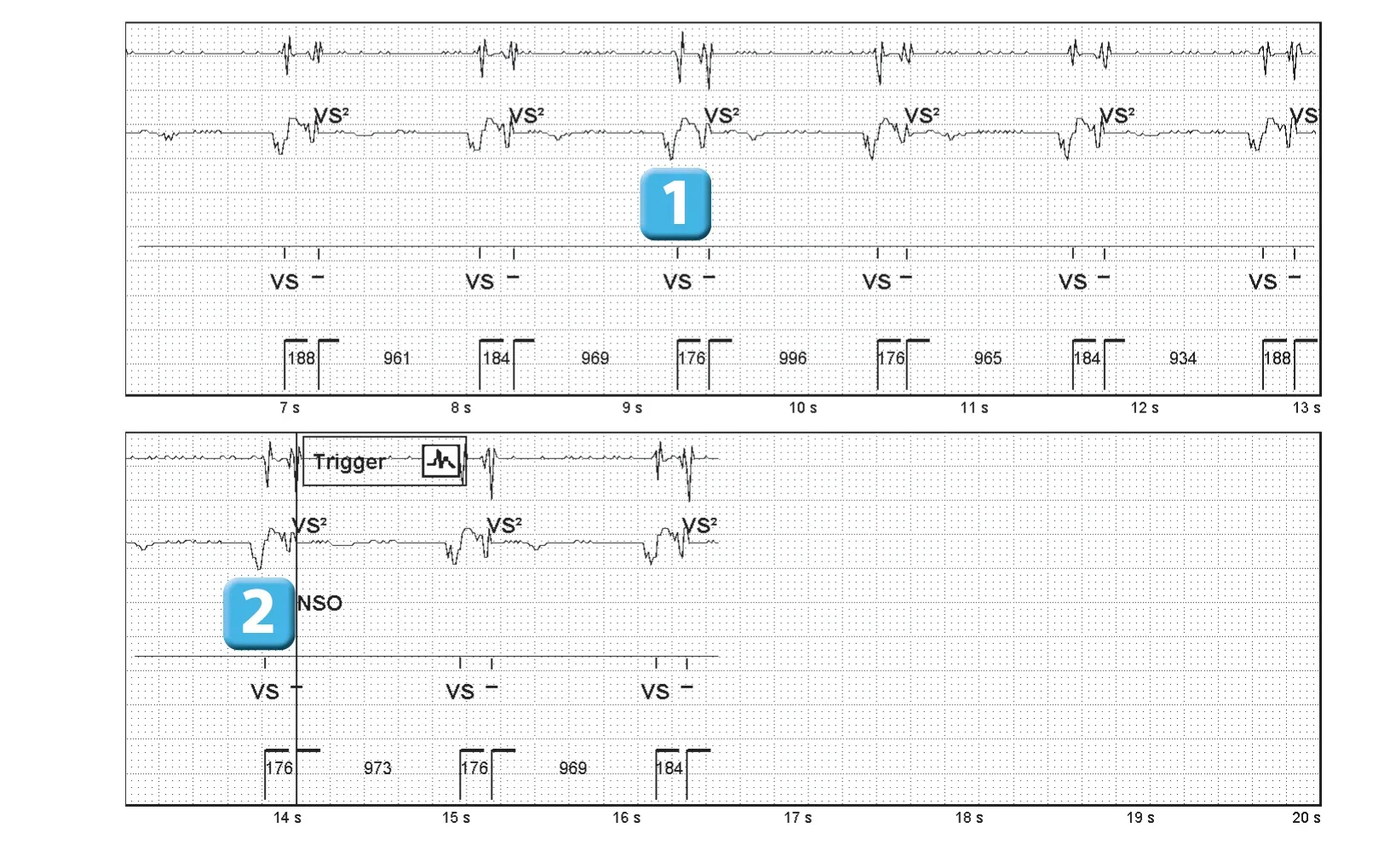
- Oversensing on the bipolar channel of a signal preceding the QRS complex corresponding to the P wave; no oversensing on the discrimination channel; alternation between unclassified cycle (long instantaneous interval but averaged interval corresponding to a tachycardia zone) and classified VS cycle
- noise counter is at 10; diagnosis of unsustained V oversensing (SNS)
Points to remember
- In this patient with sinus rhythm, the right ventricular lead detects both atrial depolarization and ventricular depolarization, with the PR interval being longer than the ventricular refractory period.
- If the patient has complete atrioventricular block, oversensing of the P wave can inhibit ventricular pacing and cause asystole; similarly, the Oversensing of atrial depolarization during atrial flutter or atrial tachycardia can cause both inappropriate therapies and asystole if the patient is dependent
- Oversensing of the atrial signal occurs preferentially in two situations 1) displacement of the right ventricular lead at the atrioventricular junction (coinciding with a decrease in the measured R wave amplitude); 2) positioning of an integrated bipolar lead near the tricuspid annulus, with the distal coil straddling the valve (coinciding with preserved R wave amplitude).
- Atrial oversensing may also occur in more exceptional circumstances: 1) right ventricular lead unintentionally placed in the coronary sinus; 2) insulation failure in the atrial portion of the lead, leading to oversensing of atrial activity; 3) interaction between the atrial lead and the right ventricular lead, with the atrial lead coming into contact with the ventricular lead and generating a signal at the time of atrial systole.
- Reprogramming options are very limited in this context and are restricted to reducing the programmed sensitivity, with a parallel risk of undersensing of a genuine episode of ventricular arrhythmia.
- As seen previously, while the SecureSense™ algorithm could lead to the virtual elimination of therapies based on T wave oversensing, its effectiveness in P wave oversensing is lower. in fact, if the discrimination channel is set between the coil and the lead housing, oversensing on this channel is more likely (coil in the atrium if the lead is positioned near the tricuspid valve) than on the bipolar channel (2 electrodes in the ventricle
Practice out loud
Just describe the tracing. What do you think is going on? Describing the numbers can help.
00:00
0%
—
From Implantable Cardioverter Defibrillator — clinical cases based on tracings by P. Bordachar, M. Strik, A. Thiyagarajah, S. Ploux. Published by Cardiocases. Every numbered marker on a recording is explained in the list beneath it; tap a marker on the trace or an entry in the list.