
Chapter 4 · Oversensing · Case 2
Recent device, lead malfunction, and SecureSense™ algorithm
Patient and episode
Patient
- Man implanted with an Abbott EllipseTMsingle-chamber defibrillator; telemedicine alert corresponding to recordings of unsustained lead noise episodes
Summary
- VF episode, V lead noise The SecureSense™ algorithm inhibited therapy
- VF episode, V lead noise The SecureSense™ algorithm inhibited therapy
The recording
Tap a number on the trace, or an entry in the list below
Episode 1
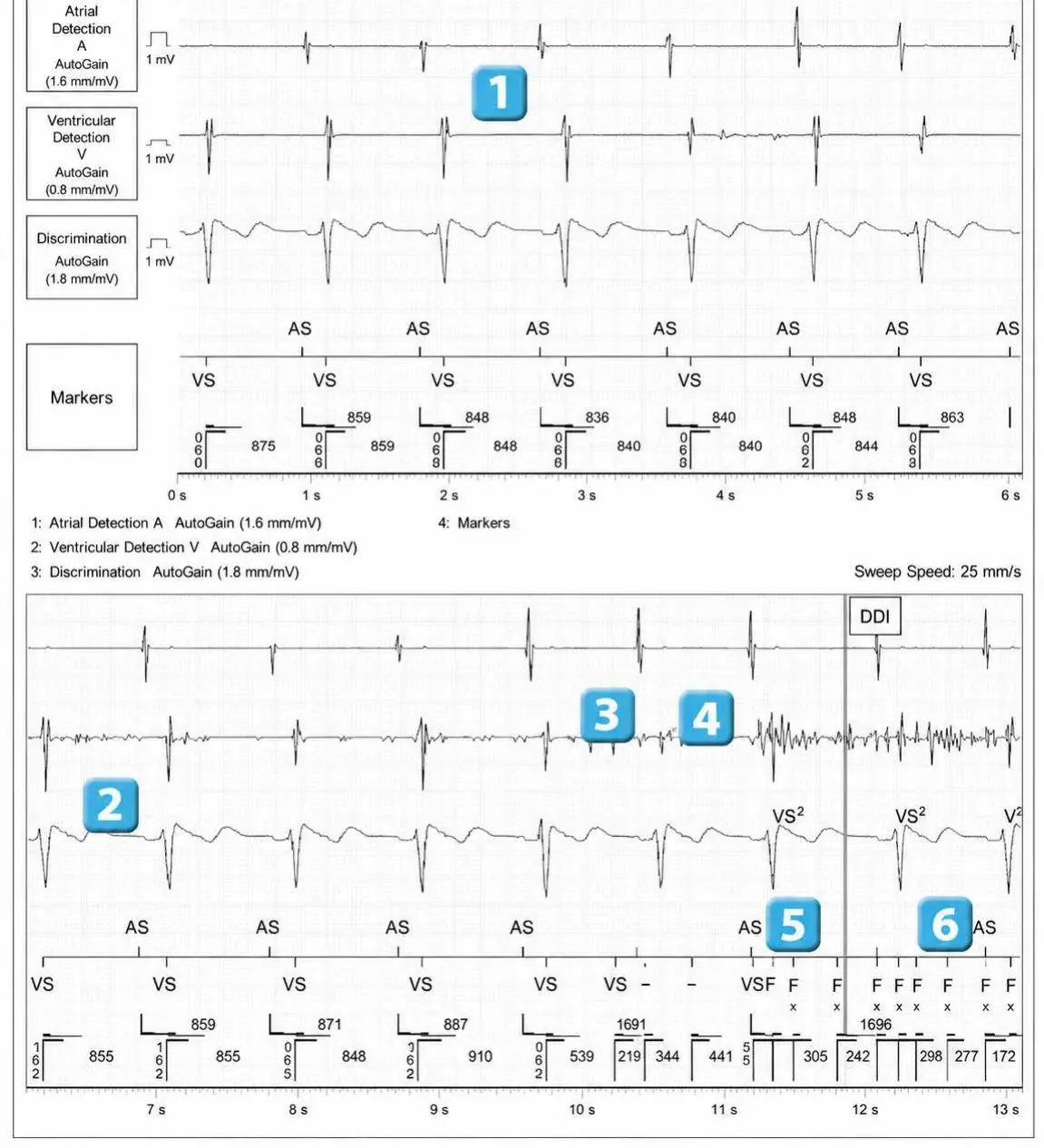
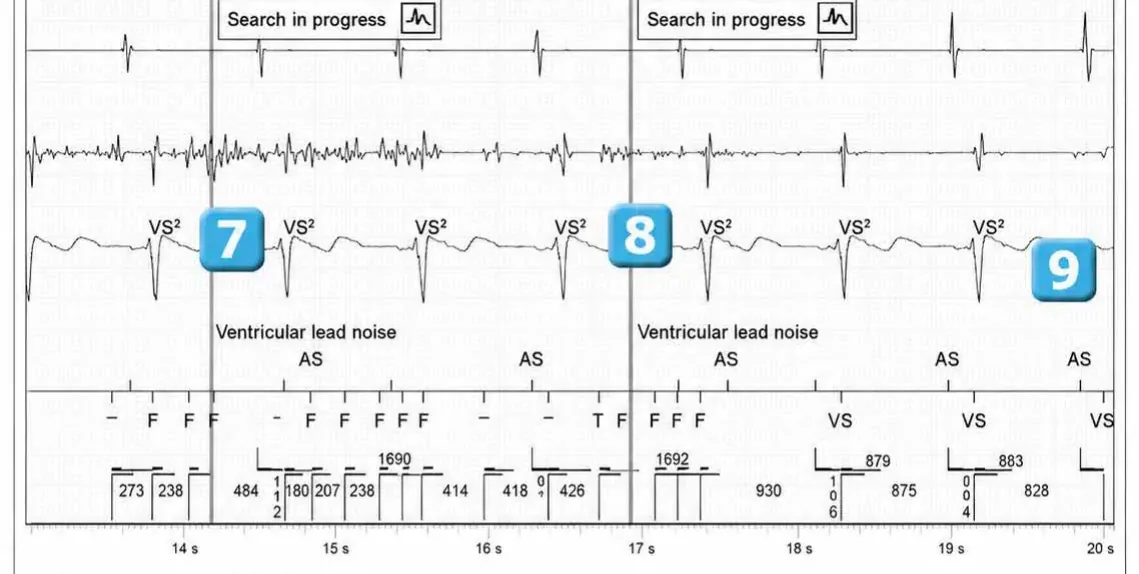
- sinus rhythm (AS-VS)
- small amplitude signals visible on the V detection channel but not detected
- first short cycle (VS then -) detected on the bipolar channel
- second short cycle (-) on the bipolar channel; start of 350 ms warm-up before noise counter activation
- first cycles classified as F incrementing the AF counter; persistence of oversensing on the bipolar channel without detection on the discrimination channel (the VS2 marker corresponds to the detection of the patient’s QRS)
- parallel increment of the PV counter and noise counter (short cycles on the bipolar channel and no short cycles on the discrimination channel)
- the VF counter is full (12); the noise counter is greater than 10, leading to a diagnosis of VD lead noise and causing therapy inhibition
- after 6 F cycles, VD lead noise is detected again (noise counter still > 10)
- diagnosis of sinus return after 3 consecutive VS cycles (no oversensing)
Episode 2
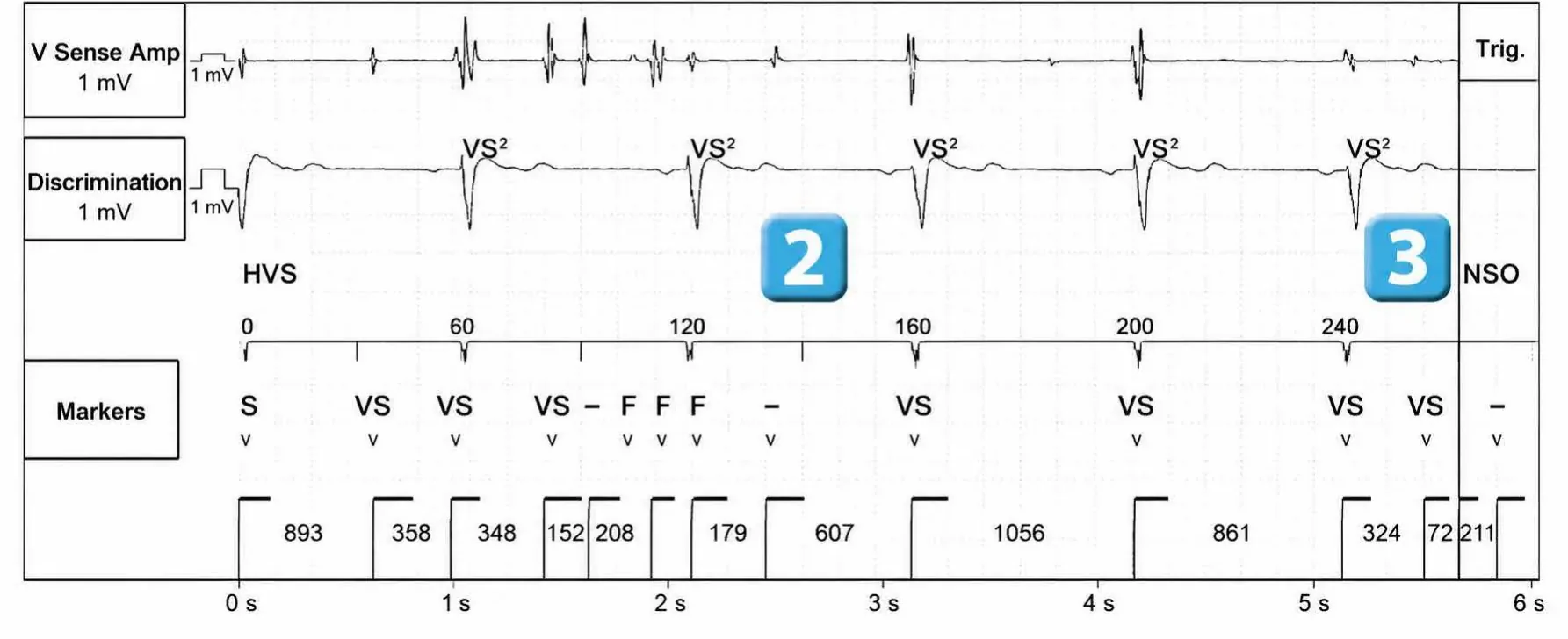
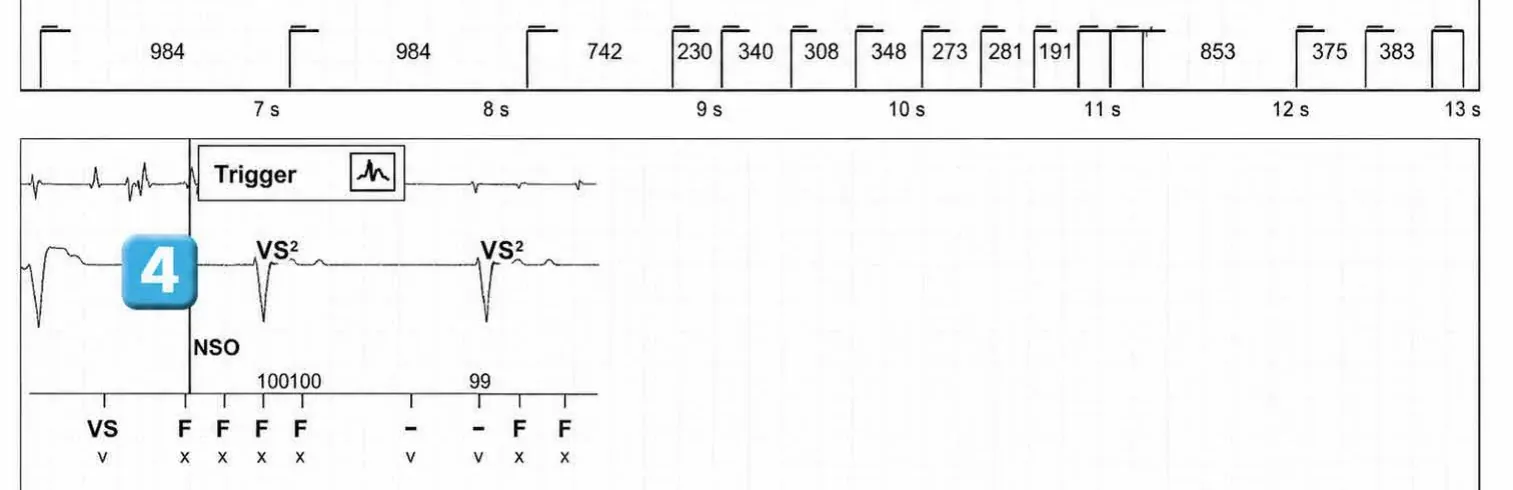
- Oversensing of non-physiological signals on the bipolar channel but not on the discrimination channel; the presence of VS2 markers on the discrimination channel shows that the noise counter is activated and that it has been incremented beforehand
- increment of the noise counter (short cycles on the bipolar channel and absence of short cycles on the discrimination channel)
- Oversensing is intermittent; the VF counter is reset to 0 (sinus return diagnosis); when the noise counter reaches 10, diagnosis of unsustained ventricular oversensing
- when the noise counter reaches a new multiple of 10, marker of non-sustained oversensing
Points to remember
- Both patients had lead dysfunction that was diagnosed early thanks to the SecureSense™ algorithm and remote monitoring, which made it possible to avoid the occurrence of inappropriate therapies; in clinical practice, the combination of this algorithm and rigorous daily monitoring via telemedicine has eliminated the vast majority of inappropriate therapies for lead malfunction
- These two tracings illustrate certain characteristic elements of the SecureSense™ algorithm’s operation during an episode of lead malfunction
- In the initial phase of lead dysfunction, oversensing may only be observed on the bipolar lead channel and may be absent on the discrimination channel; this discrepancy forms the basis of the algorithm’s operation; the noise counter increments for each short cycle on the bipolar lead channel, and the absence of short cycles on the discrimination channel discrimination channel explains why it is not reset to 0; inappropriate therapies are therefore inhibited, which is a major advantage in terms of quality of life and prognosis.
- An episode recorded by SecureSense™ triggers a telemedicine alert, reducing the time between the device’s diagnosis of dysfunction and medical treatment, which is essential for preventing inappropriate therapies; a particularly traumatic experience for the patient concerned.
Practice out loud
Just describe the tracing. What do you think is going on? Describing the numbers can help.
00:00
0%
—
From Implantable Cardioverter Defibrillator — clinical cases based on tracings by P. Bordachar, M. Strik, A. Thiyagarajah, S. Ploux. Published by Cardiocases. Every numbered marker on a recording is explained in the list beneath it; tap a marker on the trace or an entry in the list.