
Chapter 4 · Oversensing · Case 1
Lead breakage on an older model
Patient and episode
Patient
- 31-year-old man with Brugada syndrome, type 1 electrocardiogram, and syncope, implanted with a single-chamber AtlasTMdefibrillator; routine consultation
Summary
- Episode of non-sustained VF with shock abandoned
The recording
Tap a number on the trace, or an entry in the list below
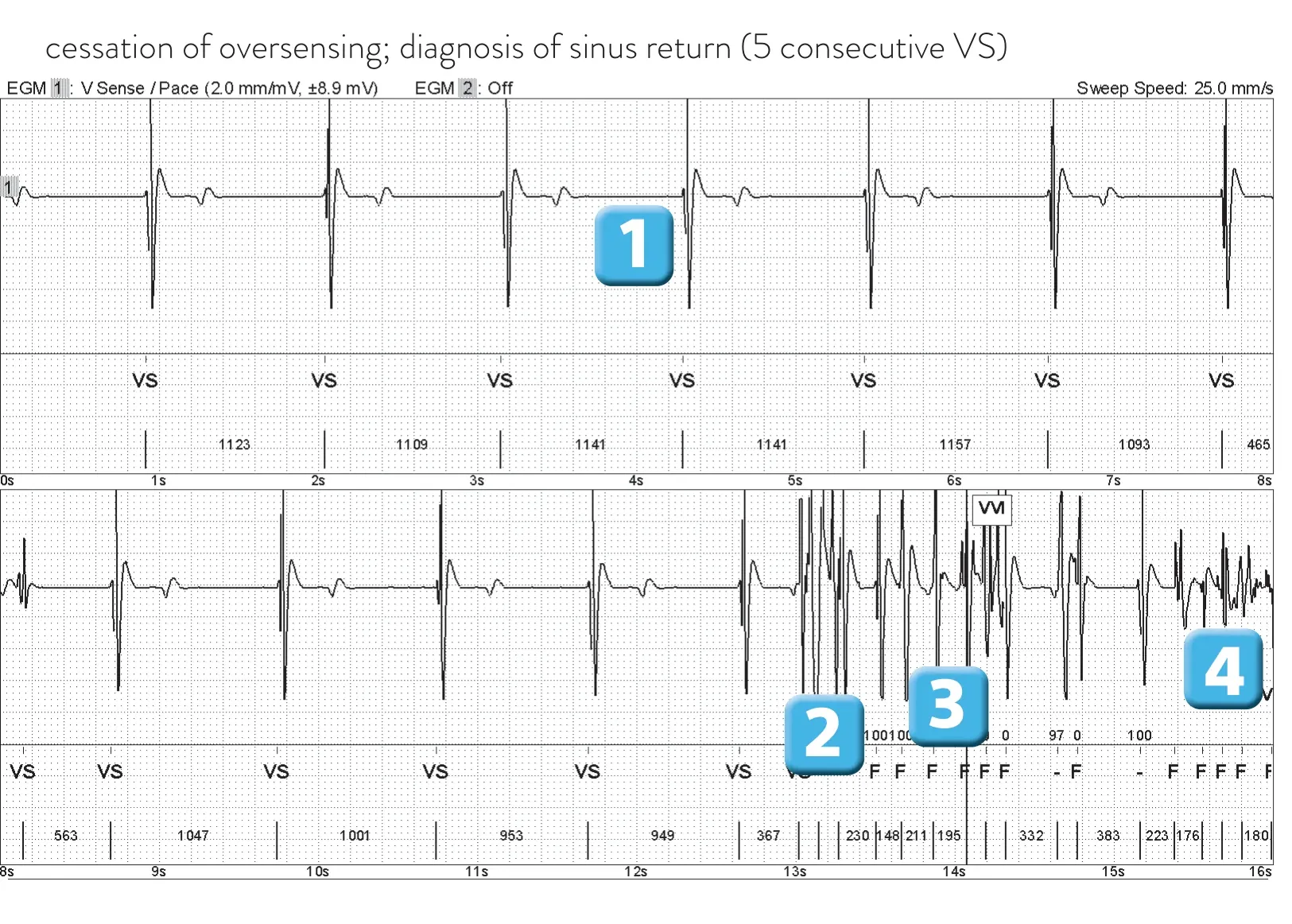
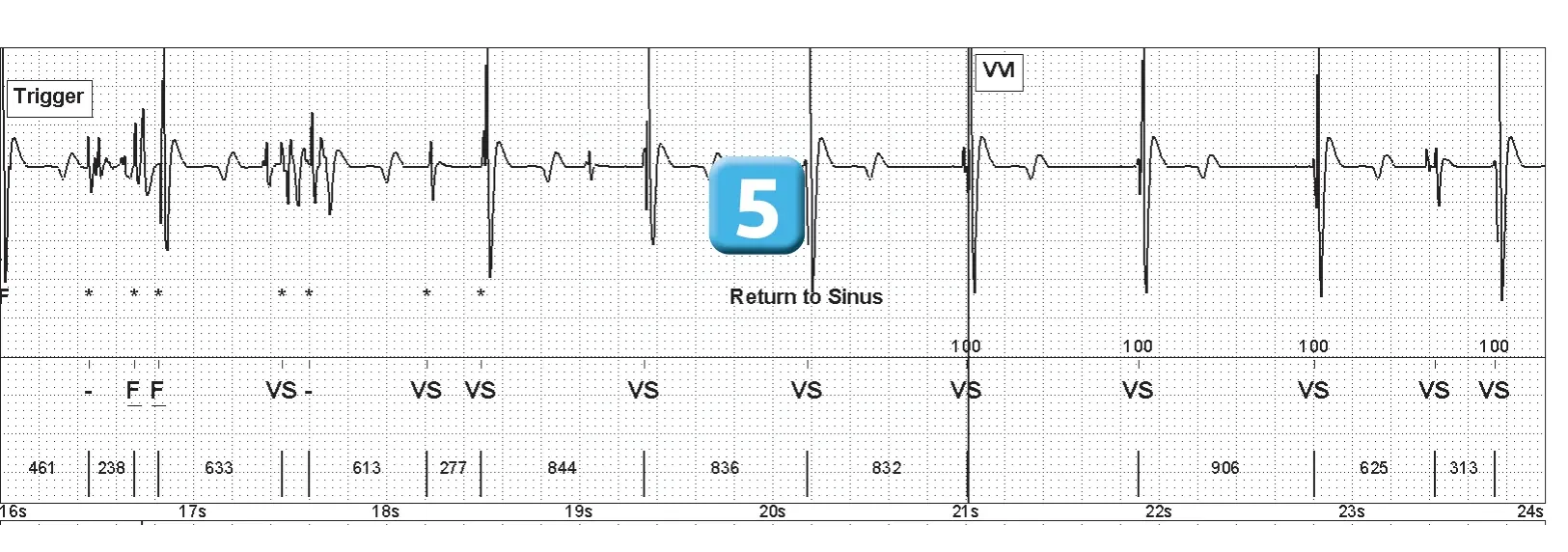
- sinus rhythm
- oversensing of high-amplitude signals saturating the amplifiers (the largest signals are clipped): lead breakage potentials
- episode mode (VVI) after 4 cycles classified as F (old platform, currently 3)
- detection of a VF episode (12 cycles classified as F) and start of capacitor charging
- cessation of oversensing; diagnosis of sinus return (5 consecutive VS)
Points to remember
- The lead is the weak link in the defibrillation system, with a percentage of malfunction that varies depending on the model.
- This trace is highly suggestive of a lead break (short cycles approaching
- ventricular refractory period, most often detected in the VF zone, intermittent in the cardiac cycle, anarchic, of variable amplitude, some signals saturating the amplifiers); these are rupture potentials highly suggestive of a conductor rupture rather than an insulation defect
- in this asymptomatic patient, telemedicine enabled early diagnosis and prevented inappropriate therapies from being administered; similarly, early diagnosis prevents a series of inappropriate charges, which, even if they are diverted, consume energy and reduce the device’s lifespan
- When a lead malfunctions, abnormalities generally occur in several stages: initially, the device’s memory may record multiple episodes of non-sustained VT without any abnormalities in the lead measurements; Second, if the diagnosis has not been made by the monitoring team, a clear break in the various impedance, threshold, and right ventricular ventricular sensing curves may be observed. The duration of oversensing episodes increases, which can lead to multiple electric shocks, a particularly traumatic experience for the patient concerned.
Practice out loud
Just describe the tracing. What do you think is going on? Describing the numbers can help.
00:00
0%
—
From Implantable Cardioverter Defibrillator — clinical cases based on tracings by P. Bordachar, M. Strik, A. Thiyagarajah, S. Ploux. Published by Cardiocases. Every numbered marker on a recording is explained in the list beneath it; tap a marker on the trace or an entry in the list.