
Chapter 5 · Bonus · Case 3
LOT-CRT with a Boston CRT-P
Patient and episode
Patient
- Sinus rhythm with complete left bundle branch block and a CRT indication. A case of Dr Racine, Université Laval, Québec
- A Boston CRT-P is implanted with three leads: an RA lead on the RA port, a SelectSecure 3830 conduction-system lead on the RV port (IS-1), and a quadripolar LV lead on the LV port (IS-4)
The recording
Tap a number on the trace, or an entry in the list below
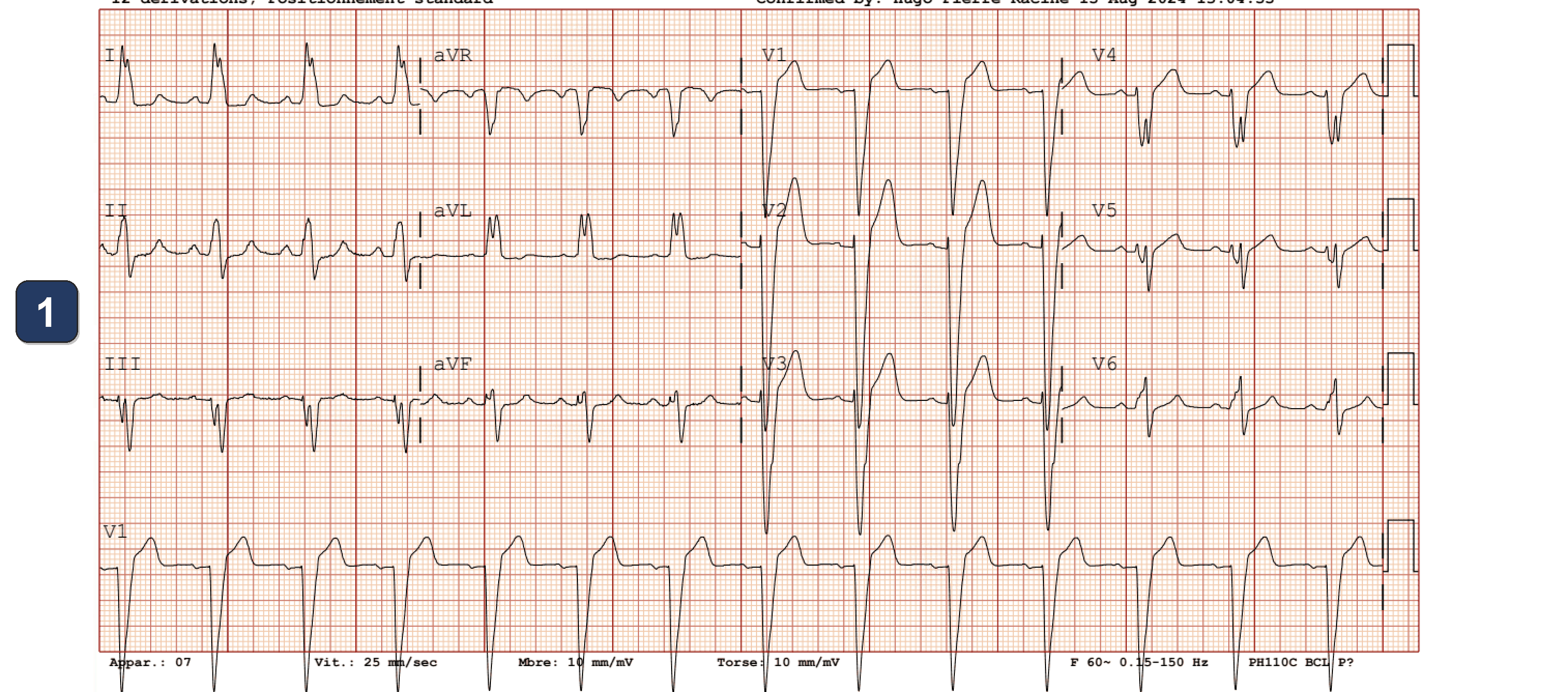



- Baseline 12-lead ECG: sinus rhythm with complete left bundle branch block, a broad QRS with notched R waves in I and aVL and deep S waves in V1-V3
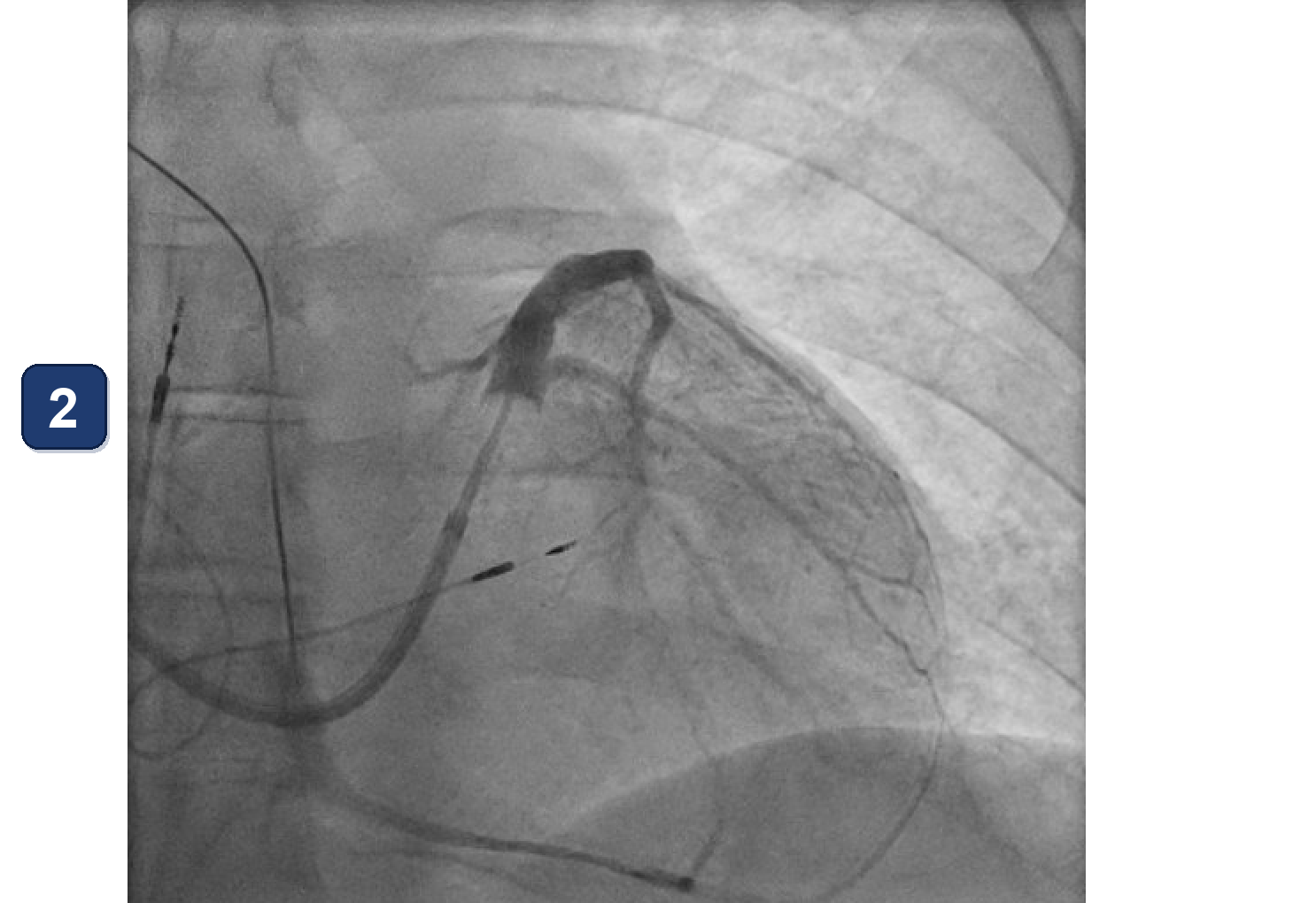
- At the implant: the 3830 lead screwed deep into the septum, in the left bundle branch area; a coronary sinus venogram shows the lateral veins
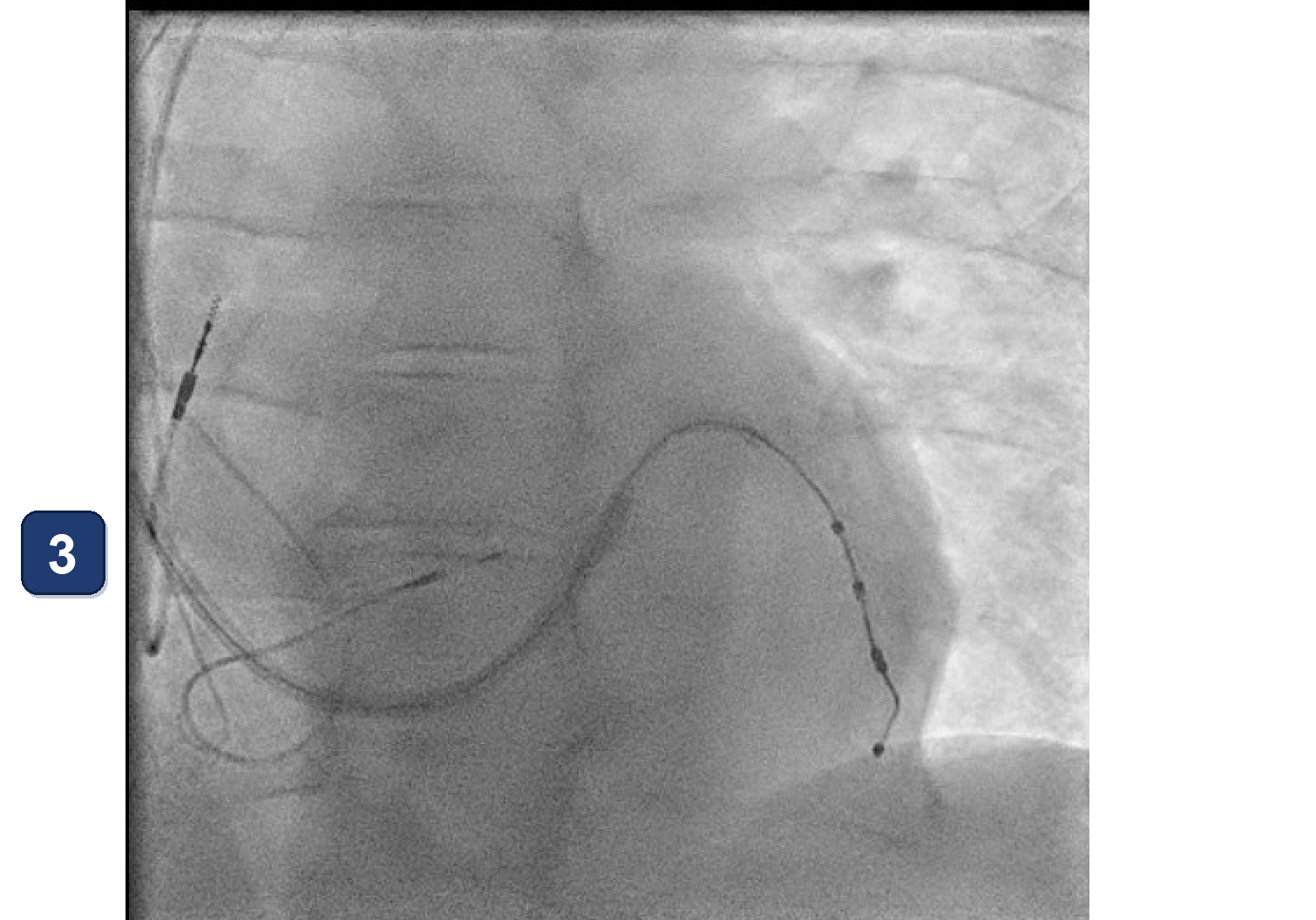
- A quadripolar LV lead in a lateral vein, next to the 3830 lead in the septum and the RA lead: left bundle branch area pacing optimized CRT (LOT-CRT)
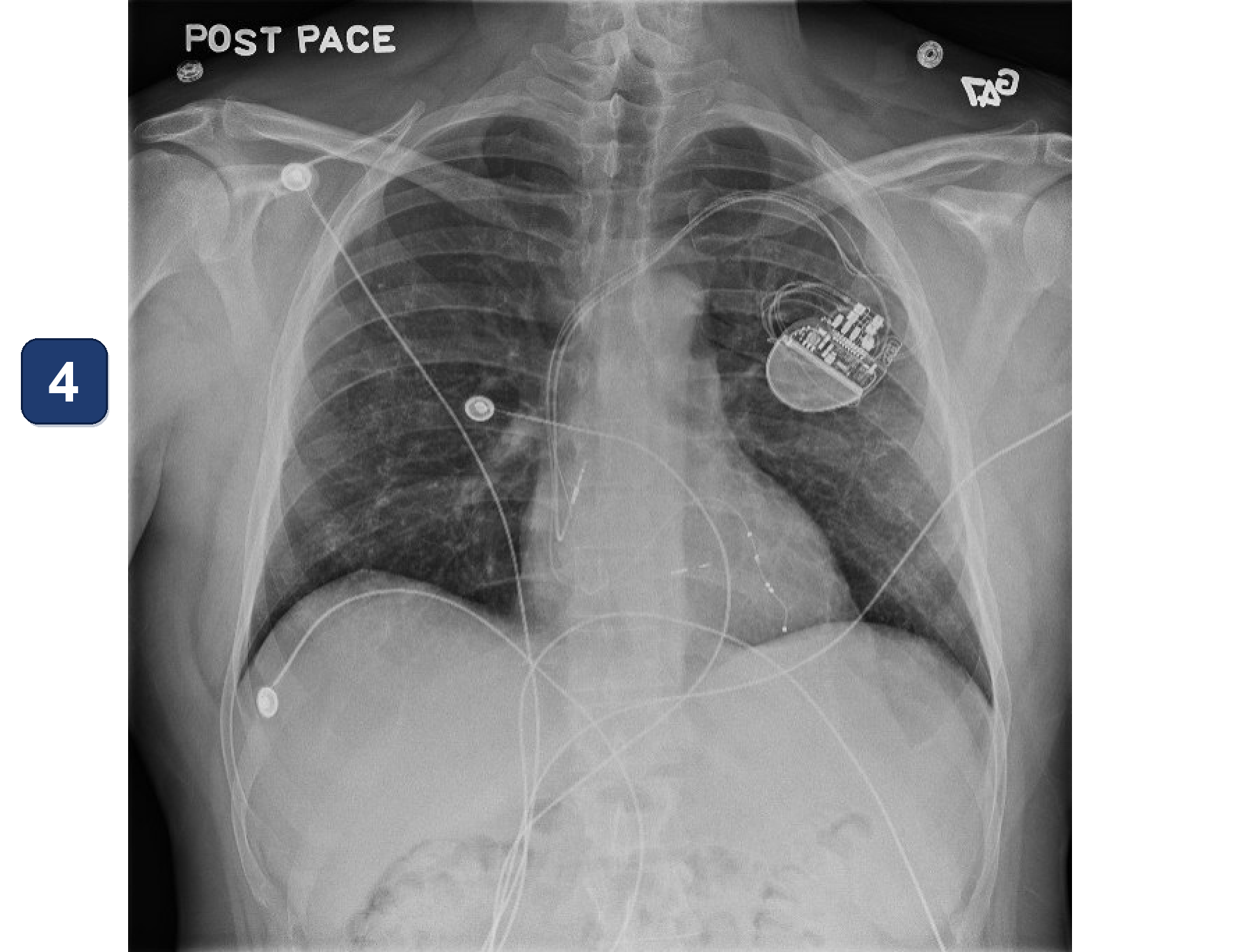
- Chest X-ray after the implant: the CRT-P on the left and its three leads
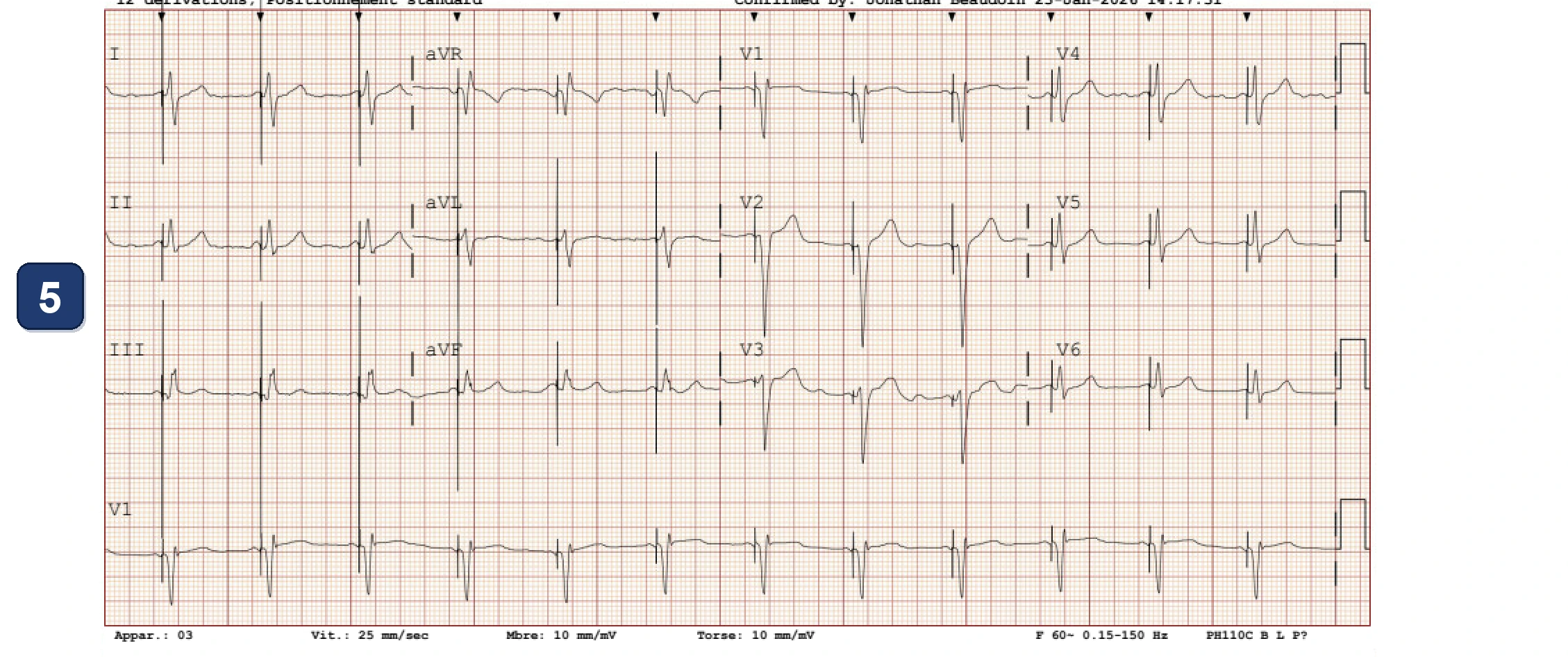
- 12-lead ECG with LOT-CRT: every beat paced (a spike before each complex), with a QRS much narrower than the baseline left bundle branch block
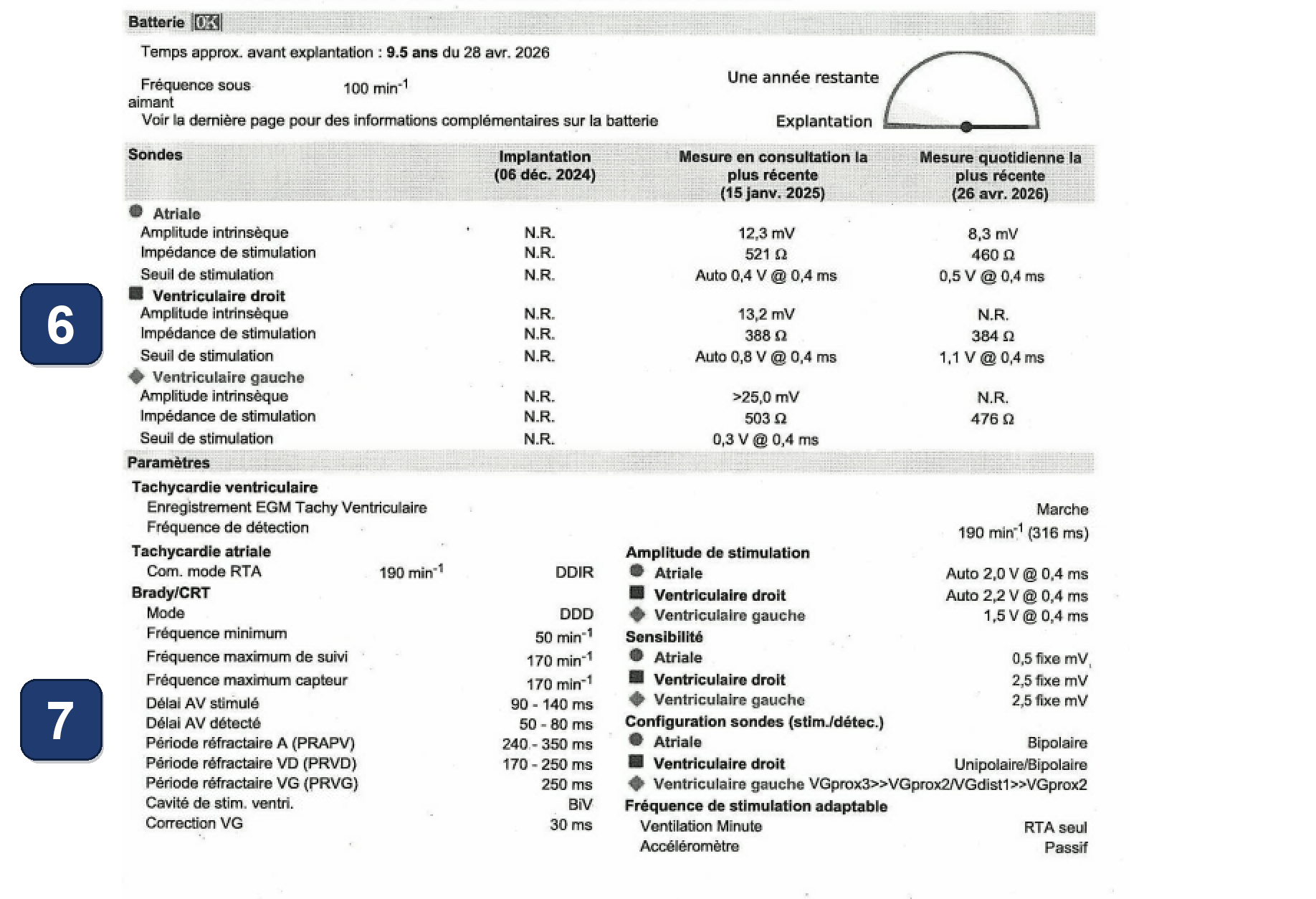
- Remote report: the “RV” values are those of the 3830 lead on the RV port (R wave 13.2 mV, 384-388 Ω, threshold 0.8-1.1 V); LV lead 476-503 Ω, threshold 0.3 V
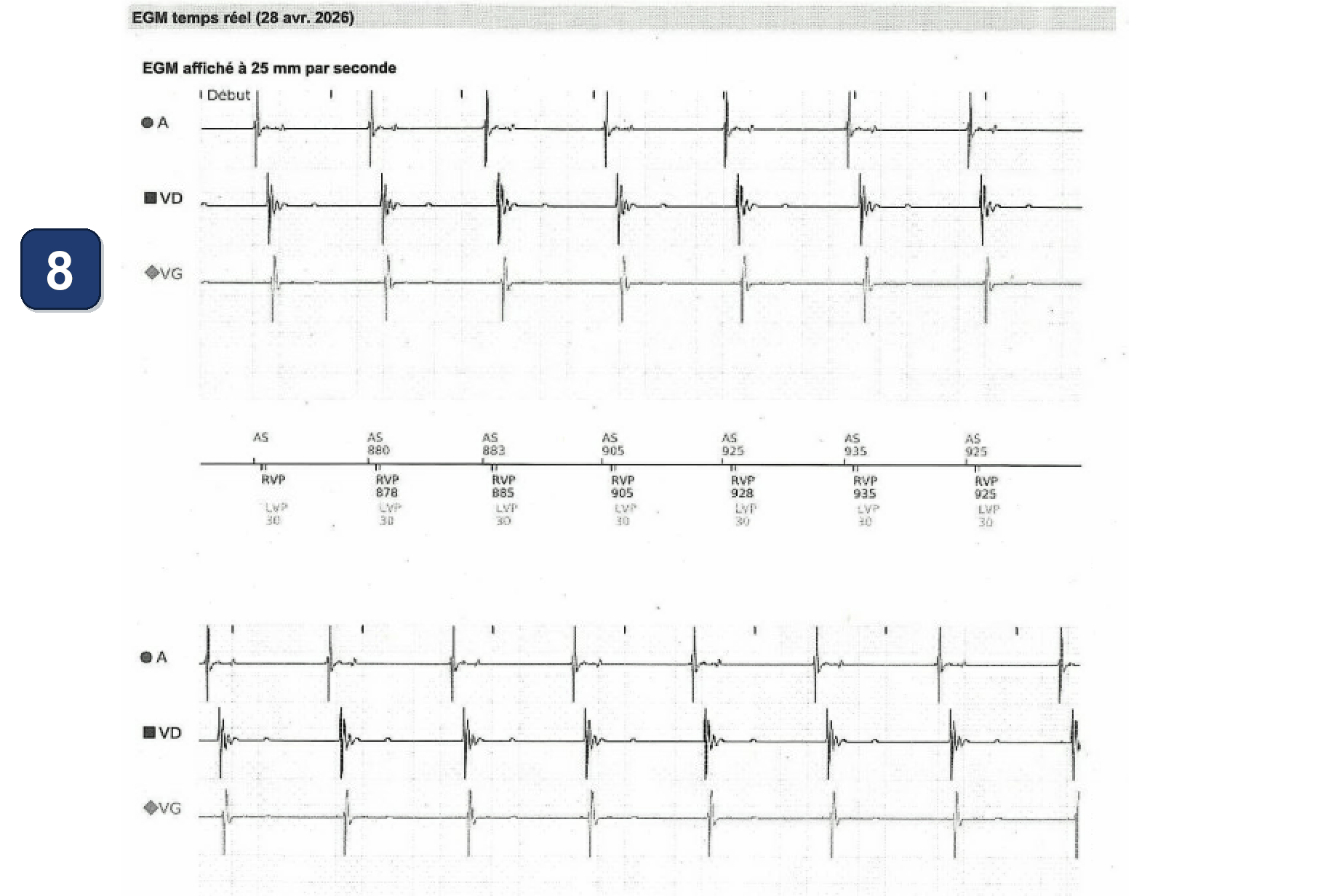
- Programming: DDD 50-170 bpm, sensed AV delay 50-80 ms and paced AV delay 90-140 ms, both short; BiV pacing with an LV offset of 30 ms: the 3830 lead (RV channel) paces first, the LV lead 30 ms later
- Real-time EGM: each atrial event is sensed (AS) and followed by RVP (the 3830 lead), then LVP 30 ms later, at every beat: the short sensed AV delay keeps the pacing ahead of the patient’s own conduction
Points to remember
- LOT-CRT combines left bundle branch area pacing (here a 3830 lead in the septum) with a coronary sinus LV lead, when left bundle branch area pacing alone does not correct the left bundle branch block enough
- On a standard CRT device the conduction-system lead goes into the RV port (IS-1) and the coronary sinus lead into the LV port (IS-4): the “RV” measurements and markers belong to the conduction-system lead
- The LV offset sets the order: here the 3830 lead paces first and the LV lead 30 ms later. Tune it, with short AV delays, on the 12-lead ECG for the narrowest QRS
- Judge the result on the 12-lead ECG: here the paced QRS is much narrower than the baseline left bundle branch block
Summary
- LOT-CRT on a Boston CRT-P: the 3830 lead in the left bundle branch area on the RV port and a quadripolar LV lead in a lateral vein, paced with the 3830 lead 30 ms before the LV lead and short AV delays. The paced QRS is much narrower than the baseline left bundle branch block
Clinical pearl
LOT-CRT on a standard CRT device: the left bundle branch area lead goes into the RV port and the coronary sinus lead into the LV port, so the “RV” measurements and markers belong to the conduction-system lead, and the LV offset (here the LV lead 30 ms after it) is tuned on the 12-lead ECG for the narrowest QRS
Practice out loud
Just describe the tracing. What do you think is going on? Describing the numbers can help.
00:00
0%
—
From Boston Scientific CRT — clinical cases by M. Strik. Published by Cardiocases. Every numbered marker on a recording is explained in the list beneath it; tap a marker on the trace or an entry in the list.