
Chapter 1 · LV pacing and threshold · Case 2
Ambulatory PaceSafe LV threshold test
Patient and episode
Patient
- RESONATE X4 CRT-D with a quadripolar LV lead, sinus rhythm with atrial tracking; LV output programmed Auto (PaceSafe LV)
- An event stored by the device and sent through LATITUDE: how does the test run, and what is the LV threshold?
The recording
Tap a number on the trace, or an entry in the list below
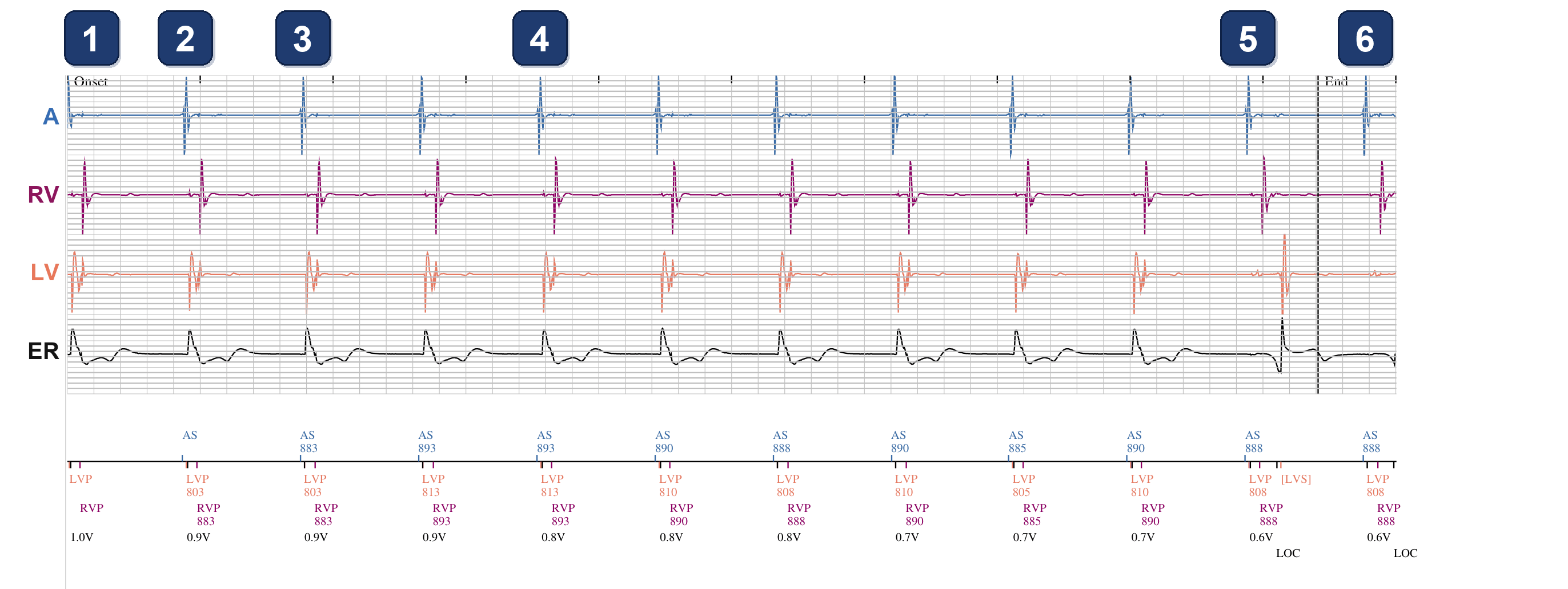
- Onset of the ambulatory PaceSafe LV test (LVAT, run every 21 hours): sinus rhythm (AS ≈ 885 ms); the LV is paced just after each atrial sensed event (about 30 ms) at the starting amplitude, 1.0 V
- Backup RV pace 80 ms after every LV test pulse, so a pulse that fails to capture never leaves the ventricles unpaced; the LV interval (803 ms) is counted from the previous RV pace (883 − 80 ms)
- Evoked response (ER, bottom channel): the same response follows every LV pulse = LV capture
- The amplitude falls by 0.1 V every 3 beats: 0.9 V, then 0.8 V, then 0.7 V, with capture each time
- 0.6 V: the evoked response changes and the LV is activated late by the RV pace ([LVS]) = loss of LV capture (LOC)
- Second loss of capture at 0.6 V: end of the test (End); the LV threshold is 0.7 V, the last amplitude that captured
Points to remember
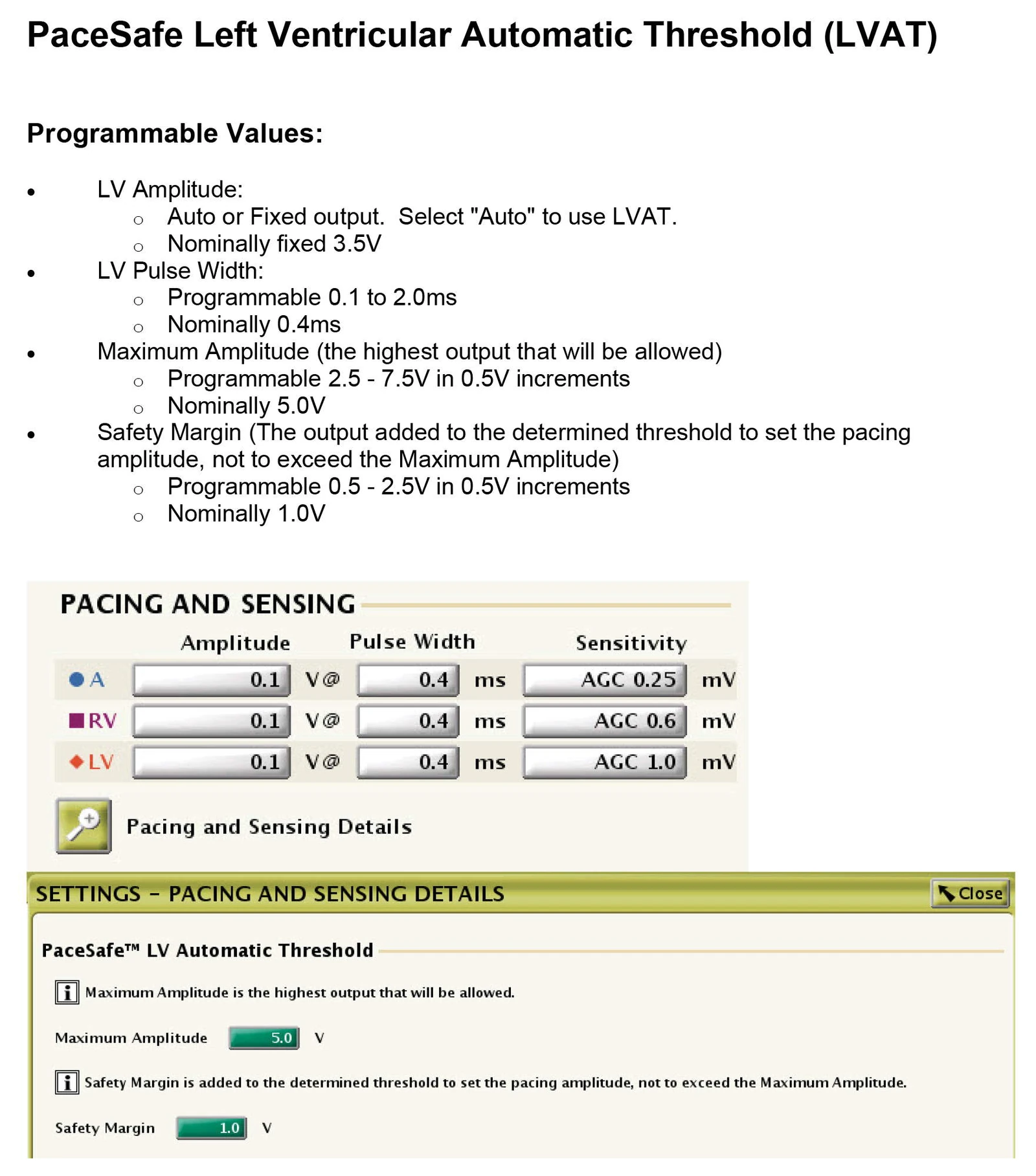
- PaceSafe LV tests the LV threshold on its own every 21 hours. Each LV test pulse is backed up by an RV pace 80 ms later, so the patient is never left unpaced; capture is judged on the LV evoked response
- The amplitude steps down by 0.1 V every 3 beats; two losses of capture end the test, and the threshold is the last amplitude that captured (here 0.7 V)
- The LV output is then set to the highest threshold of the last 7 tests plus a safety margin: it rises at once after a high threshold and falls only after several lower ones
- If the evoked response is not good enough for the test, the device reports it (“Intrinsic Beat” or “Fusion Events”) and paces the LV at the maximum amplitude
- Before turning LVAT on, a commanded test in office checks that it works with this lead. With a fixed LV output and “Daily Trend”, the test still runs every 21 hours but does not change the output
Summary
- A normal ambulatory PaceSafe LV test: the LV amplitude steps down by 0.1 V every 3 beats, LV capture is lost twice at 0.6 V, and the LV threshold is 0.7 V
Clinical pearl
PaceSafe LV measures the LV threshold but does not watch LV capture beat by beat: between two tests, 21 hours apart, only the safety margin keeps the LV captured
Practice out loud
Just describe the tracing. What do you think is going on? Describing the numbers can help.
00:00
0%
—
From Boston Scientific CRT — clinical cases by M. Strik. Published by Cardiocases. Every numbered marker on a recording is explained in the list beneath it; tap a marker on the trace or an entry in the list.