
Chapter 1 · LV pacing and threshold · Case 3
PaceSafe LV test with an unexpected beat
Patient and episode
Patient
- RESONATE CRT-D in sinus rhythm at 96 bpm with atrial tracking; LV output programmed Auto (PaceSafe LV)
- An ambulatory LV threshold test stored by the device and sent through LATITUDE, with an unexpected beat in the middle: is the measured threshold valid?
The recording
Tap a number on the trace, or an entry in the list below
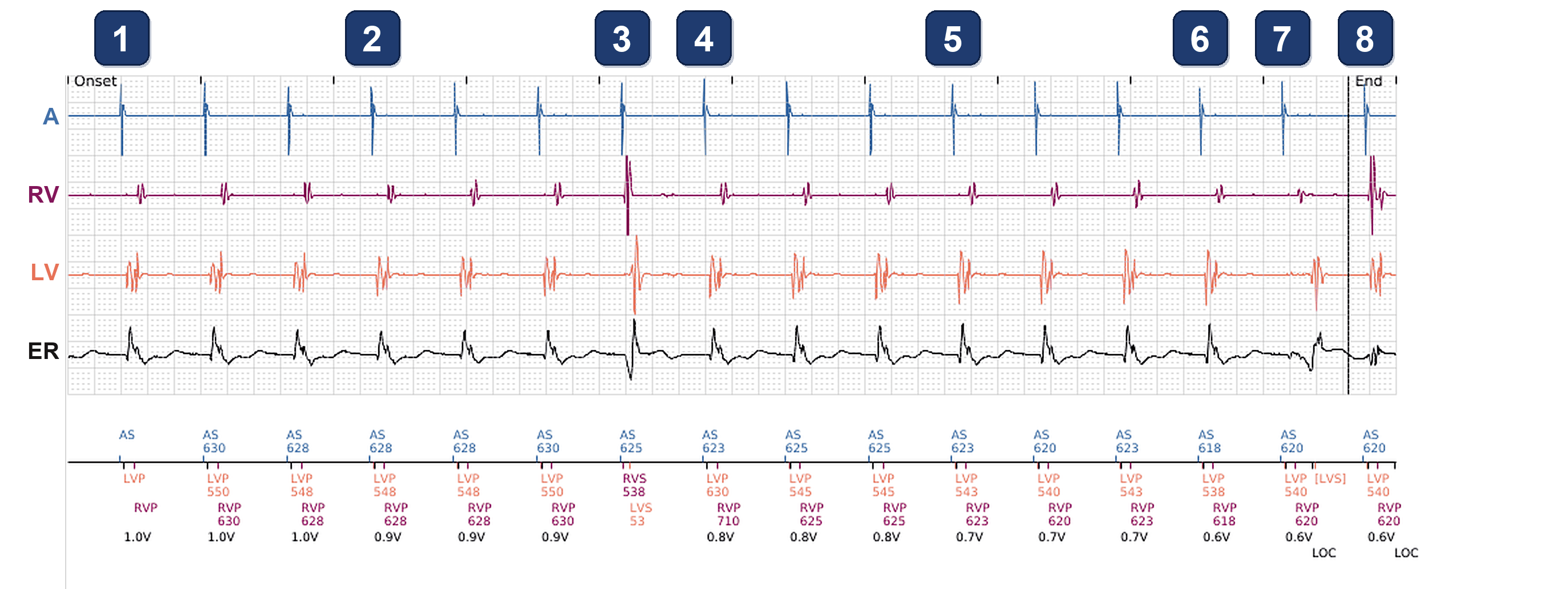
- Ambulatory PaceSafe LV test in sinus rhythm (AS ≈ 625 ms): an LV test pulse just after each atrial sensed event and a backup RV pace 80 ms later; 1.0 V for 3 beats
- 0.9 V for 3 beats, with capture
- Premature ventricular beat: RV sensed (RVS 538) about 20 ms after the atrial event and LV sensed 53 ms later, with a different morphology on every channel = PVC; no test pulse on this cycle and no loss of capture counted
- The test resumes on the next tracked beat, at the next step: 0.8 V for 3 beats (LVP 630: the LV interval restarts from the PVC)
- 0.7 V for 3 beats, with capture
- 0.6 V: the first beat still captures
- Loss of capture: the evoked response changes and the LV is activated late ([LVS])
- Second loss of capture at 0.6 V: end of the test; the LV threshold is 0.7 V
Points to remember
- A PVC, or any sensed ventricular beat, during PaceSafe LV only cancels that test cycle: no test pulse, no loss of capture counted, and the step-down resumes on the next tracked beat
- The test stops only after 2 losses of capture at one step, so a single odd beat cannot fake a high threshold: the threshold measured here, 0.7 V, can be trusted
- Tell a PVC from a loss of capture on the markers and the EGM: a PVC is sensed (RVS, then LVS), with a new shape on every channel; a loss of capture is an LV pace (LVP) followed by a changed evoked response and a late LV activation ([LVS])
Summary
- A PVC during an ambulatory PaceSafe LV test: the device skips that cycle, counts no loss of capture and goes on; the LV threshold, 0.7 V, is valid
Clinical pearl
An odd beat in an LV threshold test is not always a loss of capture: if its markers show it was sensed (RVS, LVS), it is a PVC that the test simply skips, and the threshold stays valid
Practice out loud
Just describe the tracing. What do you think is going on? Describing the numbers can help.
00:00
0%
—
From Boston Scientific CRT — clinical cases by M. Strik. Published by Cardiocases. Every numbered marker on a recording is explained in the list beneath it; tap a marker on the trace or an entry in the list.