
Chapter 4 · Discrimination · Case 16
PR Logic and conducted AF
Patient and episode
Patient
- Male implanted with a triple-chamber defibrillator (Cobalt Quad CRTD) for ischaemic cardiomyopathy.
The recording
Tap a number on the trace, or an entry in the list below
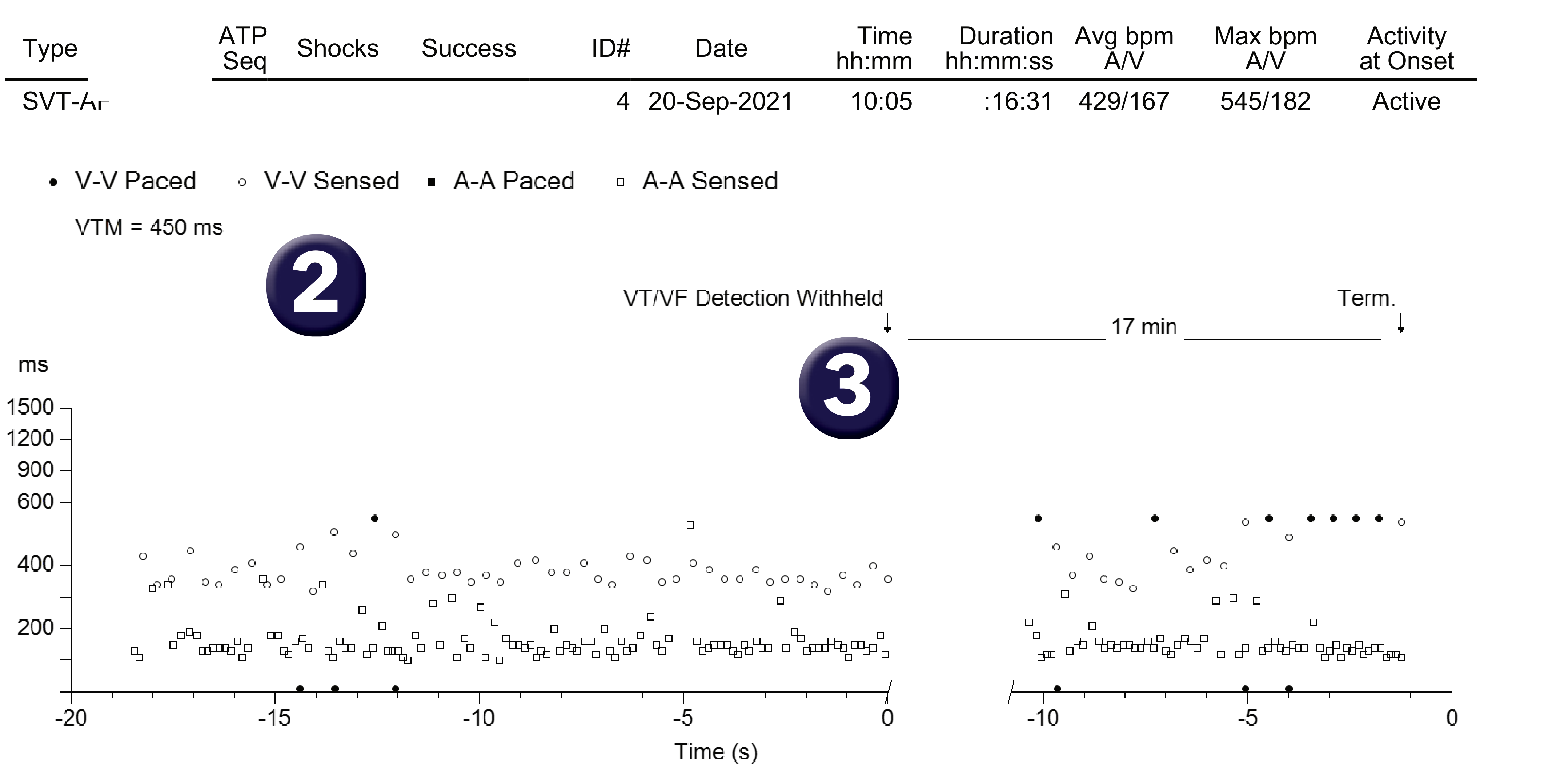
Rate / interval plot
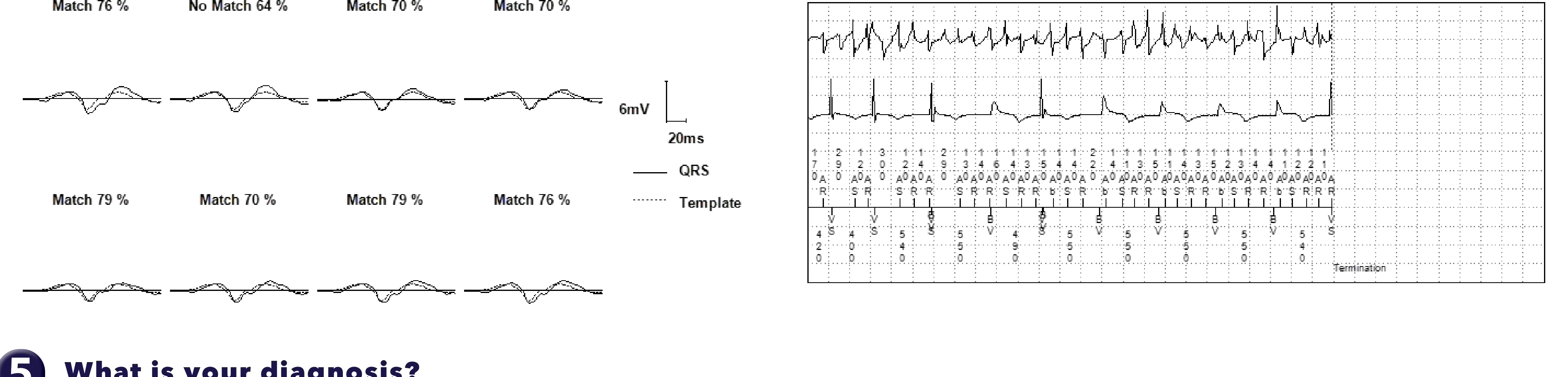
EGM

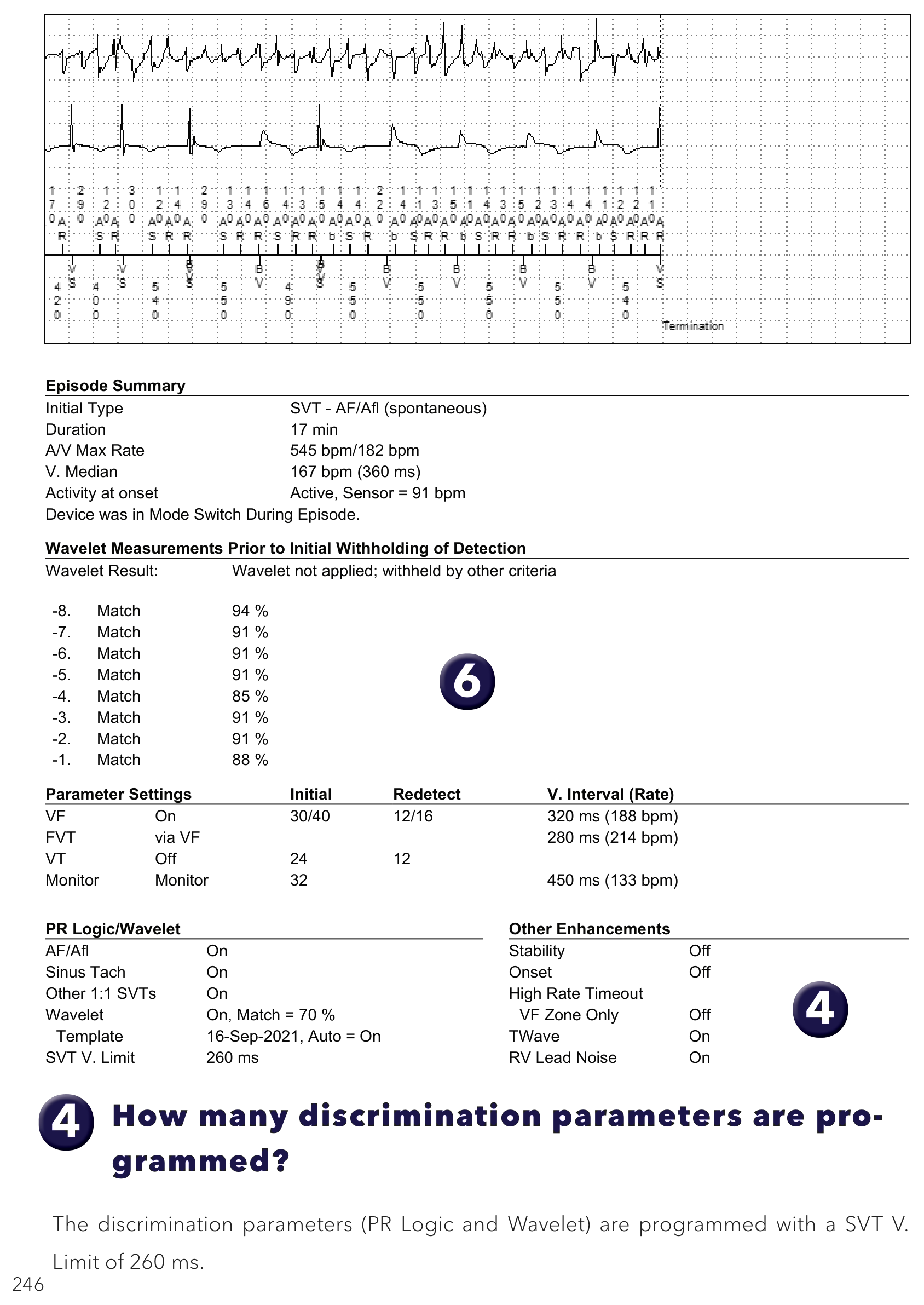
From the interrogation
- What was the diagnosis made by the defibrillator for this episode? This episode has been classified SVT-AF by the system.
- Which programmed zone appears on the graph? A monitor zone is programmed from 450 ms.
- What diagnosis does the interval plot suggest? The graph shows a tachycardia detected in the monitor zone with atrial activity faster than ventricular activity and an irregular ventricular response; the graph is in favour of conducted AF.
- How many discrimination parameters are programmed? The discrimination parameters (PR Logic and Wavelet) are programmed with a SVT V. Limit of 260 ms.
- What is your diagnosis? The pattern is suggestive of conducted AF.
- What are the results of Wavelet? Wavelet supports the diagnosis of SVT, as the 8 QRS complexes analysed were considered similar to the reference template.
Points to remember
- This patient presented with episodes of atrial fibrillation detected in the monitor zone and correctly classified by the defibrillator; this trace details the various stages leading to the diagnosis of AF by PR Logic.
- The device compares the atrial and ventricular rates; for a diagnosis of conducted AF, the median atrial interval must be less than or equal to 94% of the median ventricular interval; in this example, the atrial rate is clearly faster than the ventricular rate; this tracing corresponds to an episode with V<A.
- The device checks that there is no far-field R wave oversensing (oversensing of the R wave on the atrial channel); PR Logic detects a far-field R wave if it detects both a succession of «short-long» sequences of A-A intervals (difference > 30 ms) and a short A-V interval (< 60 ms) or a short V-A interval (< 160 ms); to diagnose far-field R wave oversensing, the device must sense a far-field R wave in at least 4 of the 12 most recent ventricular intervals; in this example, this type of sequence is not found, as the sensed atrial signals all correspond to atrial activity.
- The device analyses the atrial rhythm and assesses for the presence of atrial fibrillation; to do this, it counts the number of sensed atrial cycles between 2 sensed R waves (2 or more atrial signals between 2 ventricular signals => Counter +1, no atrial signals between 2 ventricular signals => Counter -1, 1 atrial signal between 2 ventricular signals => Counter +0 if different from the previous cycle); diagnosis compatible with AF if AF counter is greater than 6; in this example, the AF counter is well above 6 (in the majority of cycles, there are at least 2 atrial signals between 2 ventricular signals); at this stage, the 3 diagnoses to be differentiated are: bi-tachycardia (VT + AF), conducted AF, conducted atrial flutter.
- The device analyses the regularity of the ventricular rhythm using a different criterion to that used for a single-chamber defibrillator; the device counts the number of times the 2 most frequent ventricular intervals have occurred out of the last 18 ventricular intervals; if the sum of the 2 most frequent intervals represents more than 75% of the total cycles, the rhythm is considered to be regular; this is not the case in this example; the rhythm is irregular (the 2 most frequent cycles represent less than 50% of the total cycles); the device eliminates the diagnoses of bi-tachycardia and conducted flutter (regular ventricular rhythm) and retains the diagnosis of conducted AF.
- If PR Logic concludes conducted AF, Wavelet is not included in the discrimination and therefore cannot modify the diagnosis; on the other hand, if the PR Logic concludes double tachycardia (AF + VT), Wavelet is included in discrimination and can possibly correct the diagnosis.
Practice out loud
Just describe the tracing. What do you think is going on? Describing the numbers can help.
00:00
0%
—
From Medtronic ICD — clinical cases by P. Bordachar, A. Thiyagarajah, L. Fontagne, M. Strik, S. Ploux. Published by Cardiocases. Every numbered marker on a recording is explained in the list beneath it; tap a marker on the trace or an entry in the list.
Order hardcopyon Amazon