
Chapter 4 · Discrimination · Case 4
Single-chamber defibrillator and new recommendations
Patient and episode
Patient
- Male implanted with a single-chamber defibrillator (Visia AF XT VR) for primary prevention of ischaemic cardiomyopathy.
The recording
Tap a number on the trace, or an entry in the list below
Rate / interval plot
From the interrogation
EGM

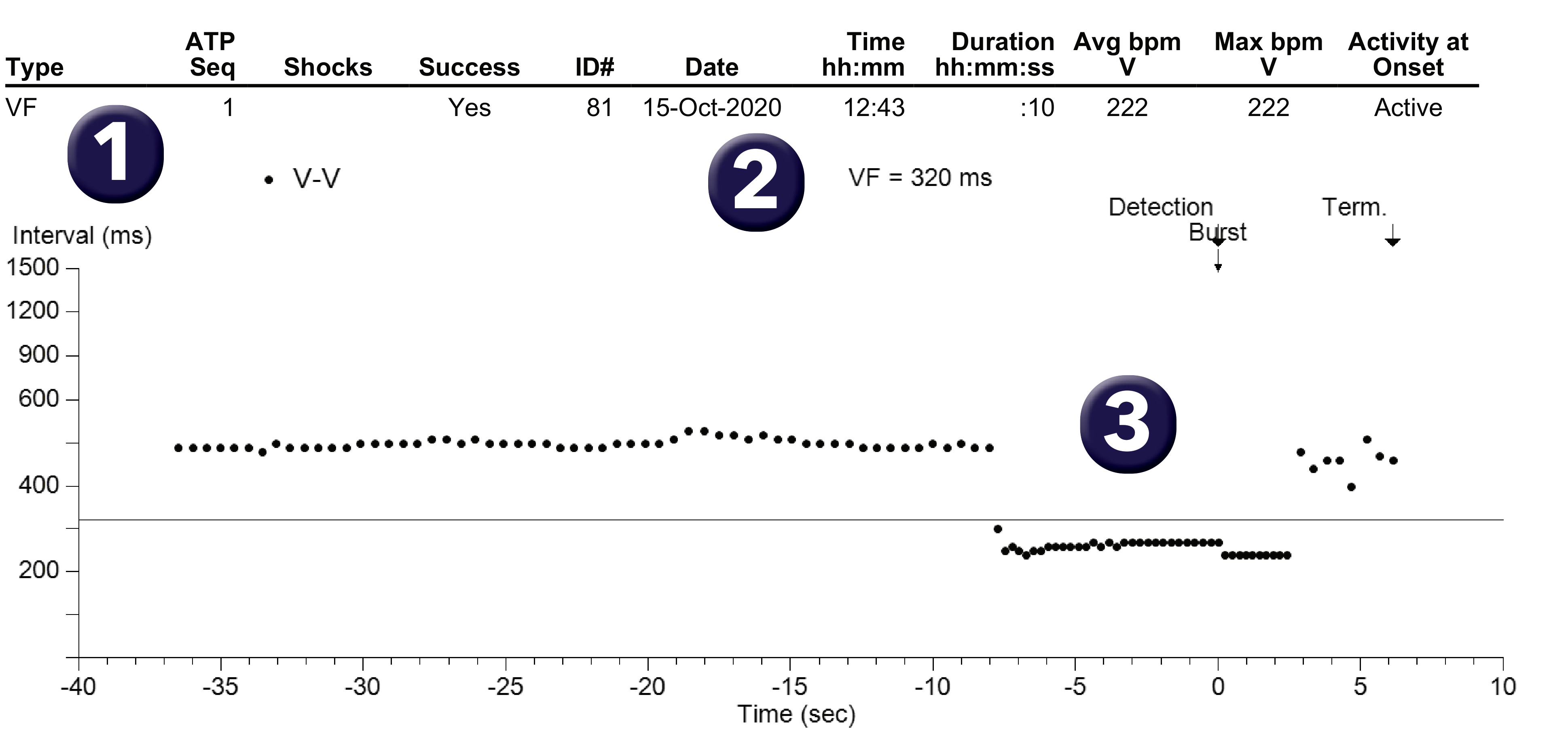
- What was the diagnosis made by the defibrillator for this episode? This episode has been classified as VF by the system.
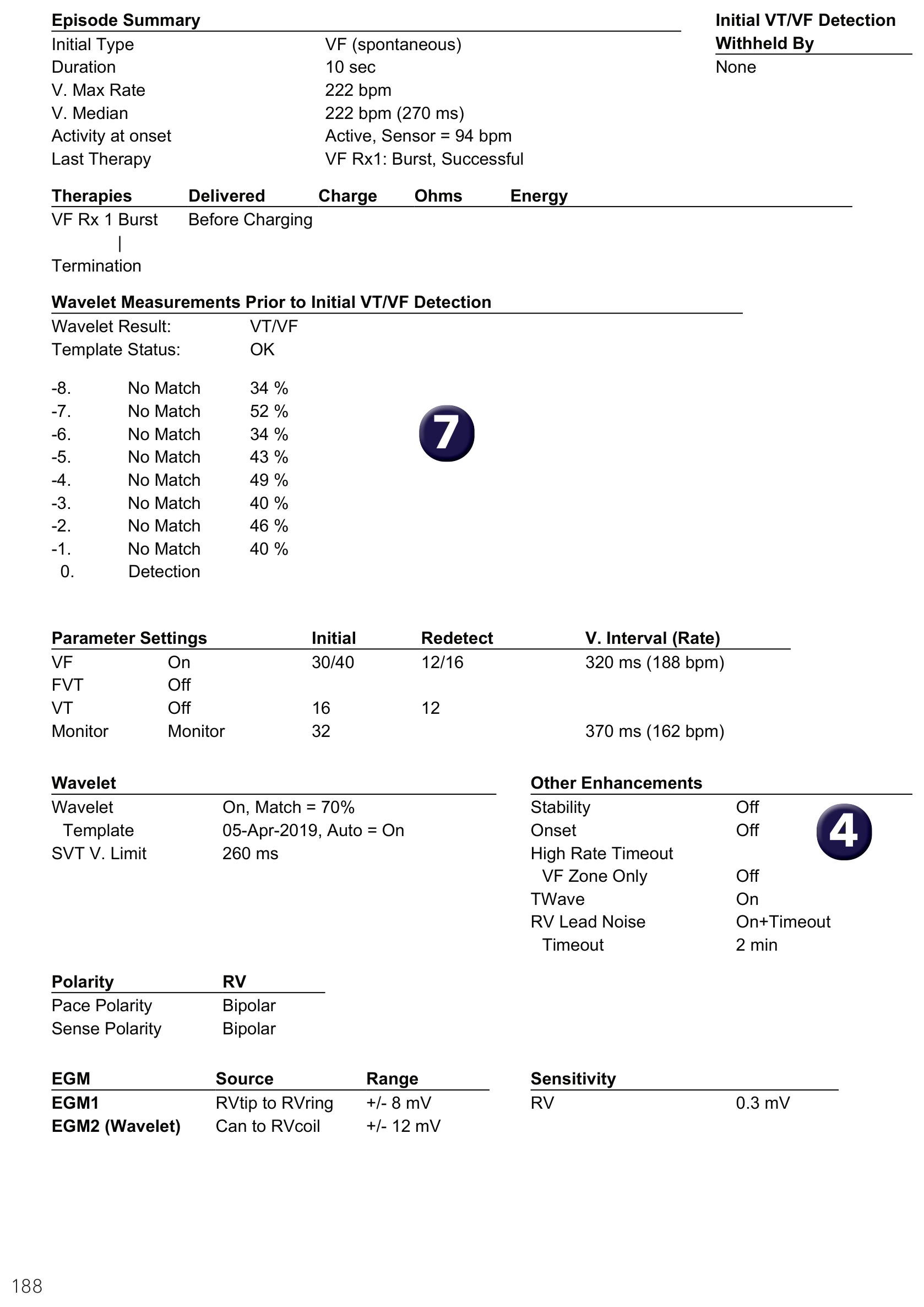
- How many detection zones are programmed? A single detection zone (VF 320 ms) has been programmed.
- What diagnosis does the interval plot suggest? The graph shows an initially stable rhythm of around 125 bpm with sudden acceleration and cycles recorded in the VF zone; a burst is delivered with a return to the initial heart rate.
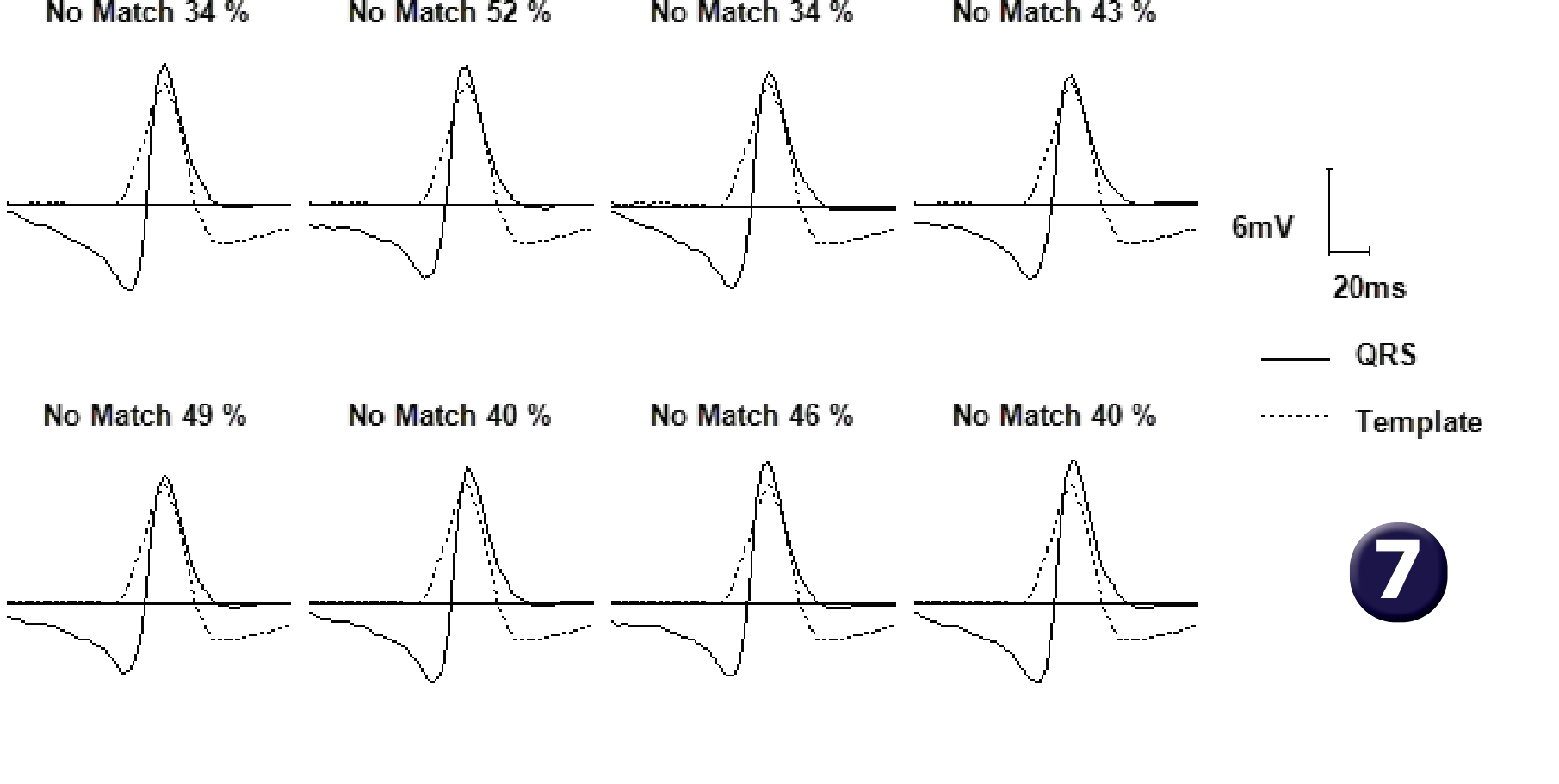
- How many discrimination parameters are programmed? Wavelet is the only discrimination criterion programmed (70% match); the stability and sudden onset criteria are set to ‘Off’’.
- How do you analyse the EGM in tachycardia? This is a regular, monomorphic tachycardia with a wide QRS (shock channel) that has a different morphology to the QRS complexes recorded in the absence of tachycardia.
- What therapy is delivered? The VF counter is completed after 30 cycles classified as FS; a burst before charging is delivered; this helps to terminate tachycardia.
- What do you think of the Wavelet results? The Wavelet appearance of the analysed complexes is clearly different from the reference complex, with similarity percentages ranging from 34% to 52%; the 8 complexes were therefore considered to be different, leading to a diagnosis of ventricular arrhythmia.
Points to remember
- In this example, the single-chamber defibrillator is programmed according to the latest HRS/EHRA/APHRS/LAHRS recommendations of 2019 for a primary prevention indication: programming of a single VF zone at a rate of 188 bpm, VF counter programmed to 30/40 for initial detection, programming of a monitor zone, Wavelet only discrimination programmed for cycle lengths up to 260 ms, programming of the T wave oversensing and RV lead noise algorithms.
- These international recommendations include 2 important messages in terms of single-chamber discrimination: 1) it is recommended that discrimination should be based solely on the Wavelet; therefore the criteria of sudden onset and stability should be programmed ‘Off’ in the first instance; in fact, when all 3 parameters are programmed ‘On’, all 3 must be fulfilled for the arrhythmia to be diagnosed and treated (sudden onset, stable rhythm, different morphology QRS to the reference); simultaneous programming of these 3 parameters may therefore reduce the sensitivity of the device; when Wavelet is functioning correctly in a given patient, discrimination based solely on this parameter enables virtually all tachycardias to be discriminated effectively (with the exception of SVT with aberrant conduction); 2) Wavelet must be programmed to function up to high heart rates, with a SVT V. Limit of 230 beats/minute, to reduce the risk of inappropriate therapies occurring for episodes of rapid AF (class I indication).
Practice out loud
Just describe the tracing. What do you think is going on? Describing the numbers can help.
00:00
0%
—
From Medtronic ICD — clinical cases by P. Bordachar, A. Thiyagarajah, L. Fontagne, M. Strik, S. Ploux. Published by Cardiocases. Every numbered marker on a recording is explained in the list beneath it; tap a marker on the trace or an entry in the list.
Order hardcopyon Amazon