
Chapter 4 · Discrimination · Case 5
Single-chamber defibrillator and SVT V. Limit
Patient and episode
Patient
- Male implanted with a primary prevention single-chamber defibrillator (Visia AF XT VR) for ischaemic cardiomyopathy.
The recording
Tap a number on the trace, or an entry in the list below
Rate / interval plot
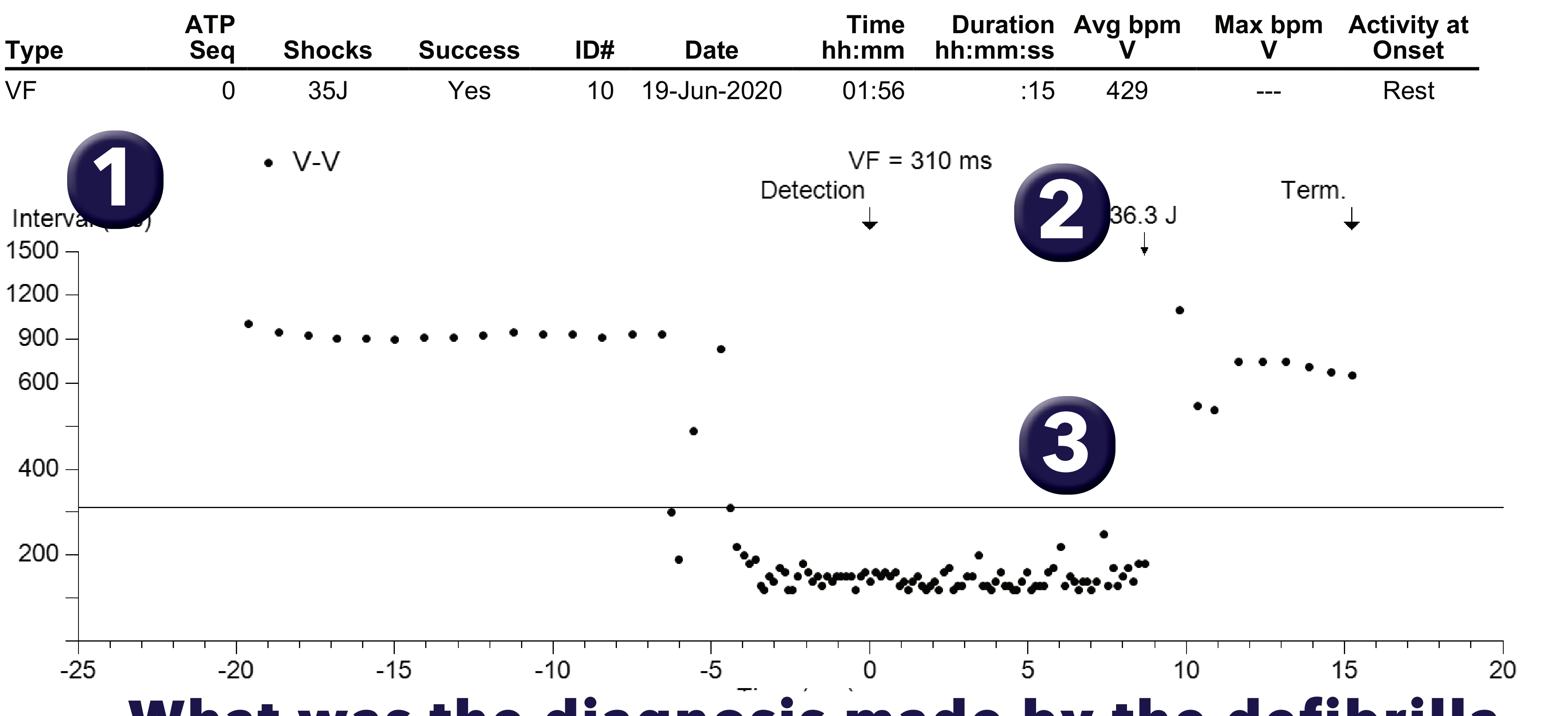
From the interrogation
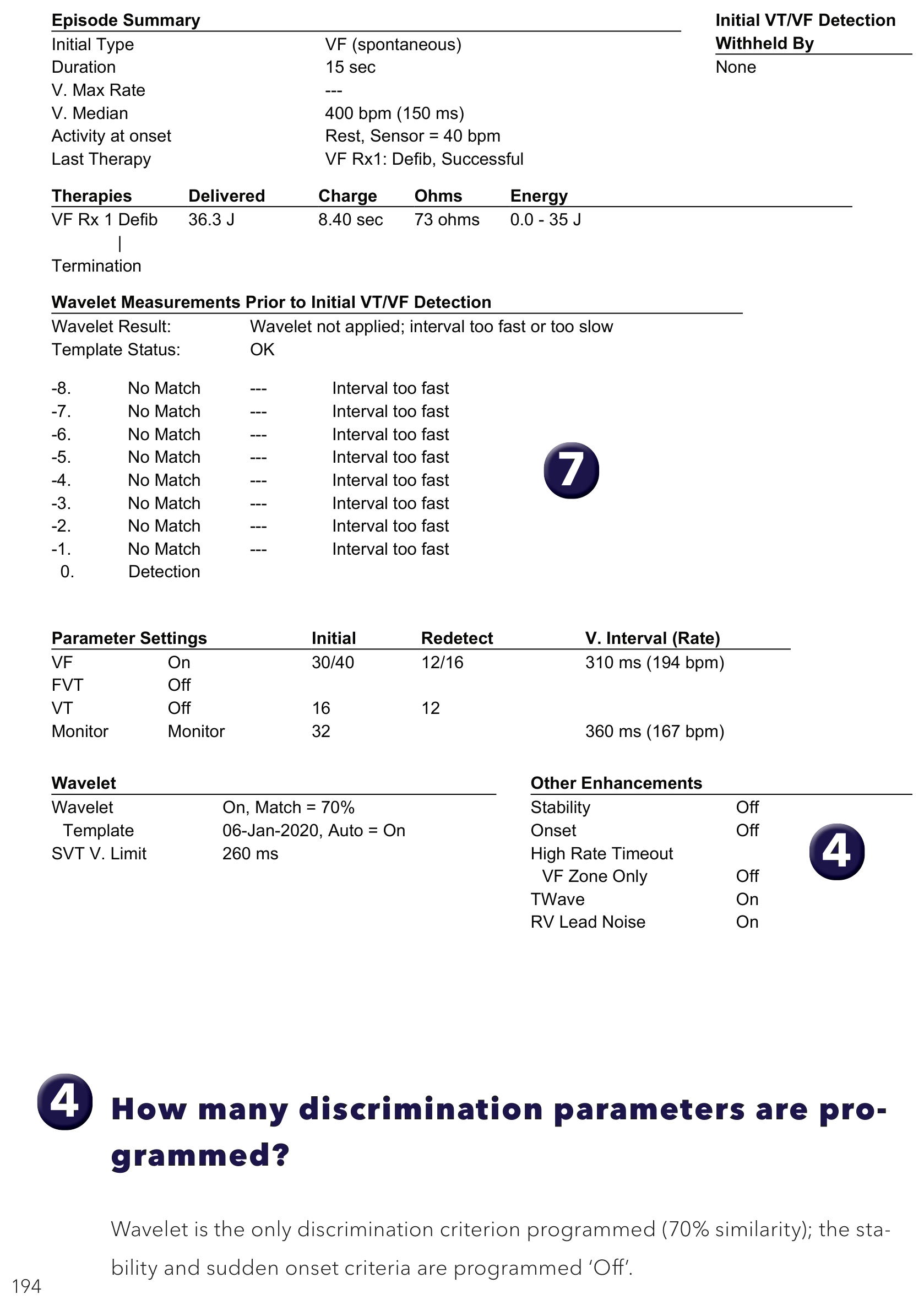
EGM

- What was the diagnosis made by the defibrillator for this episode? This episode has been classified as VF by the system.
- How many detection zones are programmed? A single zone (VF 310 ms) has been programmed.
- What diagnosis does the interval plot suggest? The graph shows an initially stable rhythm of around 60 bpm with sudden acceleration and very rapid cycles recorded in the VF zone; a maximum output shock is delivered with a return to the initial heart rate.
- How many discrimination parameters are programmed? Wavelet is the only discrimination criterion programmed (70% similarity); the stability and sudden onset criteria are programmed ‘Off’.
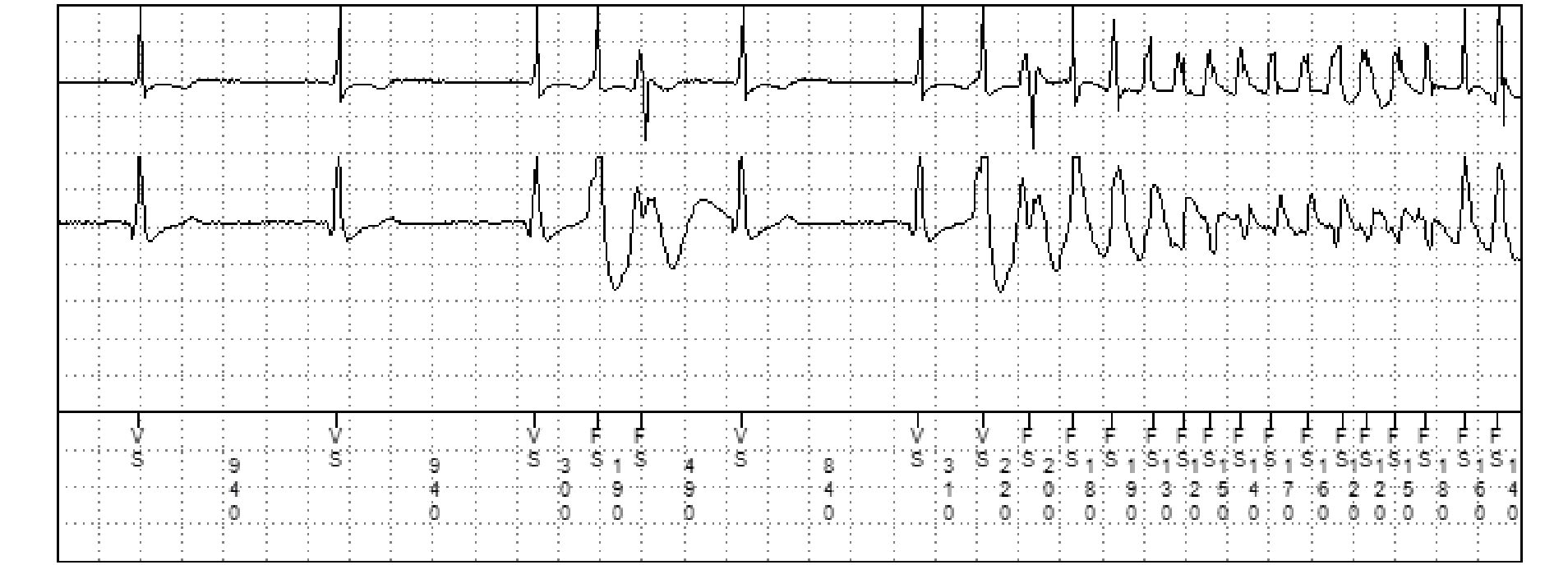
- How do you analyse the EGM in tachycardia? This is clearly ventricular fibrillation (very rapid, irregular and polymorphic tachycardia).
- What therapy is delivered? The VF counter is completed after 30 cycles classified as FS; a shock is delivered after the capacitors are charged; this terminates the tachycardia.
- What do you think of the Wavelet results? Wavelet was not used because the 8 intervals analysed were too fast.
Points to remember
- The SVT V. Limit parameter is specific to MedtronicTM devices; in fact, the SVT V. Limit is the maximum heart rate up to which discrimination based on Wavelet applies and is independent of the programmed detection zones; it can therefore be applied in the FVT or VF zone; on the other hand, the sudden onset and stability criteria are limited to the VT or FVT via VT zone; in devices from other manufacturers, no discrimination is possible in the VF zone; in this example, the VF zone starts at intervals of 310 ms and the SVT V. Limit is programmed at 260 ms; discrimination therefore applies in the VF zone for intervals between 310 and 260 ms.
- When the median cycle length of the 12 most recently detected consecutive intervals is less than this programmed limit, discrimination no longer applies; it is preferable not to program a discrimination limit that is too fast (> 230 bpm) in the majority of patients; in fact, when the heart rate exceeds this limit, the probability that the arrhythmia is supraventricular is low; moreover, incorrectly inhibiting therapies on a potentially lethal ventricular arrhythmia could prove catastrophic.
Practice out loud
Just describe the tracing. What do you think is going on? Describing the numbers can help.
00:00
0%
—
From Medtronic ICD — clinical cases by P. Bordachar, A. Thiyagarajah, L. Fontagne, M. Strik, S. Ploux. Published by Cardiocases. Every numbered marker on a recording is explained in the list beneath it; tap a marker on the trace or an entry in the list.
Order hardcopyon Amazon