
Chapter 4 · Discrimination · Case 10
Triple-chamber defibrillator and V limit. SVT
Patient and episode
Patient
- Male implanted with a triple-chamber defibrillator (Claria Quad CRTD) for dilated cardiomyopathy.
The recording
Tap a number on the trace, or an entry in the list below
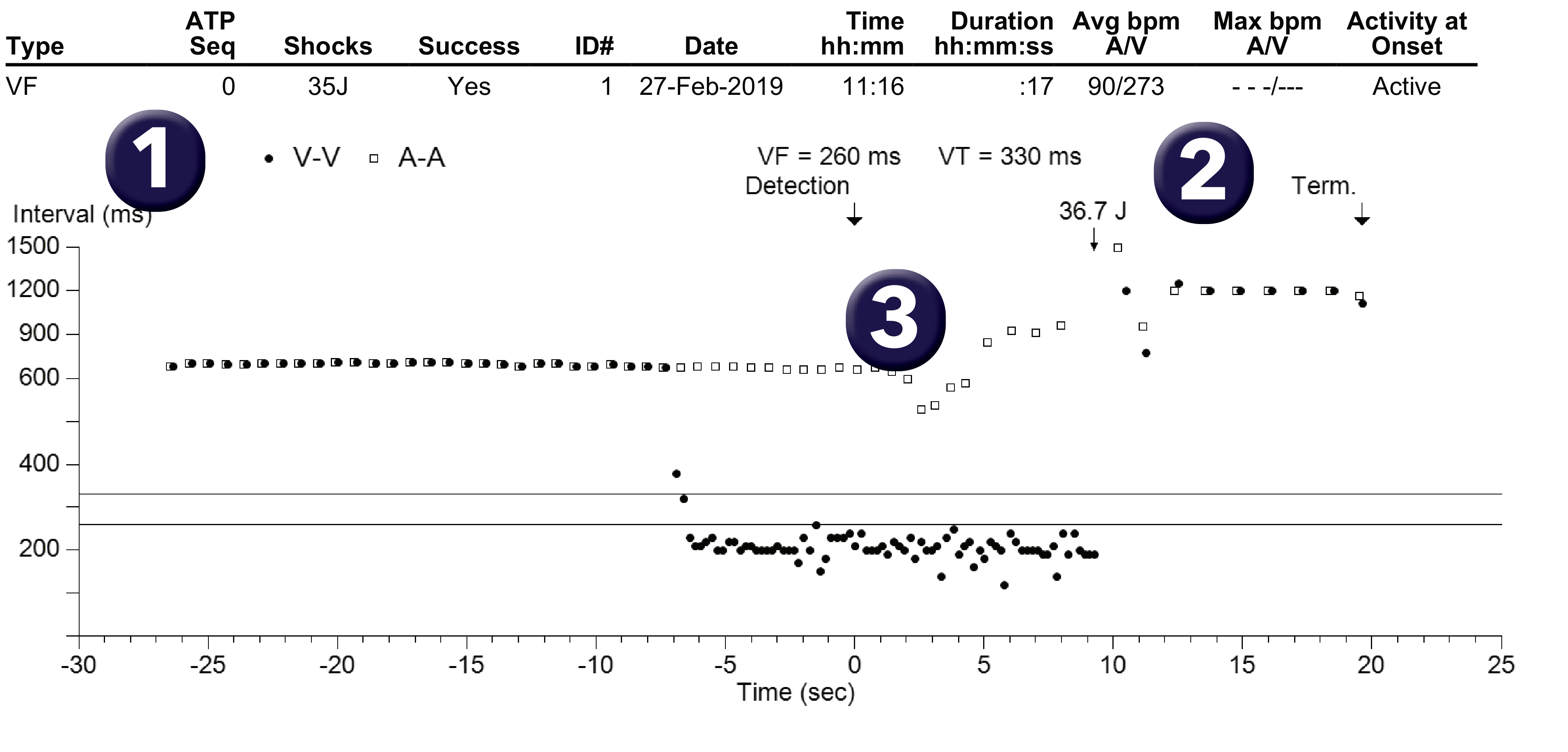
Rate / interval plot
EGM

From the interrogation
- What is the diagnosis made by the defibrillator for this episode? This episode has been classified as VF by the system.
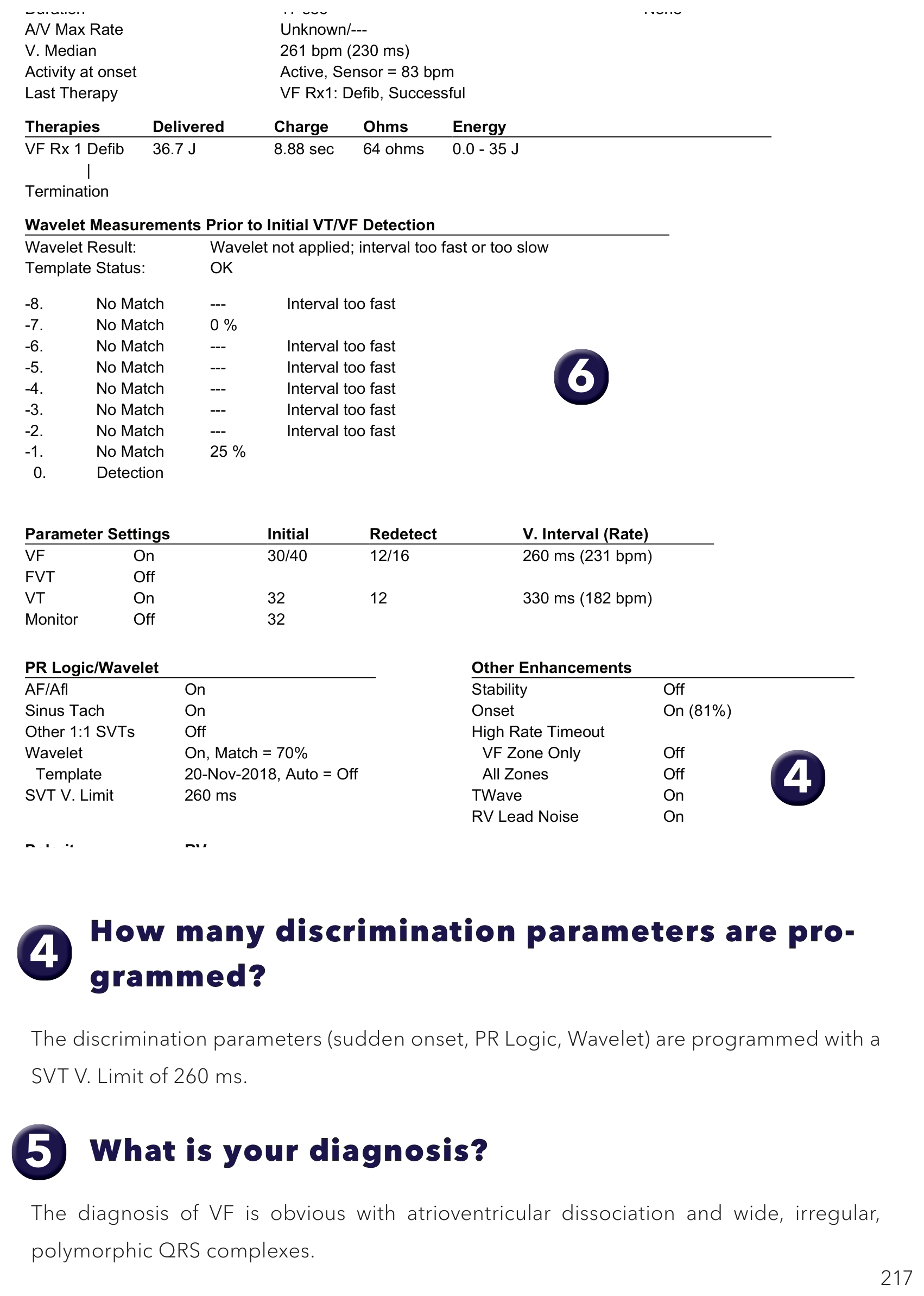
- How many detection zones are programmed? Two detection zones have been programmed.
- What diagnosis does the interval plot suggest? The graph shows atrioventricular dissociation (ventricular rhythm faster than the atrial rhythm) with very rapid and irregular ventricular cycles; a maximum output shock terminates the arrhythmia.
- How many discrimination parameters are programmed? The discrimination parameters (sudden onset, PR Logic, Wavelet) are programmed with a SVT V. Limit of 260 ms.
- What is your diagnosis? The diagnosis of VF is obvious with atrioventricular dissociation and wide, irregular, polymorphic QRS complexes.
- Why isn’t Wavelet used in this episode? Wavelet and PR Logic were not used, as the ventricular intervals were too fast and exceeded the programmed SVT V. Limit.
Points to remember
- This episode corresponds to ventricular fibrillation with intervals measured at 200 ms (300 bpm).
- For this heart rate range, it is necessary for the defibrillator to differentiate between physiological arrhythmia and oversensing of noise (lead dysfunction) or oversensing of the T wave; in fact, when oversensing occurs, the cycles detected can be very fast; this explains why the RV lead noise and T wave algorithms remain active for very high rates.
- Conversely, the probability of a supraventricular arrhythmia reaching these very high rates is very low; as with a single-chamber defibrillator, a SVT V. Limit can be programmed independently of the detection zone programming.
- The SVT V. Limit applies to both PR Logic and Wavelet.
Practice out loud
Just describe the tracing. What do you think is going on? Describing the numbers can help.
00:00
0%
—
From Medtronic ICD — clinical cases by P. Bordachar, A. Thiyagarajah, L. Fontagne, M. Strik, S. Ploux. Published by Cardiocases. Every numbered marker on a recording is explained in the list beneath it; tap a marker on the trace or an entry in the list.
Order hardcopyon Amazon