
Chapter 4 · Oversensing · Case 8
An emergency!
Patient
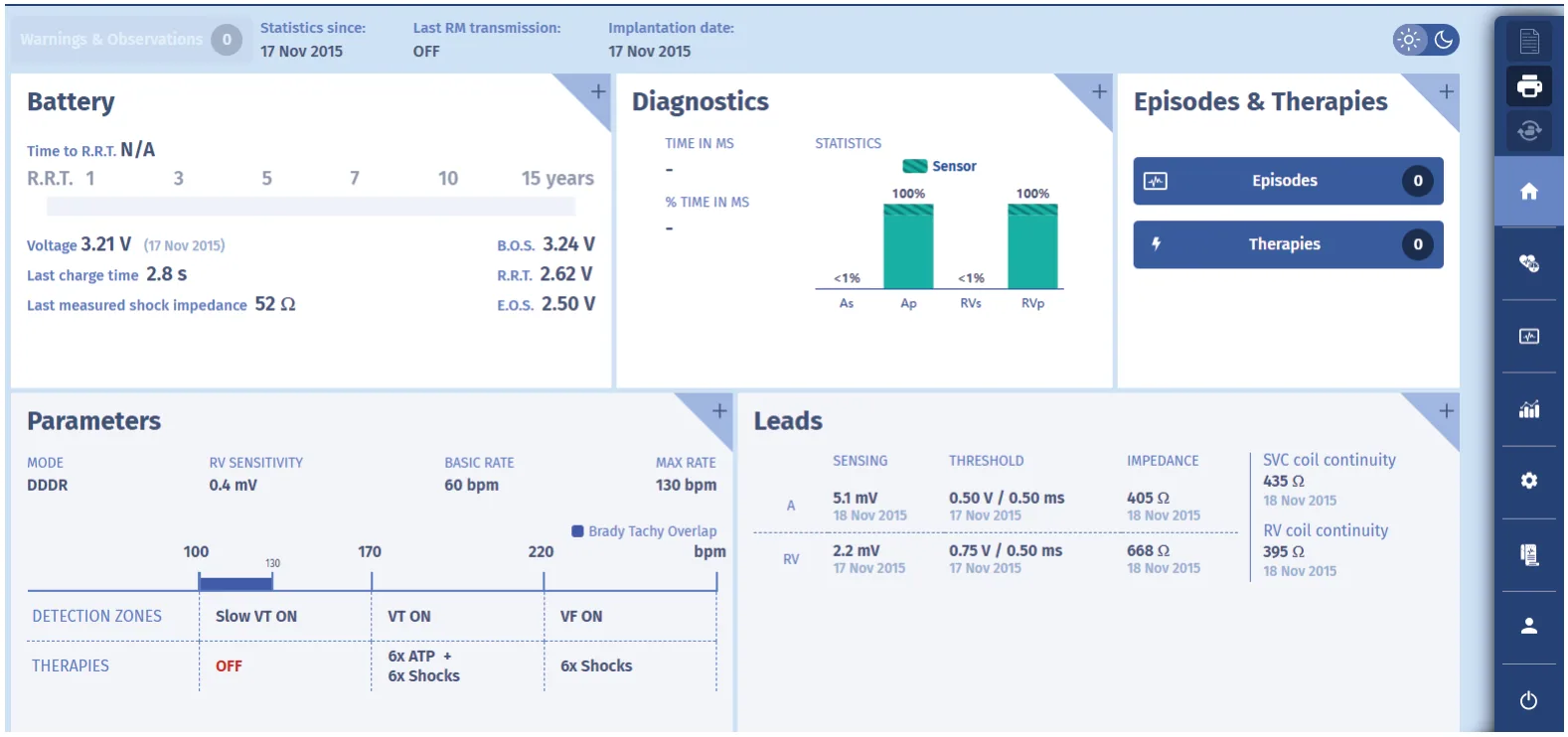
- The patient was implanted for primary prevention of obstructive hypertrophic cardiomyopathy (resting gradient: 80 mmHg). He is asymptomatic, but note the sudden death of two of his brothers, one of whom also had OHCM, with ventricular tachycardia bursts, a genetic mutation, and significant septal fibrosis at MRI. The defibrillator is dual-chamber given that the patient is bradycardic under beta-blocker therapy, and in the hope that the DDD pacing from the RV with complete RV capture while maintaining atrial systole will decrease the obstruction in the long term.
- A follow-up control was conducted on day 1, and deemed satisfactory.
Your turn
Are you satisfied with the follow-up control ?
- No, the shock impedance is too low
- Yes, completely
- No, ventricular sensing is 2.2 mV
- No, a shock is recorded, which is why a shock impedance value is provided
- No, I am not satisfied with the impedance values of the shock electrodes
However, two weeks later, a telemedicine alert was transmitted.
This is when the patient comes into clinic after the alert
Your turn
What is your opinion (1) ?
- A nonsustained ventricular fibrillation episode occurred
- The atrial lead is fractured
- The ventricular pacing/sensing lead is fractured
- The shock electrode conductor is fractured
- Need to reoperate urgently
Additional information from the alert screen
Lead sensing and impedance trends
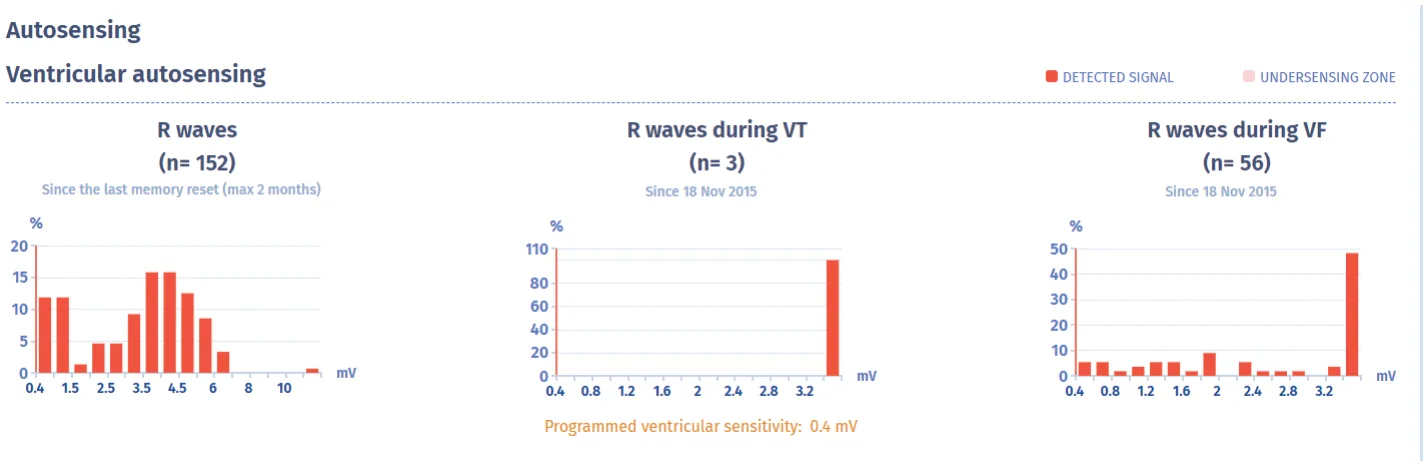
Ventricular signal amplitudes
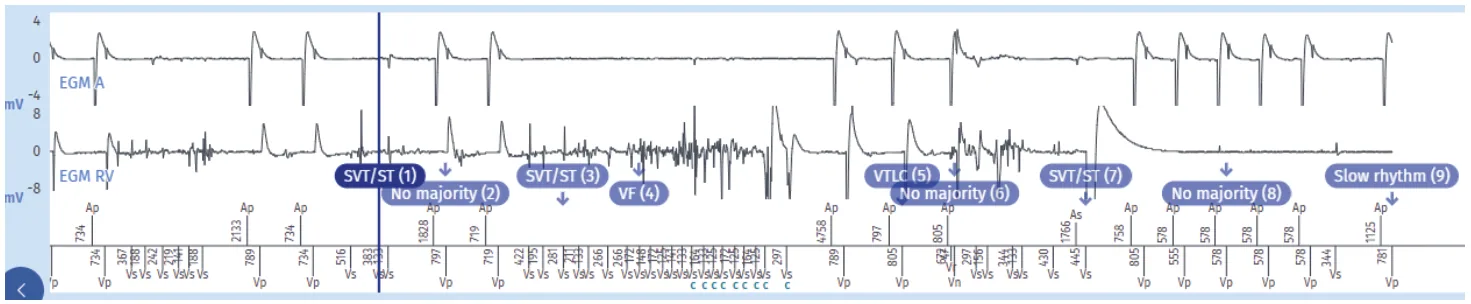
EGM saved into the memory of the device as «VF»
Your turn
What is your opinion (2) ?
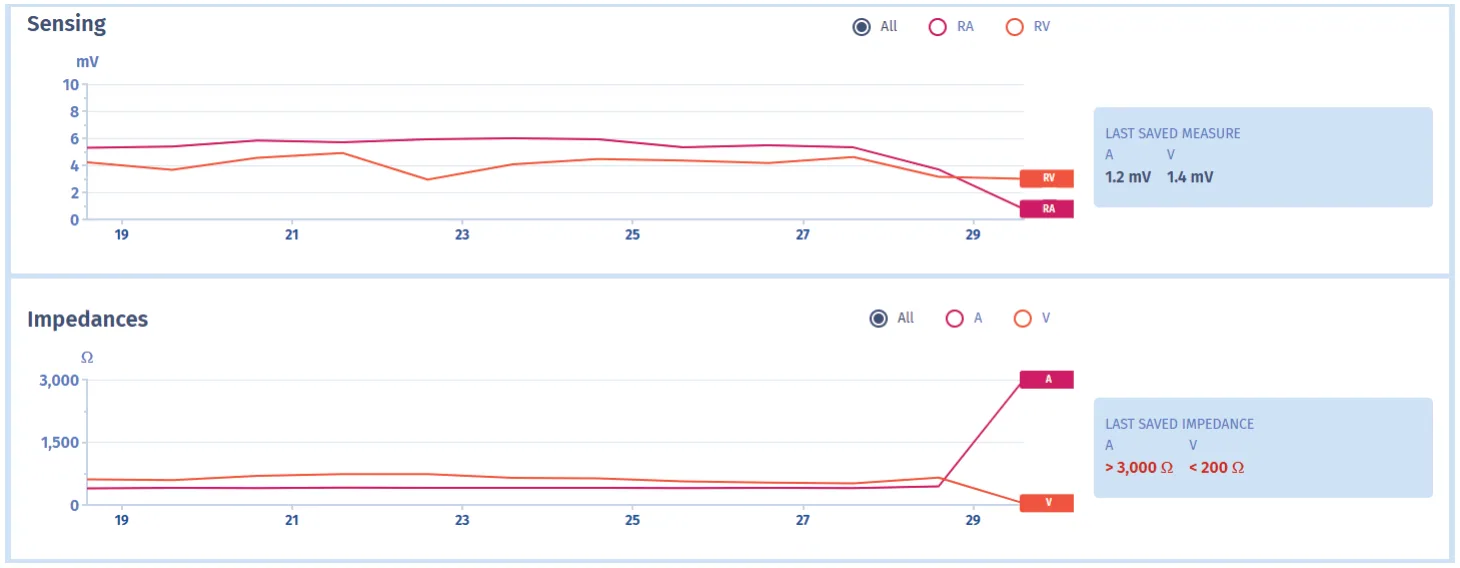
- The drop in ventricular impedance is consistent with the increase in atrial impedance and the drop in P wave amplitude
- Both leads are damaged
- The device does not sense R-waves since only 152 R waves have been detected
- The VF episode corresponds to RV lead fracture signals
- If the artifacts persist, the risk is an inappropriate shock
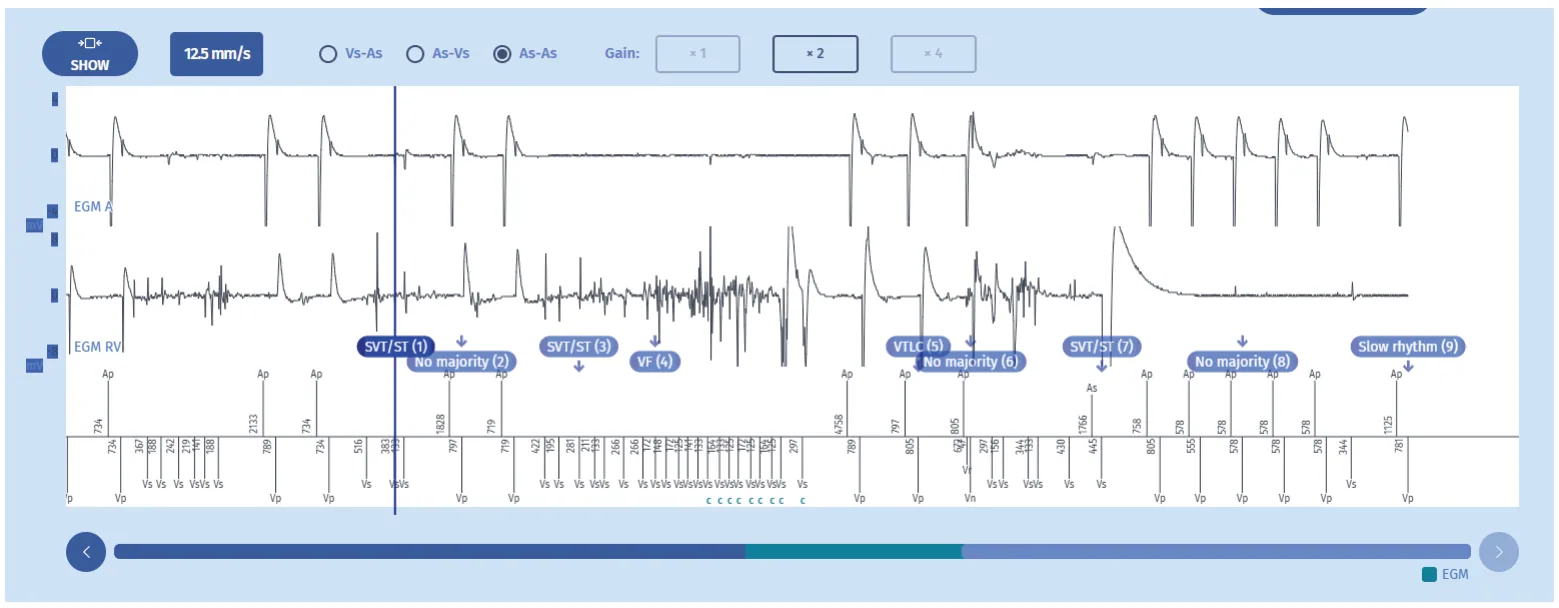
Episode recorded during the emergency follow-up, after manipulation of the defibrillator case through the skin
Interpretation
- At the first follow-up control, 24 hours after defibrillator placement, ventricular sensing is low at 2.2 mV. This parameter must be re-assessed after a few days, although if the detection value remains very low or decreases again, it will be necessary to discuss the repositioning of the ventricular lead. A minimum value of 5 mV is allowed for the amplitude of the R wave at the time of lead placement.
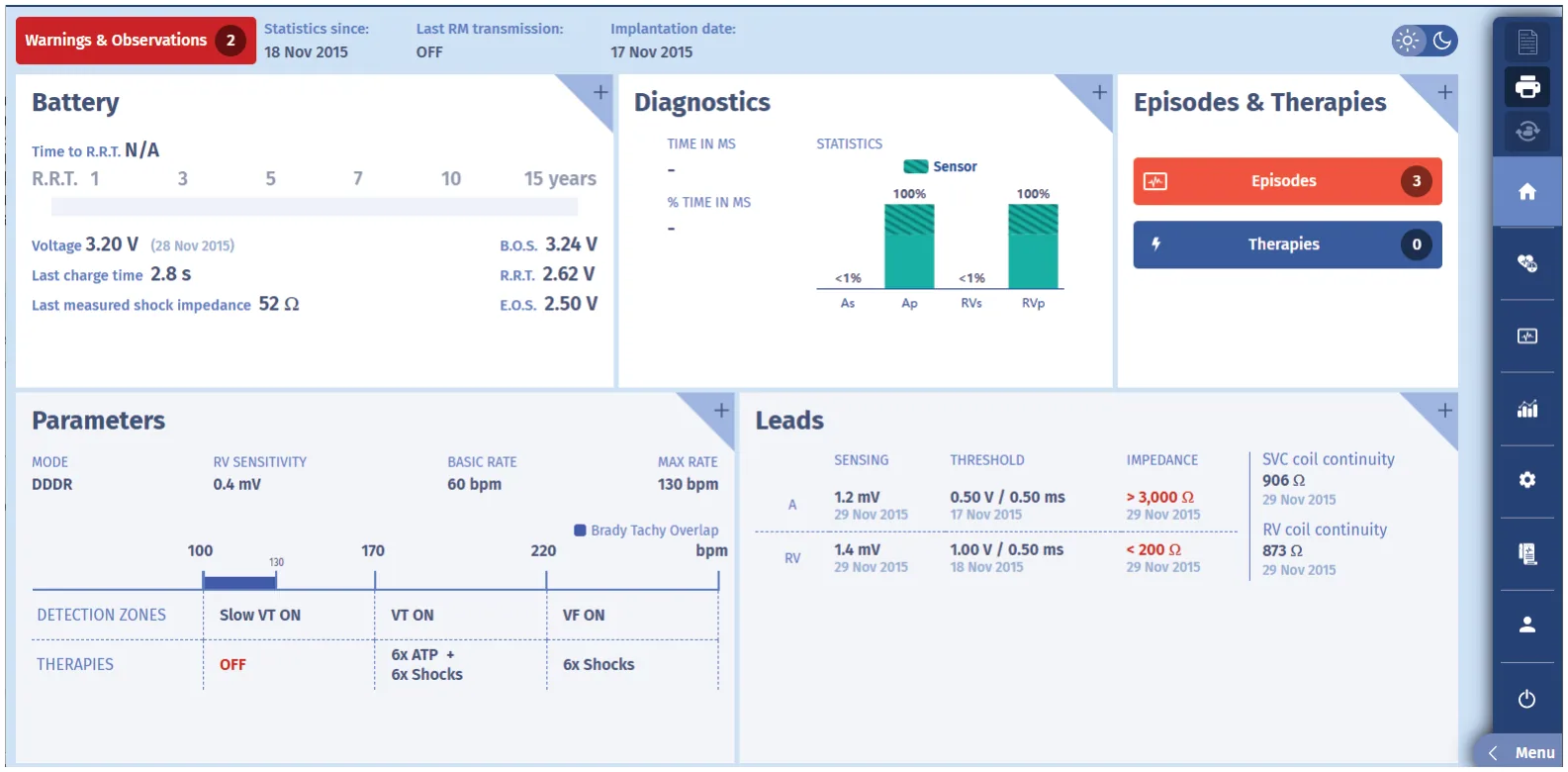
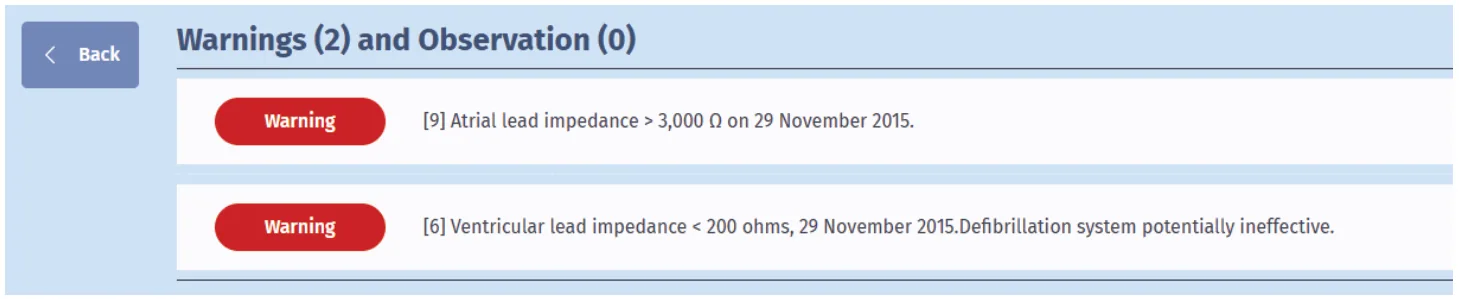
- The teletransmission initiated an alert due to abnormalities in measured lead impedances. The atrial impedance exceeded the upper limit of 3000 Ohm, signalling a fractured conductor, and the ventricular lead exceeded the lower limit of 200 Ohm, signalling an internal insulation fracture.
- These anomalies occurred at the same time on both leads and suggest a mechanical aggression on the two leads, probably related to a traumatic lead fixation given their occurrence soon after the installation of the device.
- The problem cannot be a connection fault at the level of the defibrillator case, since in this instance, the impedances of the two leads would be beyond the maximum values.
- Only 152 R-waves were sensed since the defibrillator is constantly pacing. R-waves in VF and VT are fracture artifacts and can have a very large amplitude.
- These artifacts occurring in runs lead to false VF diagnoses, which induces capacitor charges.
- It is necessary to reoperate urgently and change the two leads. In the meantime, the therapies are inactivated.
- The handling of the material through the skin « finished off » the leads. The last electrogram no longer reveals any physiological signal, and the artifacts saturate the atrial channel.
Correct answers: Follow-up : 3 Opinion n°1 : 2 and 5 Opinion n°2 : 1, 2, 4 and 5
Comments
- The observed lead fracture potentials call for a rapid reintervention since the time lapse between the first electrical signs of fracture (such as an out-of-norm impedance and/or aberrant, non-physiological and very fast ventricular signals such as those of our example), and complete fracture and/or triggering of shocks can be very short.
- For the defibrillator, other than the placing of a magnet next to the defibrillator case, the risk is an inappropriate, repetitive and uncontrollable shock, which must lead to an urgent consultation; for the pacemaker, the risk is the inhibition of cardiac pacing and the resulting asystole in a device-dependent patient.
- In both cases, the situation is very dangerous.
- Should the reoperation involve the extraction of the lead? The answer is difficult. Lead extraction is only recommended in instances of infection of the material. In the absence of infection, extraction adds its own risks (vein tearing, cardiac perforation with tamponade, tricuspid valve tear with concurrent major cardiac insufficiency, etc.) that can lead to immediate and precarious restorative cardiac surgery. On the other hand, however, the now-surplus material no longer hinders the venous circuit or the cardiac chambers. Therefore? ... If the lead has recently been placed (less than two years), it can be extracted and indeed be removed by simple unscrewing and careful traction. Beyond this timeframe, our tendency is not to extract the lead, and to add the new lead, making sure that the two shock electrodes do not touch each other so as to avoid that in the event of shock therapy, some of the energy will be diverted to the abandoned lead.
Message
A defibrillation lead fracture necessitates an urgent response: a reoperation for a change of material.
Practice out loud
Just describe the tracing. What do you think is going on? Describing the numbers can help.
00:00
0%
—
From Implantable Cardioverter Defibrillator — Clinical cases from patients with MicroPort™ ICDs by M. Strik, A. Thiyagarajah, S. Ploux, P. Bordachar, P. Ritter. Published by Cardiocases. Each case is a question on real device interrogations: pick your answer, check it, then read the authors’ interpretation. Tap any figure to open it full screen.