
Chapter 1 · Counters · Case 6
Classification of cycles and ventricular undersensing during an episode of VF
Patient and episode
Patient
- Male patient with a Gallant triple-chamber defibrillator implant; hospitalization for syncope with electric shock
Summary
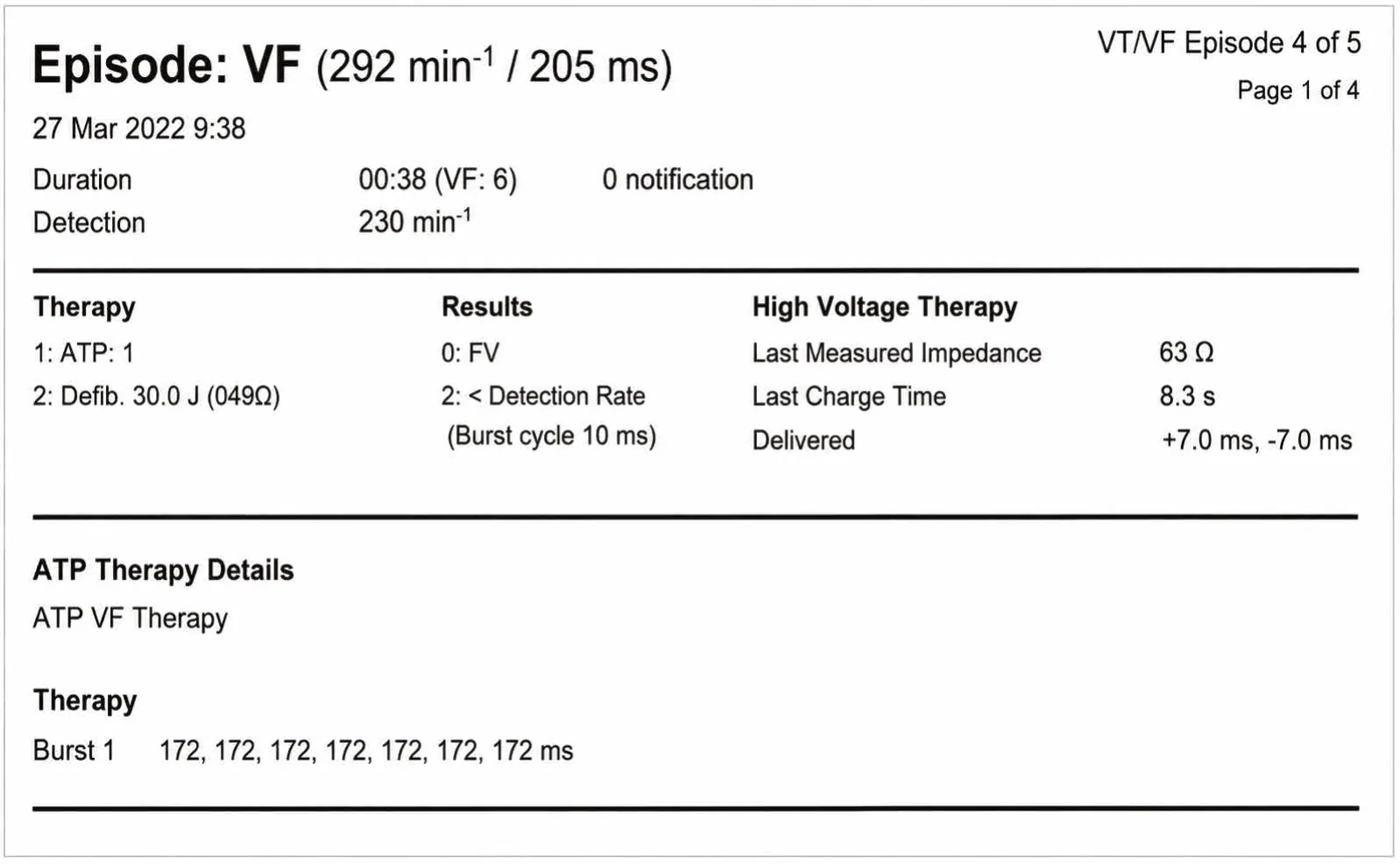
- episode recorded in March 2022 episode classified as VF treated with a sequence of ATP followed by electric shock
The recording
Tap a number on the trace, or an entry in the list below
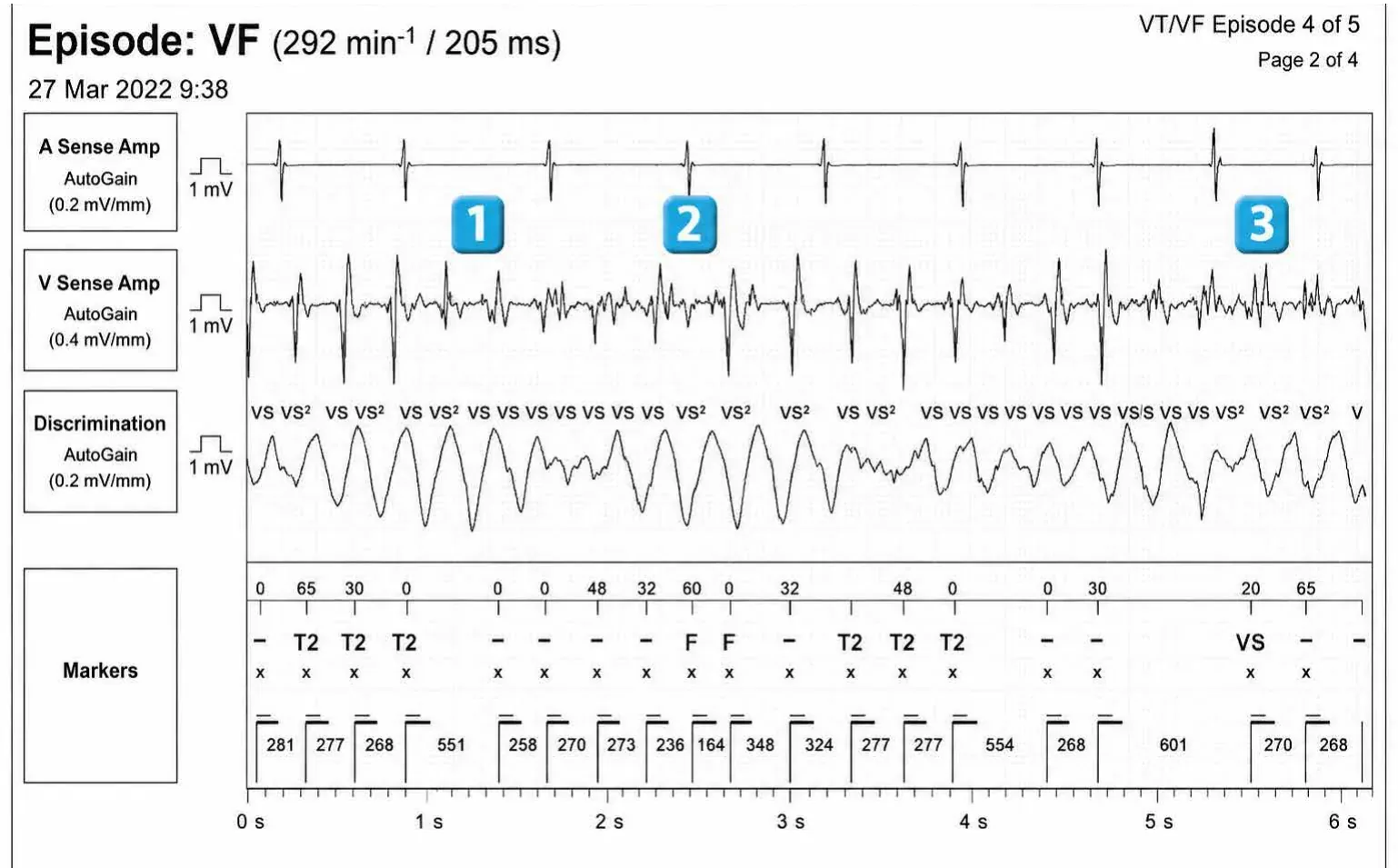
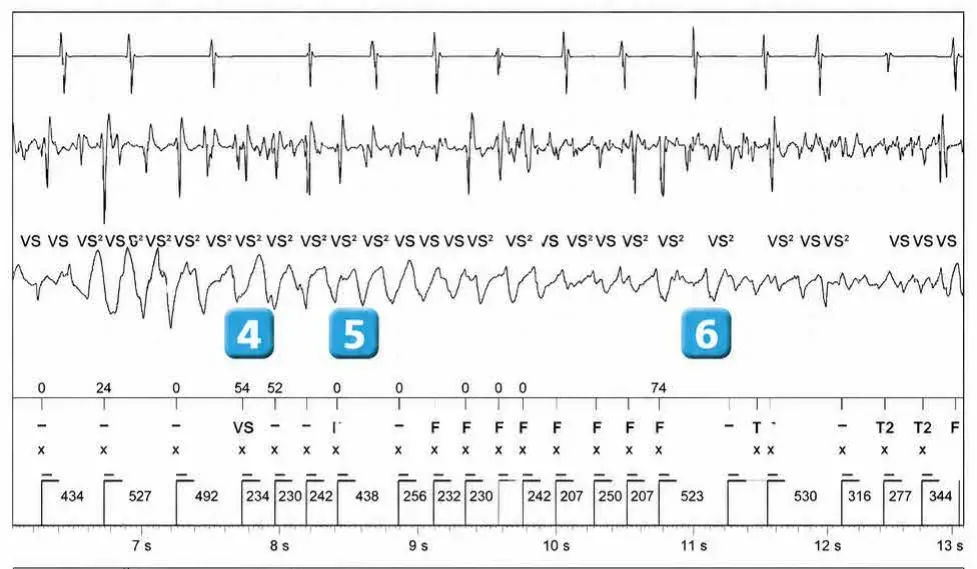
- episode of AF but cycles classified as T2 or in transition (-) due to very imperfect detection quality
- cycle classified as F
- new undersensing and cycle classified as VS
- undersensing and new VS marker (sinus return counter at 2)
- improvement in ventricular sensing quality and cycle classified as F; sinus return counter returns to 0
- new undersensing but no cycle classified as VS
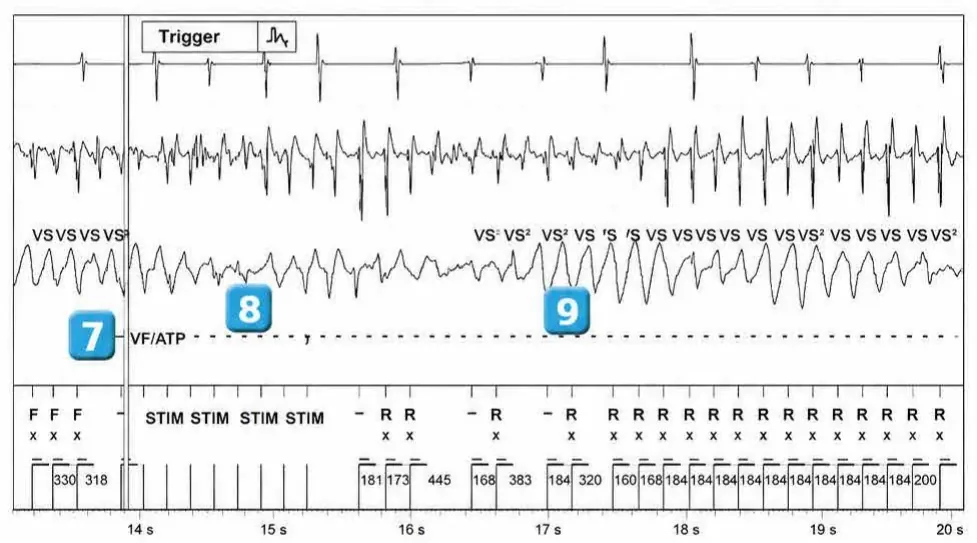
- VF counter completed
- ATP during pacing
- arrhythmia continues; during pacing, rapid cycles are labeled R underlined
- 36 joules electric shock
- effective shock and end-of-episode diagnosis after 3 BP cycle
From the interrogation
Points to remember
- This patient therefore experienced an episode of VF that was treated with electric shock despite very poor detection quality.
- The absolute priority for the functioning of an implantable defibrillator is to preserve
- 100% sensitivity and therefore correctly detect and treat all sustained episodes of VF that could lead to sudden death
- This trace illustrates the main benefit of cycle classification based on comparison between the current interval and the averaged interval; even though a significant number of cycles are classified as transition during this episode of VF with undersensing, the sinus return/end-of-episode counter is never completed (maximum of 2); this counter is systematically reset to 0 when a cycle is classified as VT (T1, T2, or F); in the presence of undersensing, there is a certain latency before a cycle is classified as VS (markers - initially); similarly, there is a certain latency before the sinus return counter is completed; The classification used in Abbott devices therefore provides protection against the risk of not treating a VF episode even when detection is imperfect.
- It is possible to program the number of cycles required to set the sinus return/end of episode counter, which is not the case with other manufacturers. The nominal value is 5 (other programmable values are 3 and 7); in this example, this counter had been reprogrammed to 3. When ventricular sensing is imperfect, it is advisable to program a sinus return counter to 7 in order to minimize the risk of not detecting a VF episode.
- Various parameters can be programmed to optimize detection quality.
- after detection of a ventricular complex, ventricular blanking (refractory period) begins with two programmable values: 125 ms (nominal value) and 157 ms; the latter value can be programmed in the presence of double counting of the R wave
- Following blanking, sensitivity gradually increases during the cycle (decreases in value) in order to search for a possible low-amplitude signal up to a maximum sensitivity limited to an adjustable value
- three parameters are also programmable: adaptation level, adaptation delay, and maximum sensitivity; nominal values depend on the model and the presence of a specific filter
- At the end of blanking, the ventricular sensitivity adaptation level starts at a percentage (programmable to 50, 62.5, 75, or 100%) of the detected R-wave amplitude (without exceeding 6 mV), remains the same during the adaptation delay (programmable to 0, 30, 60, 95, 125, 190, or 220 ms), and then the sensitivity gradually increases until it reaches the programmed sensitivity value; even if the defibrillator detects an R wave of 20 mV, the maximum is 6 mV, so an 50% adaptation would give 3 mV, a value of 62.5% would give 3.75 mV, a value of 75% would give 4.5 mV, and a value of 100% would give 6 mV; the maximum
- Refractory periods, adaptation levels, and adaptation delay can be set differently for post- stimulation and post-detection.
- One of the specific features of Abbott devices is that maximum sensitivity can be programmed differently in bradycardia and tachycardia; this can prevent stimulation inhibition on myopotentials in a dependent patient without the risk of undersensing a VF episode; if, for example, sensitivity in tachycardia is programmed to 0.5 mV and tachycardia sensitivity to 2 mV, signals between 0.5 and 2 mV in post-stimulation will not inhibit stimulation (pacemaker function) but will be integrated (defibrillator function) into the arrhythmia count
Practice out loud
Just describe the tracing. What do you think is going on? Describing the numbers can help.
00:00
0%
—
From Implantable Cardioverter Defibrillator — clinical cases based on tracings by P. Bordachar, M. Strik, A. Thiyagarajah, S. Ploux. Published by Cardiocases. Every numbered marker on a recording is explained in the list beneath it; tap a marker on the trace or an entry in the list.