
Chapter 3 · Discrimination · Case 4
Simple chamber discrimination and discriminant association
Patient and episode
Patient
- Woman implanted with a single-chamber Ellipse VR defibrillator as part of primary prevention for ischemic cardiomyopathye
Summary
- VT diagnostic criteria: if 2 out of 3 diagnosed episode of SVT 1 programmed discrimination parameter favors VT: morphology (number of similar cycles: 2 out of 10); 2 programmed discrimination parameters favor SVT: stability delta (55 ms) and sudden onset (max delta at 16%)
The recording
Tap a number on the trace, or an entry in the list below
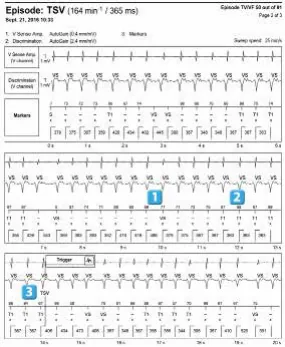
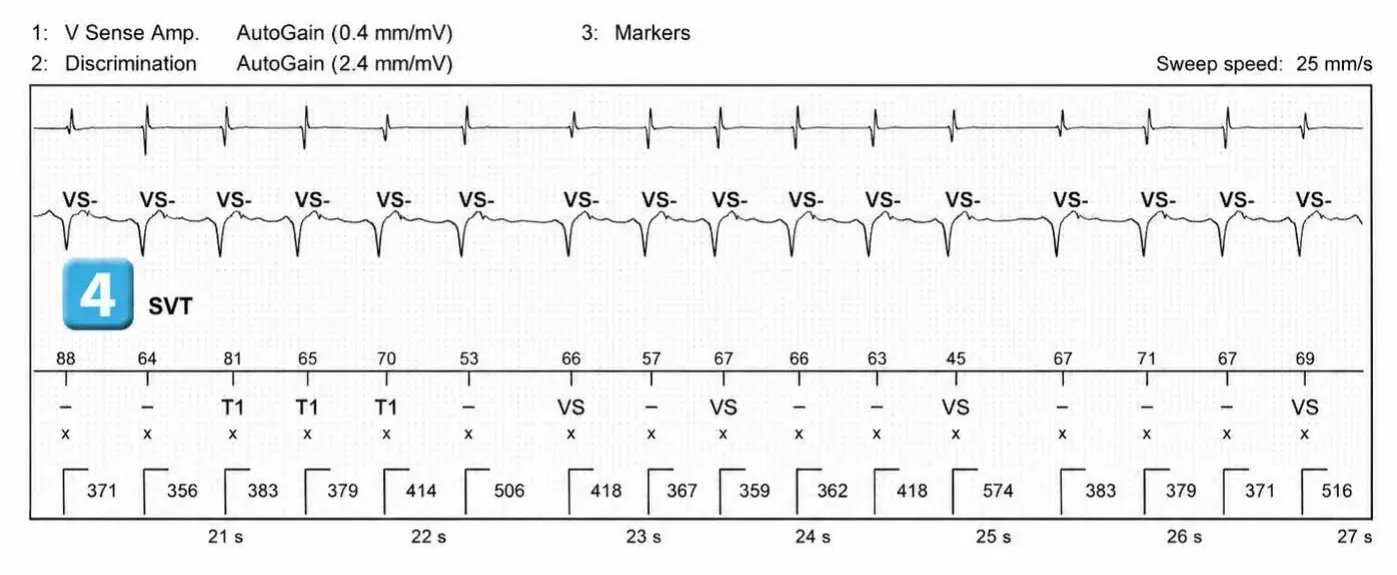
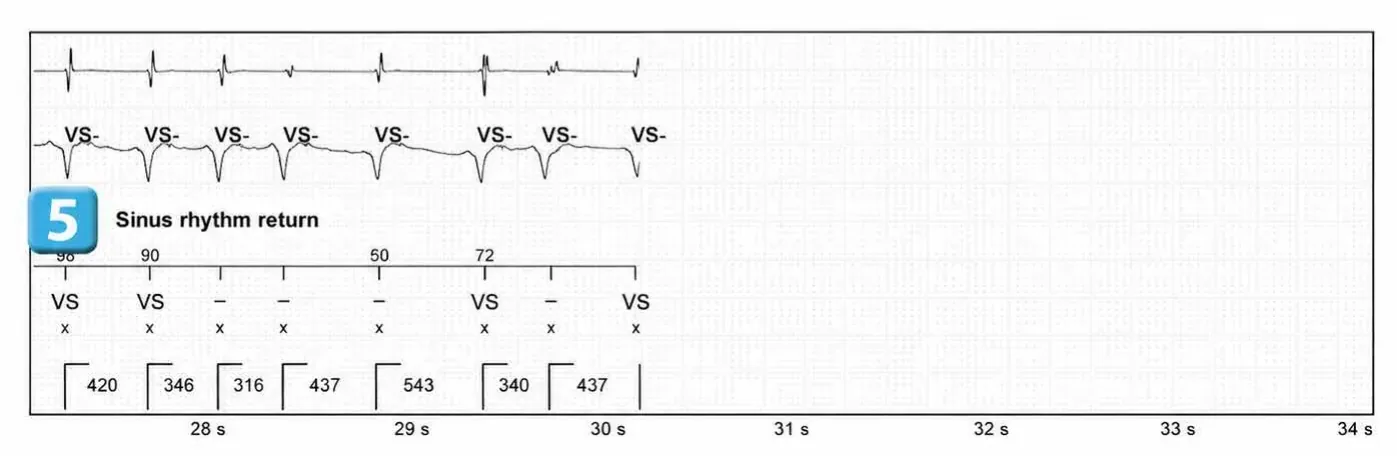
- Highly irregular ventricular rhythm with a highly variable percentage of similarity from one cycle to the next in relation to the reference morphology (from 0 to 98%)
- the sinus return counter is not complete and the T1 counter is gradually implemented
- The VT1 counter is completed; diagnosis of SVT
- Confirmation of the diagnosis of SVT when the redetection counter is at 6
- diagnosis of sinus return
Points to remember
- This trace corresponds to an episode of well-discriminated AF due to 2/3 programming and despite an error in the morphology-based criterion; this shows that there is no optimal programming for all patients; here, 2/3 programming allows for a correct diagnosis, whereas discrimination based solely on morphology would have led to inappropriate therapies.
- On older Saint Jude Medical defibrillator platforms, only the bipolar detection channel was used for morphology analysis; on more recent platforms, the bipolar channel (for temporal reference) and the far-field channel (morphological discrimination) are used. Bipolar detection EGM allows alignment (location of QRS peaks), with comparison then being made on the far-field channel (decomposition of the QRS complex into 8 points). The use of the far-field channel allows for a broader and more accurate signal analysis than an analysis based solely on the bipolar detection channel.
- for each cycle in tachycardia, a percentage of similarity is determined and compared to a programmable threshold; if the percentage is equal to or exceeds the threshold, the ventriculogram is considered correlated (in favor of a SVT), otherwise it is considered uncorrelated (in favor of a VT)
- With nominal programming, if at least 3 out of 10 ventricular cycles are correlated (rolling window of 10 cycles), the tachycardia is considered supraventricular and therapies are inhibited; if fewer than 3 out of 10 ventricular cycles are correlated, the tachycardia is considered ventricular and therapies are delivered.
- Abbott is the only manufacturer where the number of correlated cycles (3 in nominal, programmable between 3 and 20) and the number of cycles defining the analysis window (10 in nominal, programmable between 6 and 20) are programmable; the threshold percentage defining the correlation is also programmable
- in the event of malfunction, as in this example, it is possible to change the far-field channel (distal RV-lead instead of RV-lead coil, which corresponds to the nominal programming); the choice of this vector will also be the one used by the SecureSense algorithm; it is also possible to revert to the operation of older devices by using the bipolar detection channel for discrimination
- The reference ventriculogram can be acquired in real time during interrogation with a programmer and then automatically updated by the device; the first model must therefore be acquired manually; the initial model corresponds to the average of 8 cycles of the amplitude of 8 points; this model is continuously updated (nominal value every 3 hours); the model then becomes the moving average of the last 16 updates
- during follow-up interrogations, it is possible to verify that the percentage of concordance between the spontaneous conducted ventricles detected during the consultation and the reference ventriculogram is high (above the programmed threshold and as close to 100% as possible)
Practice out loud
Just describe the tracing. What do you think is going on? Describing the numbers can help.
00:00
0%
—
From Implantable Cardioverter Defibrillator — clinical cases based on tracings by P. Bordachar, M. Strik, A. Thiyagarajah, S. Ploux. Published by Cardiocases. Every numbered marker on a recording is explained in the list beneath it; tap a marker on the trace or an entry in the list.