
Chapter 3 · Discrimination · Case 3
Atrial tachycardia and single-chamber discrimination
Patient and episode
Patient
- Simulator-generated atrial tachycardia trace on a single-chamber Gallant defibrillator
Summary
- VT diagnostic criteria: morphology on exercise, stability, and sudden onset on passive testing One programmed discrimination parameter favors SVT: morphology (number of similar cycles: 8 out of 10); two discrimination parameters favor VT: stability delta (5 ms) with His counter at 0 and sudden onset (max delta at 60%)
The recording
Tap a number on the trace, or an entry in the list below
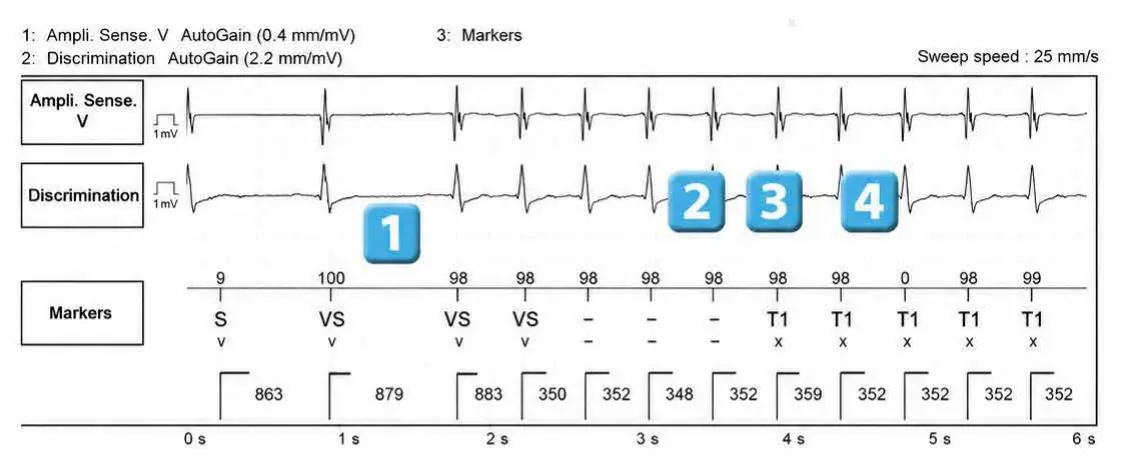
- sinus rhythm (VS) with high percentage of similarity to the reference morphology
- Onset of regular tachycardia with complexes of identical morphology; first cycle classified as T1
- from this complex, there are 12 cycles until diagnosis; stability analysis is performed on these 12 cycles
- from this complex, there are 10 cycles until diagnosis; morphology analysis is performed on these 10 cycles
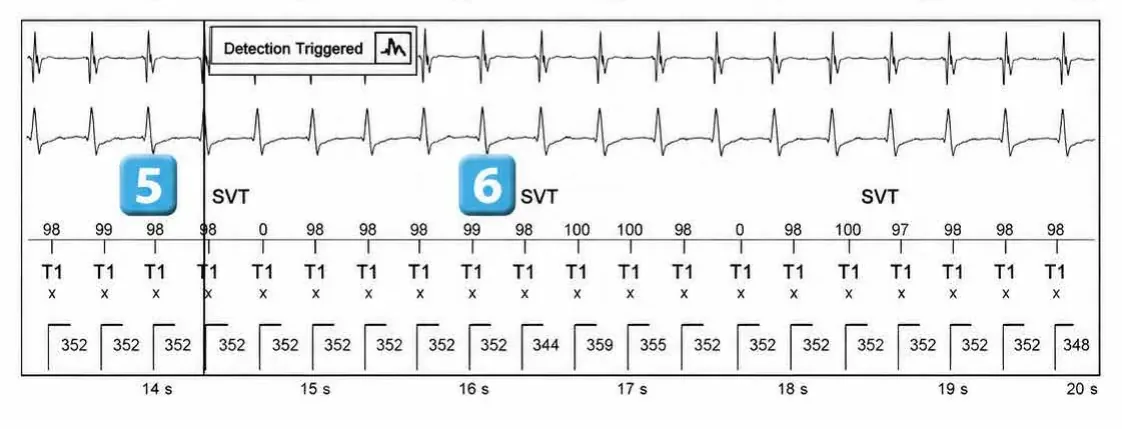
- SVT diagnosis made by the device once the VT counter is full (30 cycles classified as T1); 8 out of 10 ventriculograms analyzed for morphology criteria are deemed similar
- Confirmation of the SVT diagnosis every 6 cycles
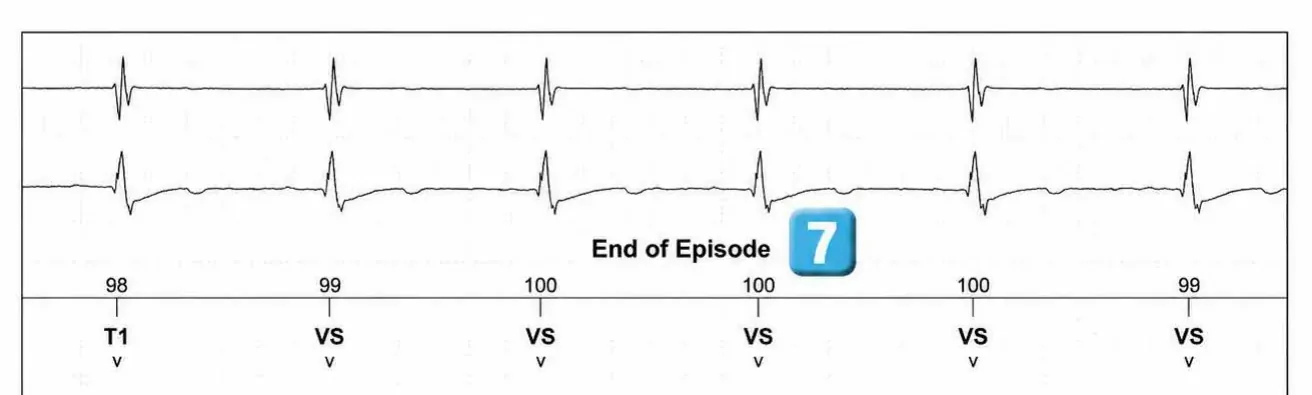
- reduction of the episode and diagnosis of end of episode
Points to remember
- International recommendations advise the systematic programming of a discrimination algorithm up to a frequency limit of 230 beats per minute (in the absence of AV block). For AbbottTM single-chamber devices, discrimination based solely on morphology analysis is proposed with a 90% concordance threshold, a minimum of 3 similar cycles out of 10; it is recommended to program the other 2 discriminants to Passive.
- this trace illustrates the difficulties of discriminating between atrial tachycardia and flutter Typically, in cases of atrial tachycardia or flutter, two out of three criteria indicate VT. In fact,
- there is most often a sudden onset (VT), a stable rhythm (VT), and a similar morphology (ATV). Therefore, 2/3 programming does not allow for effective discrimination, unlike programming based solely on morphology.
- The problem is the same for episodes of rapid AF (possible sudden onset and ventricular rhythm that may stabilize over a number of cycles) with a risk of inappropriate therapies with 2/3 programming.
- The stability criterion allows differentiation between atrial fibrillation (irregular) and ventricular tachycardia (regular); however, this parameter does not allow effective discrimination between ventricular tachycardia and sinus tachycardia or atrial tachycardia/flutter, where the ventricular rhythm is most often regular.
- the stability delta is defined as the maximum difference between the second longest cycle and the second shortest cycle among 12 consecutive cycles; this value is always expressed as an absolute value (nominal value 40 ms); frequency stability is continuously reevaluated during the episode; if the stability difference is less than the delta programmed, then the rhythm is considered stable and the parameter favors VT; otherwise, the parameter favors conducted AF
- The stability criterion can be misleading in certain specific cases and can lead to an erroneous diagnosis in patients 1) with rapid AF with a frequency exceeding 170 beats/minute, where the rhythm is generally stable, 2) in certain patients where the initiation of VT is accompanied by irregular ventricles with subsequent regularization.
- The stability of tachycardia cannot always effectively distinguish between VT and AF in isolation; it may be useful to add the criterion of sinus interval history; sinus interval history (SIH) works in conjunction with rate stability (set to: On + SIH), and only in single-chamber models; This function may be useful for discriminating between regularized AF with long cycles; this criterion only applies if the ventricular rate is considered stable.
- The long cycle counter is incremented when - The cycle is unclassified (either the current RR interval value is in the sinus zone but the average interval value calculated over 4 RR cycles including the current cycle is not, or the average interval value is in the sinus zone but the current interval is not) - the cycle is classified in the sinus zone (the value of the current interval and the value of the average interval are in the sinus zone)
- if the number of long cycles since the first cycle classified as VT is equal to or greater than the programmed value (nominal value 2), then AF is considered to be regularized with long cycles and the parameter favors SVT; otherwise, the parameter favors VT
Practice out loud
Just describe the tracing. What do you think is going on? Describing the numbers can help.
00:00
0%
—
From Implantable Cardioverter Defibrillator — clinical cases based on tracings by P. Bordachar, M. Strik, A. Thiyagarajah, S. Ploux. Published by Cardiocases. Every numbered marker on a recording is explained in the list beneath it; tap a marker on the trace or an entry in the list.