
Chapter 4 · Oversensing · Case 5
New device, T wave oversensing, and SecureSense™ algorithm
Patient and episode
Patient
- Man implanted with an Abbott Ellipse™ DR single-chamber defibrillator; episodes of unsustained V oversensing recorded in memory; SecureSense™ algorithm ON (RV coil to housing)
Summary
- Episode of non-sustained ventricular oversensing
The recording
Tap a number on the trace, or an entry in the list below
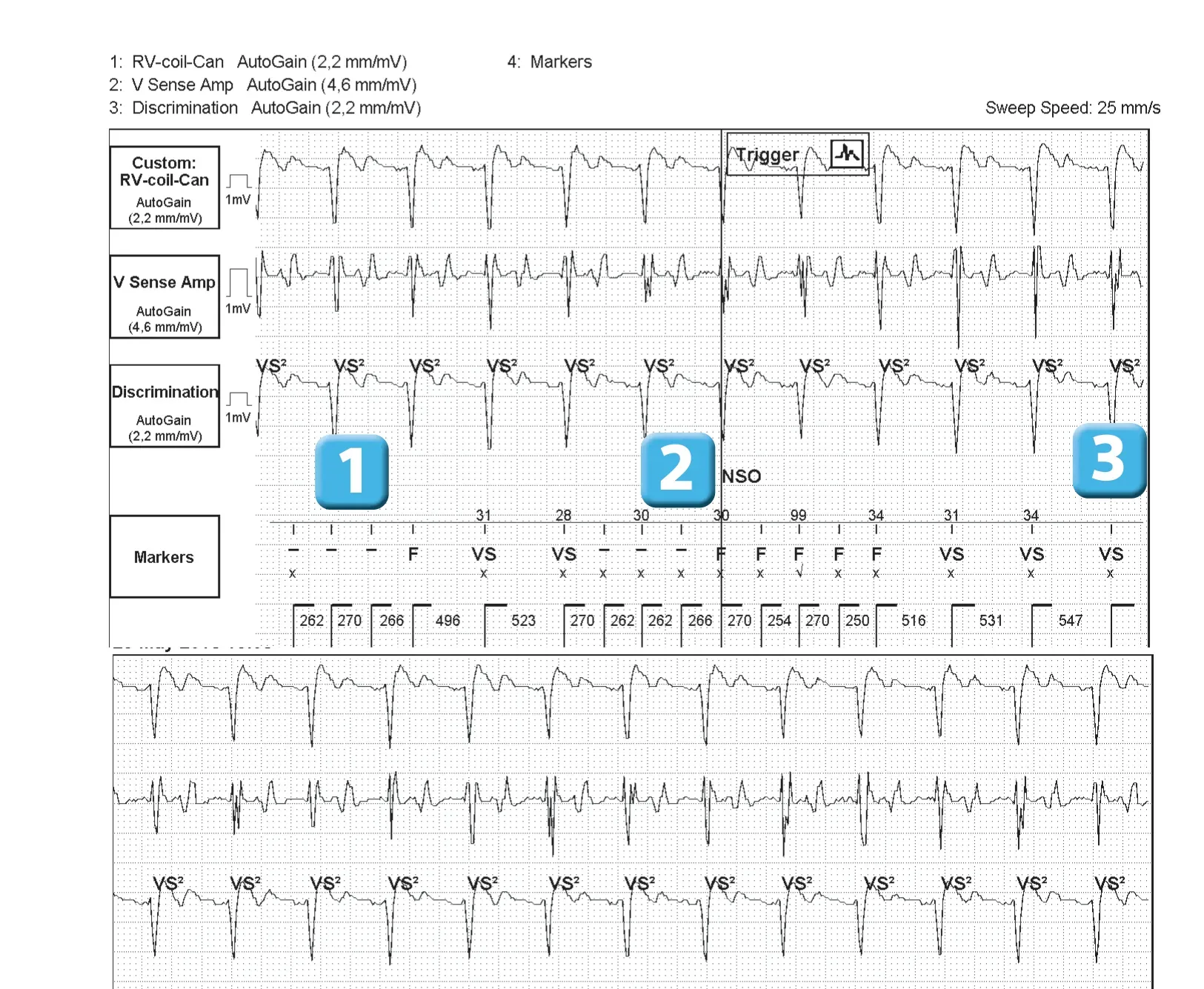
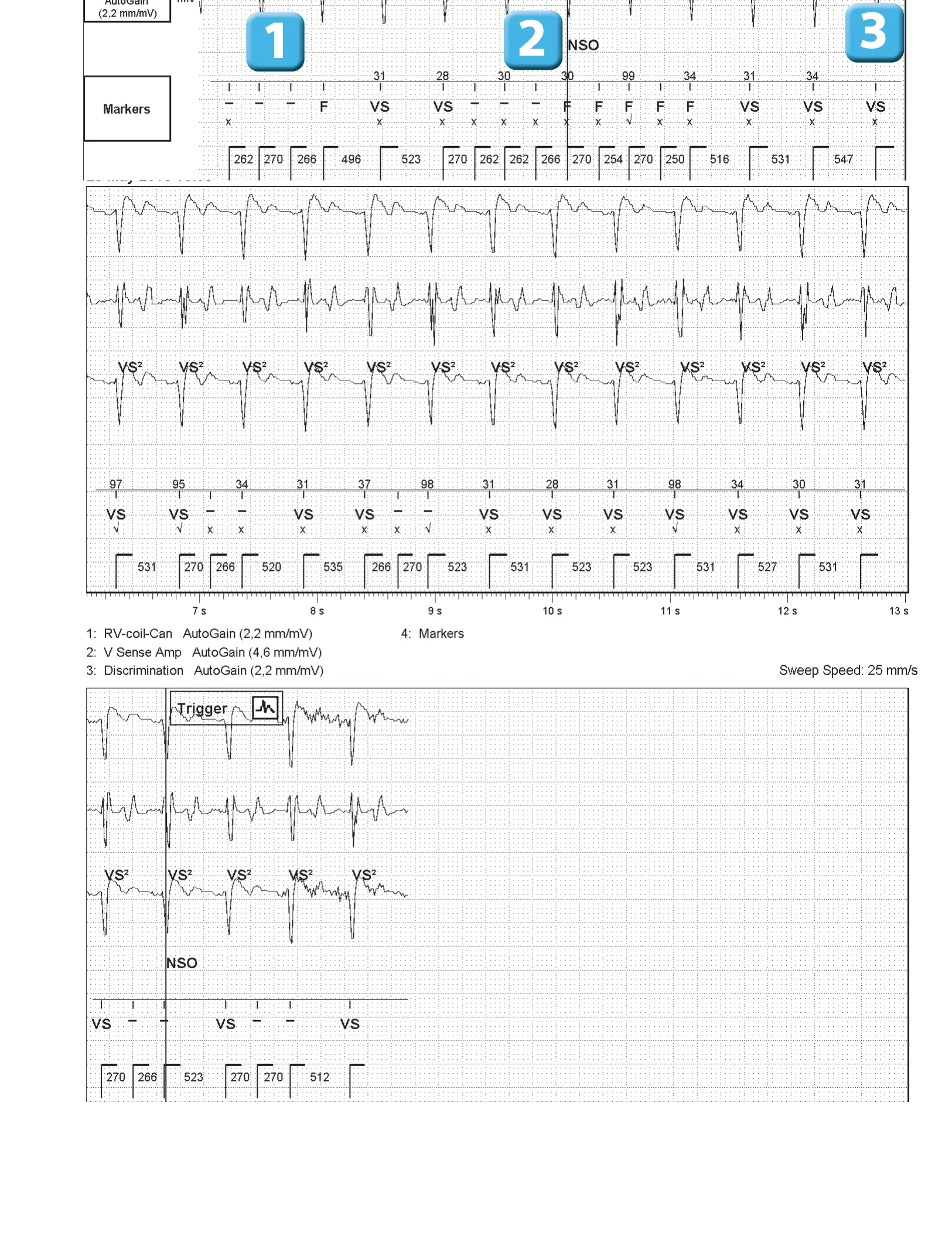
- The presence of VS2 markers on the discrimination channel at the beginning of the trace indicates that the noise counter is activated and has been incremented beforehand; T wave oversensing (post-ventricular sensing) exclusively on the bipolar channel (no VS2 marker on the discrimination channel corresponding to the T wave)
- The noise counter is at 10 (10 short cycles on the bipolar channel, some of which are not visible on this trace) while the VF or VT counter is not filled; diagnosis of non-sustained V oversensing (SNS)
- the oversensing is intermittent, which explains why the arrhythmia counters are not filled
From the interrogation
Points to remember
- The SecureSense™ algorithm, initially designed to prevent inappropriate therapies in the event of lead breakage, also represents a significant advance in the oversensing of the T wave.
- When this algorithm is programmed, T wave oversensing leading to inappropriate therapy must be present more or less simultaneously on the bipolar channel and the discrimination channel. It is relatively unlikely that the very specific conditions leading to T wave oversensing (small amplitude R wave, lowered R/T ratio, unfiltered T wave) will be present at the same time on these two channels.
- In this example, the noise counter increments with each short cycle on the bipolar channel without resetting to zero (no short cycles on the discrimination channel); even if the VF counter had been filled, therapies would have been inhibited, as the noise counter value exceeded 10.
- This trace also shows that this algorithm allows for rapid diagnosis even when oversensing is intermittent; without SecureSense™ programming, the oversensing observed on this trace would have gone unnoticed.
- in practice, first-line programming of this algorithm (as recommended by international guidelines) has significantly reduced the occurrence of inappropriate shocks due to T wave oversensing
Practice out loud
Just describe the tracing. What do you think is going on? Describing the numbers can help.
00:00
0%
—
From Implantable Cardioverter Defibrillator — clinical cases based on tracings by P. Bordachar, M. Strik, A. Thiyagarajah, S. Ploux. Published by Cardiocases. Every numbered marker on a recording is explained in the list beneath it; tap a marker on the trace or an entry in the list.