
Chapter 4 · Oversensing · Case 12
SecureSense™ algorithm and undersensing on the discrimination channel
Patient and episode
Patient
- 71-year-old male implanted with an Ellipse™ VR defibrillator for ischemic cardiomyopathy; episode of VT recorded in memory
Summary
- episode of unsupported ventricular oversensing
- episode of unsupported ventricular oversensing
The recording
Tap a number on the trace, or an entry in the list below
Episode 1
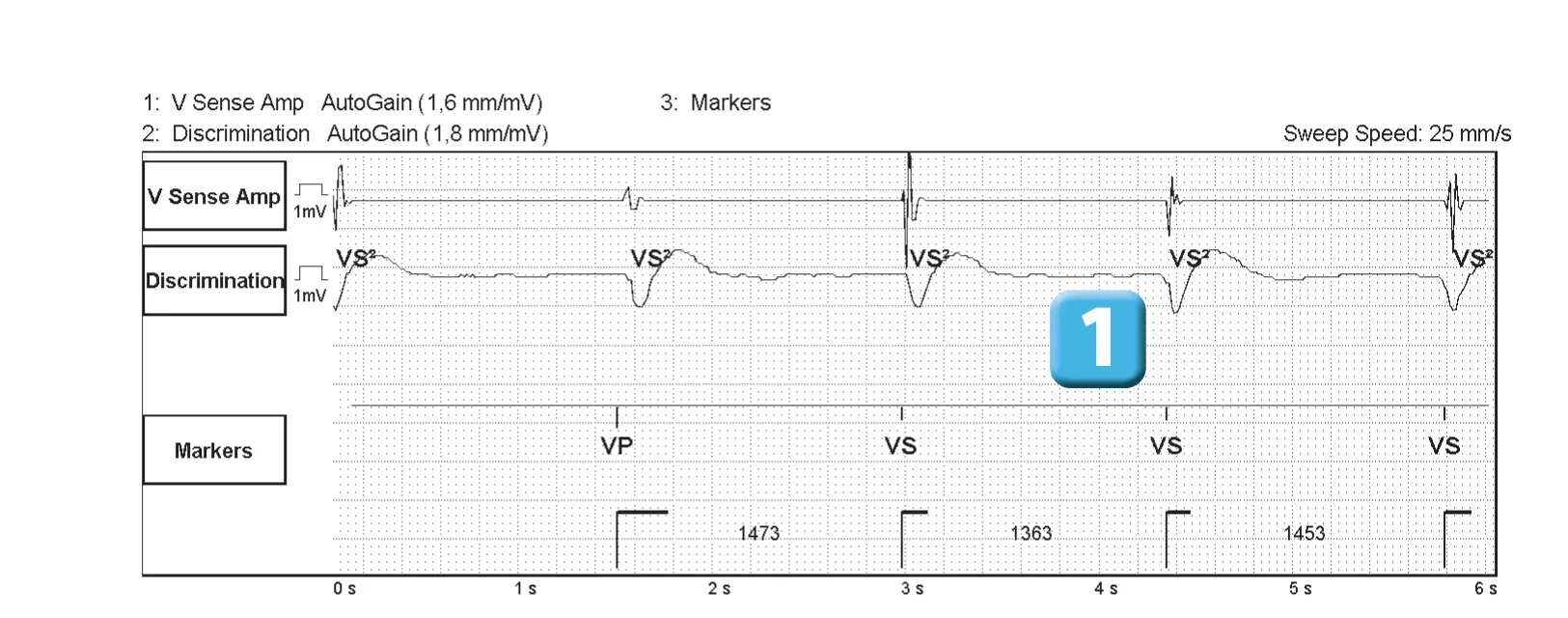
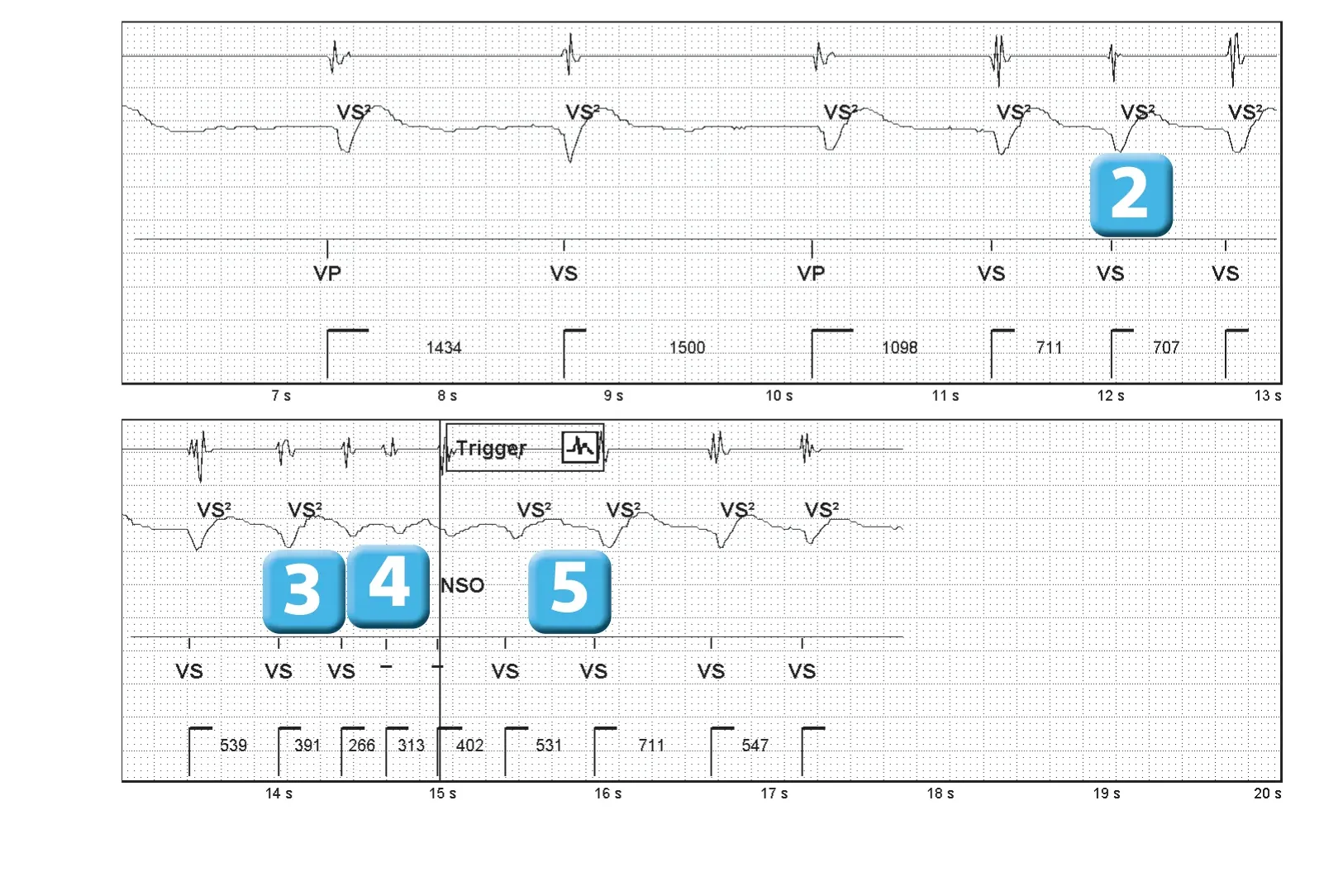
- alternation between ventricular pacing and ventricular sensing
- acceleration of ventricular rate
- acceleration of arrhythmia rate with change in morphology; cycles correctly detected on bipolar channel but not detected on discrimination channel; short cycles on bipolar channel and not on discrimination channel (noise counter increment)
- diagnosis of unsustained ventricular oversensing
- detection on the discrimination channel (the pause on this channel lasted less than 2 seconds)
Episode 2

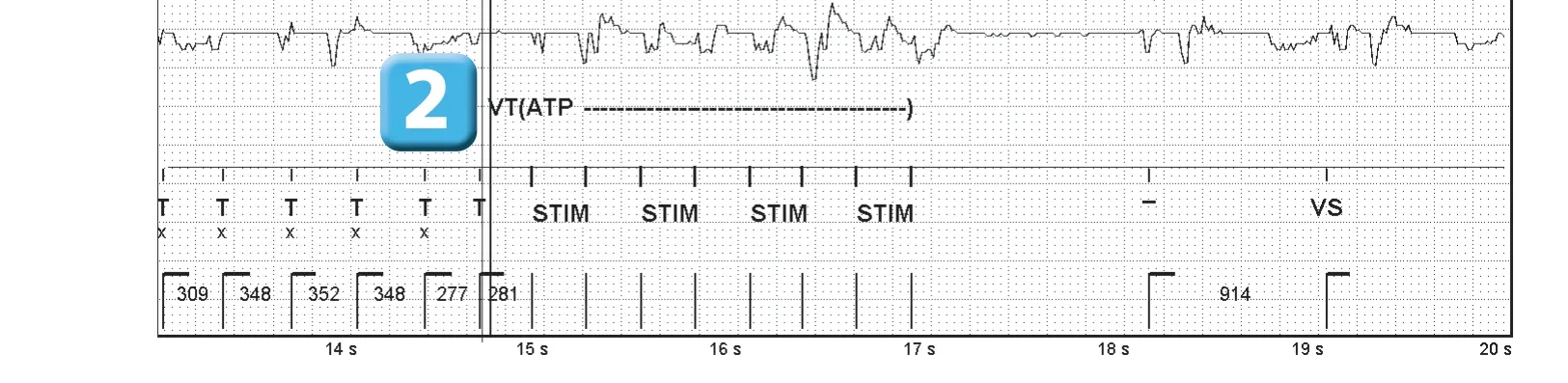
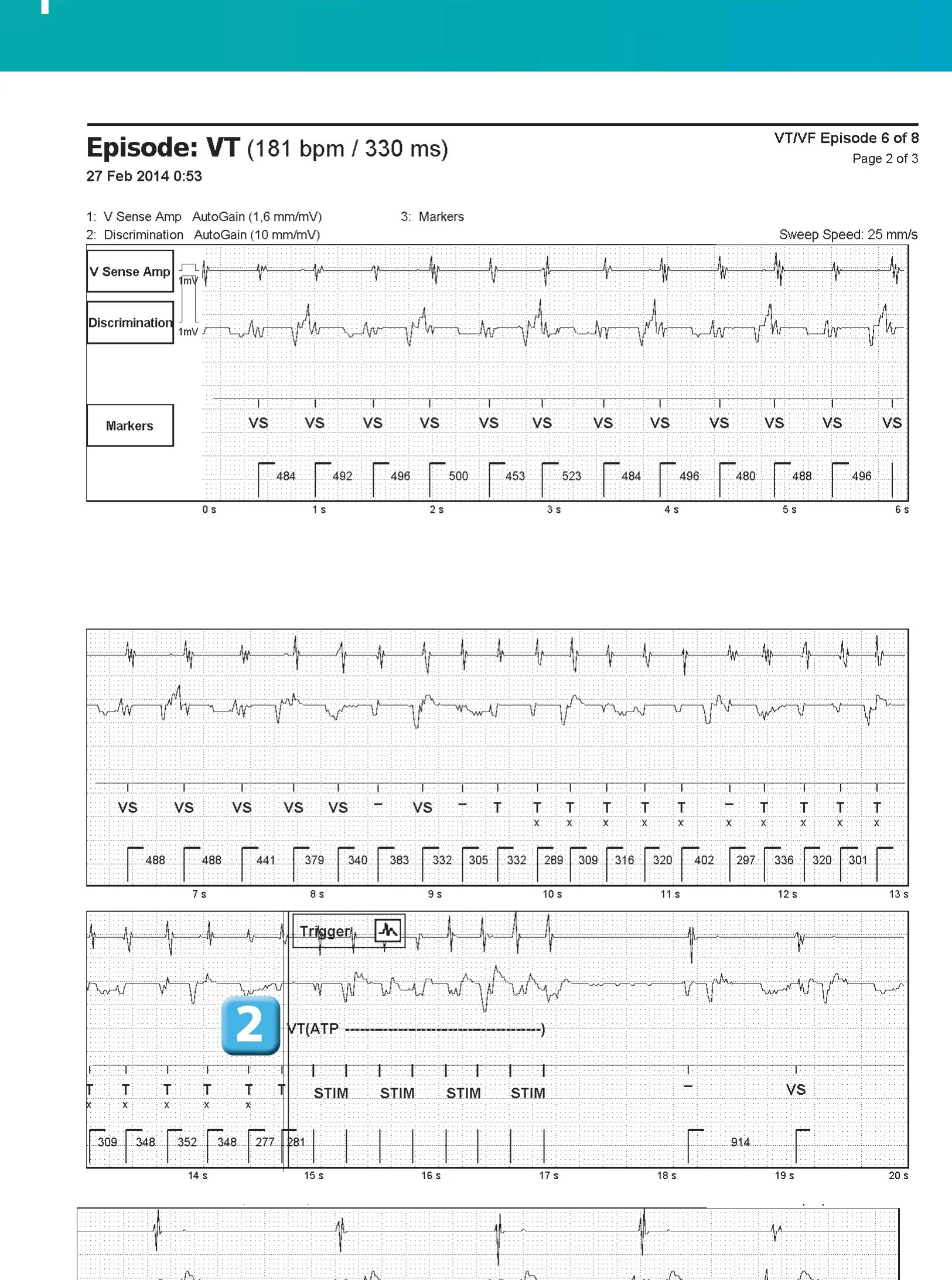
- The SecureSense™ algorithm was automatically switched to Passive due to undersensing diagnosis on the discrimination channel.
- When the tachycardia counter is full, the SecureSense™ algorithm does not intervene to potentially inhibit therapies.
From the interrogation
Points to remember
- Maintaining maximum sensitivity for ventricular arrhythmia detection is an absolute prerequisite for any algorithm that may inhibit therapies; the SecureSense™ algorithm incorporates protection against undersensing on the discrimination channel
- The algorithm is suspended if at least one of the following three events is observed during an episode: 1) the presence of at least two VS2 cycles with an amplitude of less than 0.6 mV; 2) a pause between two VS2 cycles of more than 2200 ms; 3) a single cycle detected on the discrimination channel during tachycardia; the SecureSense™ algorithm is then automatically reprogrammed to passive during the episode and
- An undersensing alert is signaled on the programmer during an episode of sustained ventricular arrhythmia, three scenarios are possible depending on the quality of detection on the discrimination channel: 1. If detection is correct, the presence of short cycles on the discrimination channel regularly resets the noise counter to 0 and therapies are not inhibited by the algorithm. 2. If the quality of detection is significantly impaired (second trace), at least one of the three criteria is met, the SecureSense™ algorithm is suspended and reprogrammed to passive mode, an alert is signaled on the programmer, and therapies are not inhibited by the algorithm. 3. In very rare cases, there is intermittent undersensing (first trace) with a risk of inappropriate inhibition of therapies. However, this risk is very limited, and in a study conducted at our center involving a large number of patients, we did not find any prolonged inhibition of therapies that compromised patient prognosis. In fact, the probability of undersensing an episode over a long period of time while not meeting at least one of the criteria described above is very low.
- When detection quality is imperfect on the discrimination channel, it is not possible to modify the detection parameters for this channel (blanking, adaptation percentage, adaptation delay, and ventricular sensitivity are not programmable).
- However, it is possible to reprogram the discrimination channel to Distal RV – Lead, which also changes the Far-Field Morphology vector used for discrimination. However, integrating the distal electrode into the detection vector on the discrimination channel may limit the ability of this algorithm to function effectively in preventing inappropriate therapies in the event of lead dysfunction, as the distal electrode is part of both detection vectors (bipolar and discrimination). The likelihood of a discrepancy between the two vectors is reduced if the distal electrode malfunctions; the other option in rare cases of undersensing is therefore to program the algorithm to passive mode so as not to expose the patient to the risk of inappropriate inhibition of therapies
Practice out loud
Just describe the tracing. What do you think is going on? Describing the numbers can help.
00:00
0%
—
From Implantable Cardioverter Defibrillator — clinical cases based on tracings by P. Bordachar, M. Strik, A. Thiyagarajah, S. Ploux. Published by Cardiocases. Every numbered marker on a recording is explained in the list beneath it; tap a marker on the trace or an entry in the list.