
Chapter 2 · Therapies · Case 3
Activation of the VFTA algorithm to promote the delivery of an electric shock during an episode of ventricular arrhythmia
Patient and episode
Patient
- Man implanted with a Gallant biventricular defibrillator for secondary prevention of VF; permanent AF; hospitalization for syncope with electric shock
Summary
- 3 programmed detection zones: VT1 (136 bpm, 440 ms), VT2 (171 bpm, 350 ms), VF (222 bpm, 270 ms) activation of the VF Therapy Assurance algorithm episode initially classified in VT2 zone ATP x 2, acceleration of rhythm and electric shock in the VF zone
The recording
Tap a number on the trace, or an entry in the list below
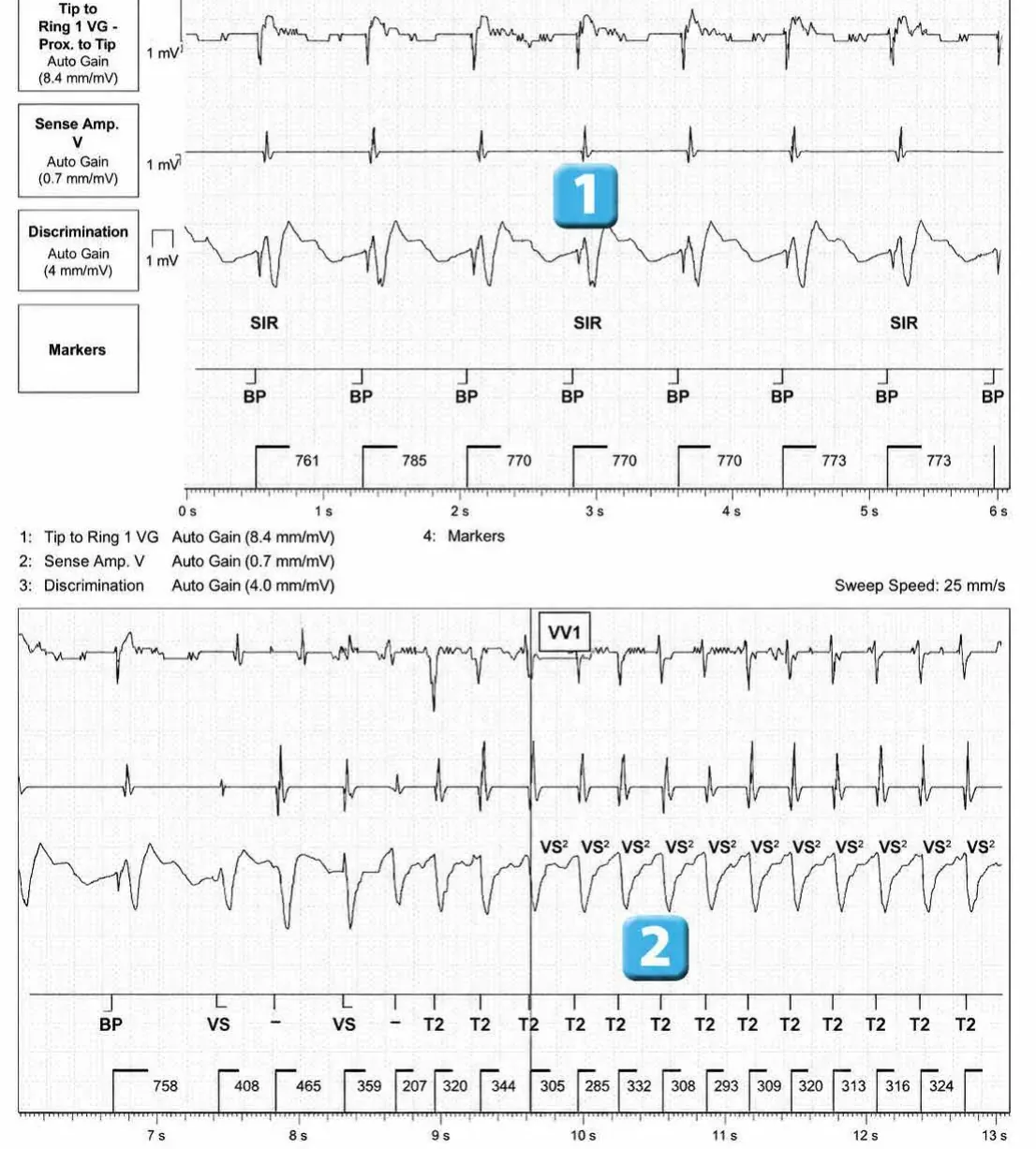
- biventricular pacing at sensor frequency
- onset of monomorphic ventricular arrhythmia detected in the VT2 zone; ventricular cycles are clearly detected in the bipolar detection channel (near-field) and in the discrimination channel (far- field, VS2 markers)
- after 20 cycles classified as T2, VT2 counter completed; burst
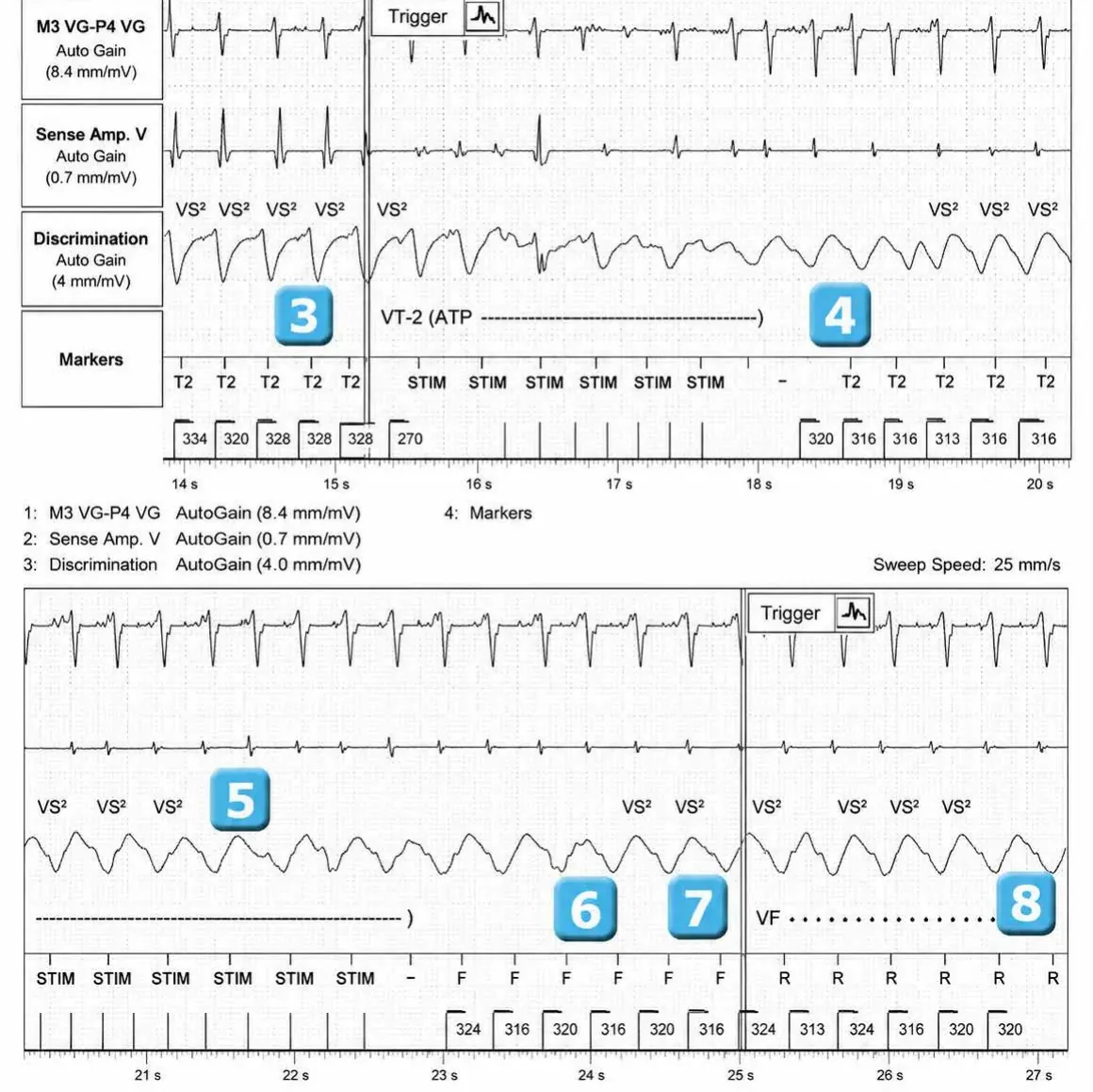
- Ineffective burst and continuation of arrhythmia in the VT2 zone correctly detected by the detection channel; initially, no detection in the discrimination channel; probable activation of the VFTA algorithm
- second burst
- ineffective burst; cycles corresponding to the VT2 zone but classified as VF
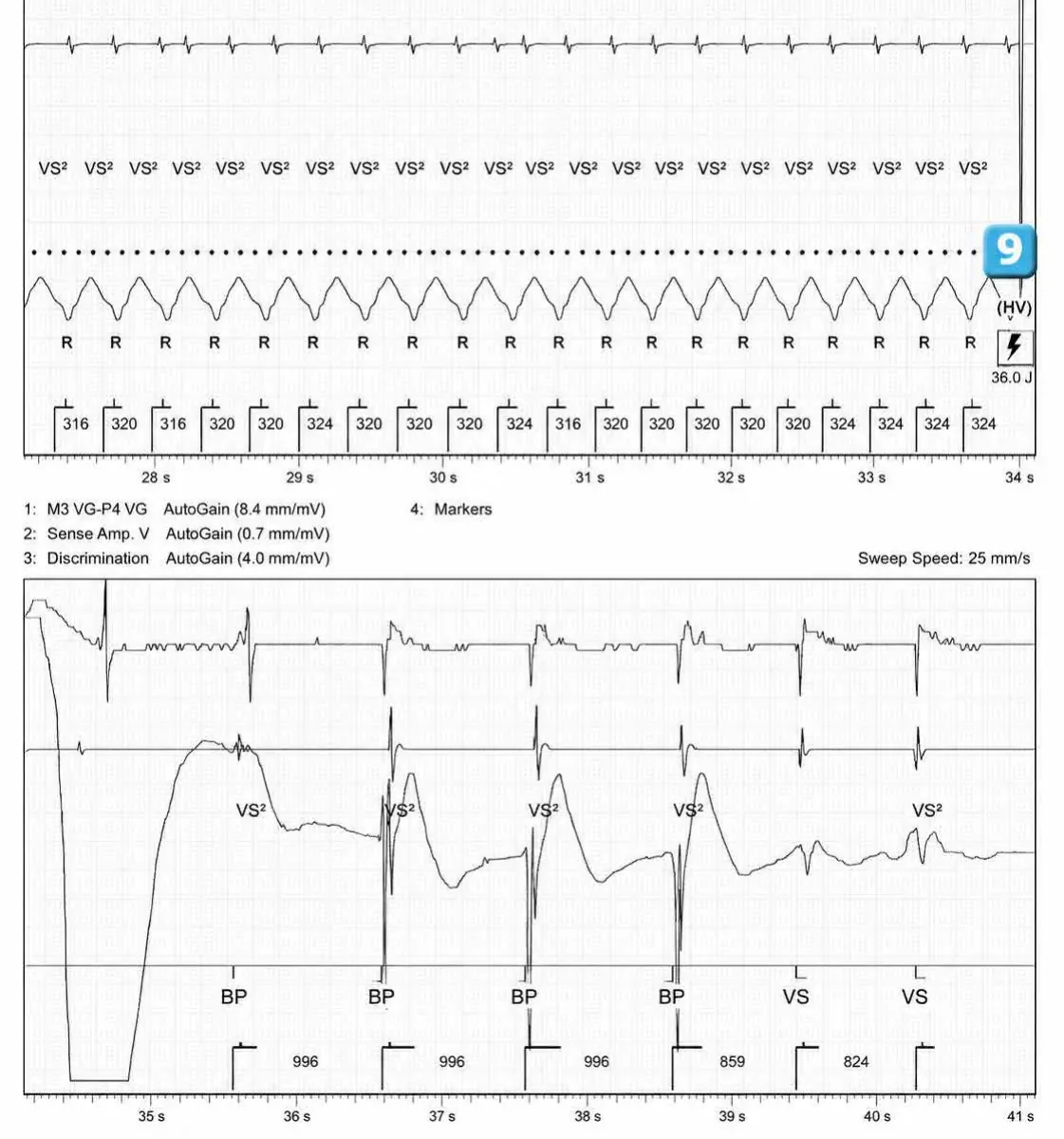
- after only 6 classified as F, VF counter completed
- capacitor charge
- 36 joules electric shock
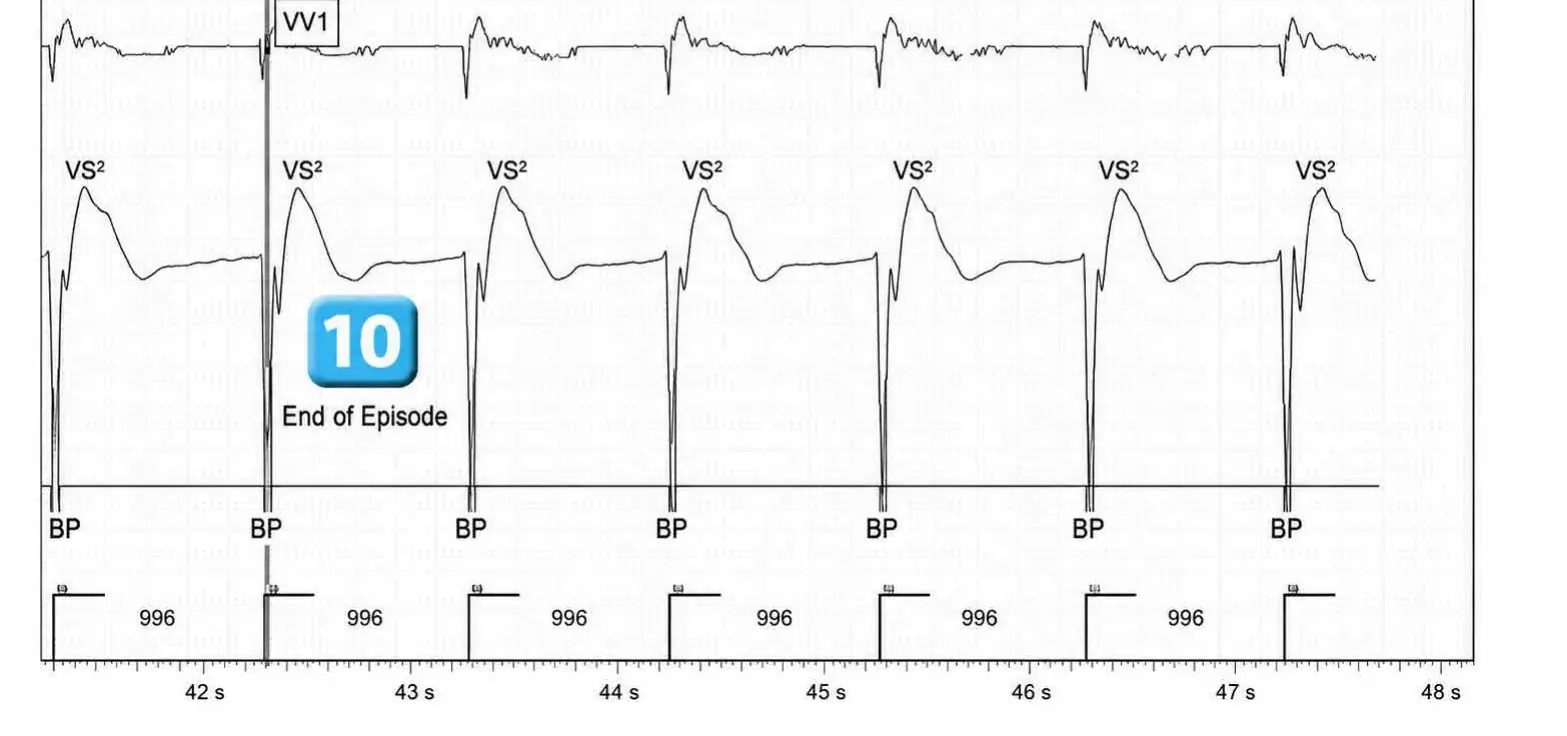
- Effective shock and end-of-episode diagnosis after 7 VP or VS cycles, even though the sinus return criterion was set to fast (3 cycles)
Points to remember
- This graph illustrates how the VFTA™ (VF Therapy Assurance) algorithm works.
- New international guidelines recommend programming detection zone for relatively fast frequencies with a high number of cycles in initial detection to minimize the risk of avoidable therapies; this is theoretically accompanied by an increased risk of undersensing of polymorphic VT or VF episodes with potentially dramatic consequences (delayed or absent treatment of a life-threatening arrhythmia); this type of complication is probably underestimated due to the device’s failure to record when the quality of the Detection is highly imperfect
- The VFTA algorithm was developed to reduce the risk of missed or delayed therapy during an episode of undersensing VF by temporarily adjusting the criteria for detection criteria in the presence of initial undersensing observed on the far-field channel; in fact, a loss of signal on the far-field channel may precede undersensing on the bipolar channel and predict a potentially unstable and dangerous arrhythmia; at strategic moments during a VT/VF episode, the VFTA evaluates detection on the far-field channel and temporarily applies new parameters (VFTA parameters) when undersensing criteria are met; The adjustments relate to detection, redetection, episode end, and therapy parameters to promote the delivery of therapy detection, redetection, episode termination, and therapies to promote the delivery of an electric shock
- The VFTA algorithm analyzes only the far-field channel (discrimination channel) and uses two independent counters (low amplitude counter and ventricular pause counter). These two counters operate according to certain rules: They are always active but are reset to zero for each new episode (VT/VF). They measure the amplitude of the far-field signal when the VS2 marker is present. They increment or reset to zero, but do not decrement. They trigger VFTA programming when at least one criterion is met at a checkpoint.
- the low amplitude counter looks for a drop in signal amplitude on the discrimination channel (detection is present but variable); small VS2 signals (0.3mV - 0.6mV) increment this counter by 1; large VS2 signals (> 0.6mV) reset this counter to 0 to prevent a very brief undersensing from activating the VFTA algorithm; VFTA programming is triggered if this counter is ≥ 2 at the checkpoint
- The pause counter searches for pauses of at least 2 seconds on the discrimination channel. 2 seconds without detecting a VS2 increments this counter by 1; large VS2 signals (> 1mV) reset this counter to zero to prevent very brief undersensing from activating the VFTA algorithm; VFTA programming is triggered if this counter is ≥ 1 at the checkpoint
- the counters are only checked in 4 situations that correspond to the VFTA checkpoints: 1. the number of intervals for one of the tachycardia zones ( monitor, VT1, VT2, or VF) is completed and discrimination indicates ventricular arrhythmia (does not activate if SVT is diagnosed); 2. the number of 45 T or F intervals has been reached since the start of an episode without any of the VT or VF counters being completed; 3. One of the redetection counters (VT or VF) is completed; 4. When a cycle classified as T or F appears during the 15 cycles after sinus return/end of episode. Sinus return resets the 45-cycle counter.
- If the criteria are met at one of the checkpoints, new detection parameters apply: a single VF zone, a decrease in the low frequency of the VF zone (100 ms added to the slowest tachycardia zone with a limit of 400 ms corresponding to 150 bpm), the number of intervals in initial detection reduced to 6, the ATP sequences are deprogrammed, the end-of-episode criterion is reprogrammed to 7; this programming is temporary, with a return to the initial parameters at the end of the episode
- if the VFTA algorithm is triggered, a recording of the episode is automatically stored in the device’s memory and labeled «VF Therapy Assurance»
- In this example, the quality of detection deteriorates after the ATP sequence; the criterion VFTA is triggered at the moment of redetection (checkpoint); this results in certain changes: the redetection cycles corresponding to the VT2 zone are then classified as F (a single VF zone starting at 150 bpm); the number of intervals in initial detection in this single VF zone is reduced to 6; the episode end criterion is reprogrammed to 7
Practice out loud
Just describe the tracing. What do you think is going on? Describing the numbers can help.
00:00
0%
—
From Implantable Cardioverter Defibrillator — clinical cases based on tracings by P. Bordachar, M. Strik, A. Thiyagarajah, S. Ploux. Published by Cardiocases. Every numbered marker on a recording is explained in the list beneath it; tap a marker on the trace or an entry in the list.