
Chapter 2 · Therapies · Case 4
Electrical shock and induction of an AF episode
Patient and episode
Patient
- 34-year-old man with hypertrophic cardiomyopathy implanted with an Atlas dual-chamber defibrillator for syncopal ventricular tachycardia; consults for syncope followed by electric shock during exertion
Summary
- Episode of VF requiring a 25-joules electric shock (shock impedance 46 ohms); the diagnosis of VF by a defibrillator is based solely on the frequency criterion and not on the irregular and polymorphic nature of the arrhythmia; VT entering the VF zone will be diagnosed as VF.
The recording
Tap a number on the trace, or an entry in the list below
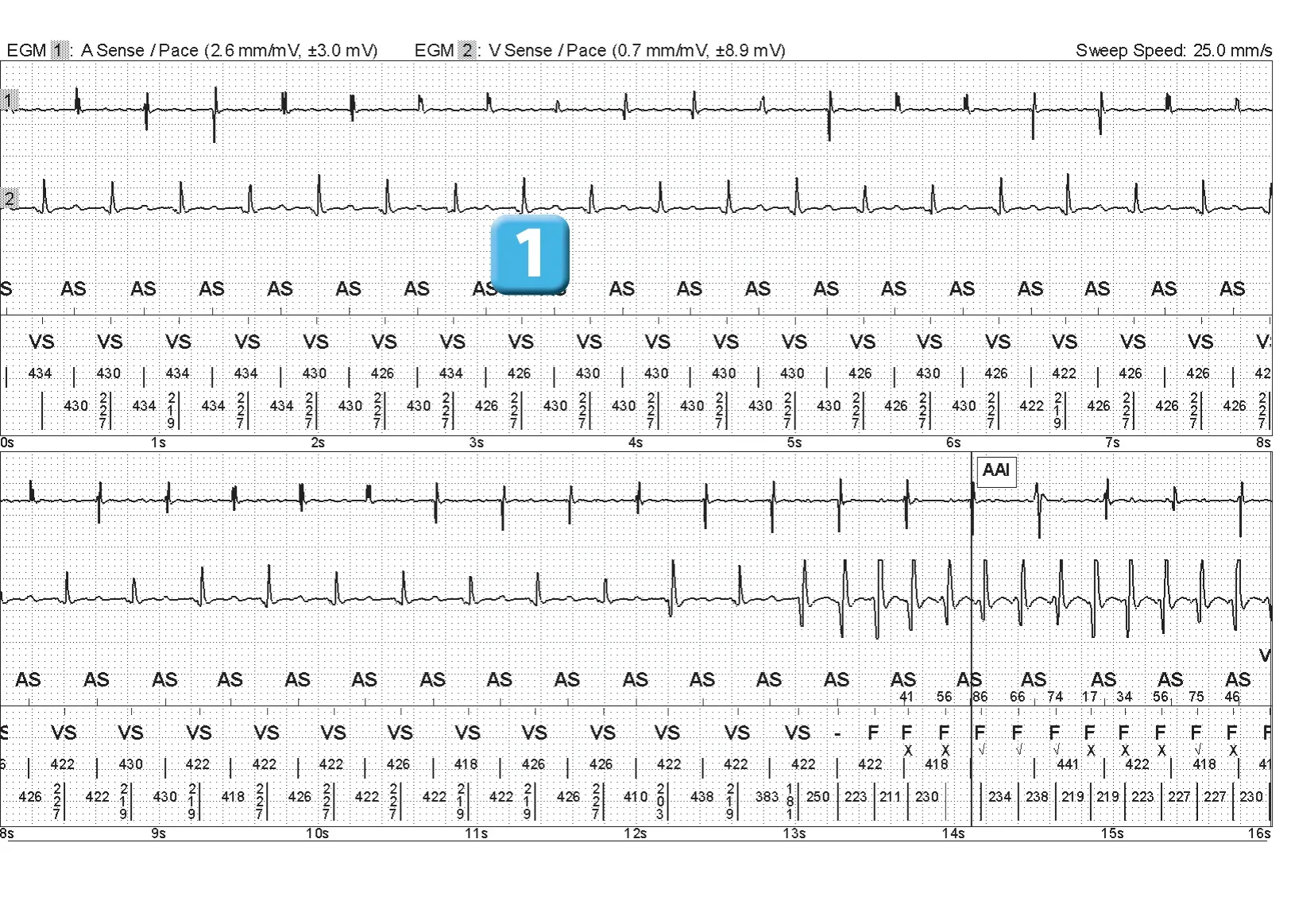
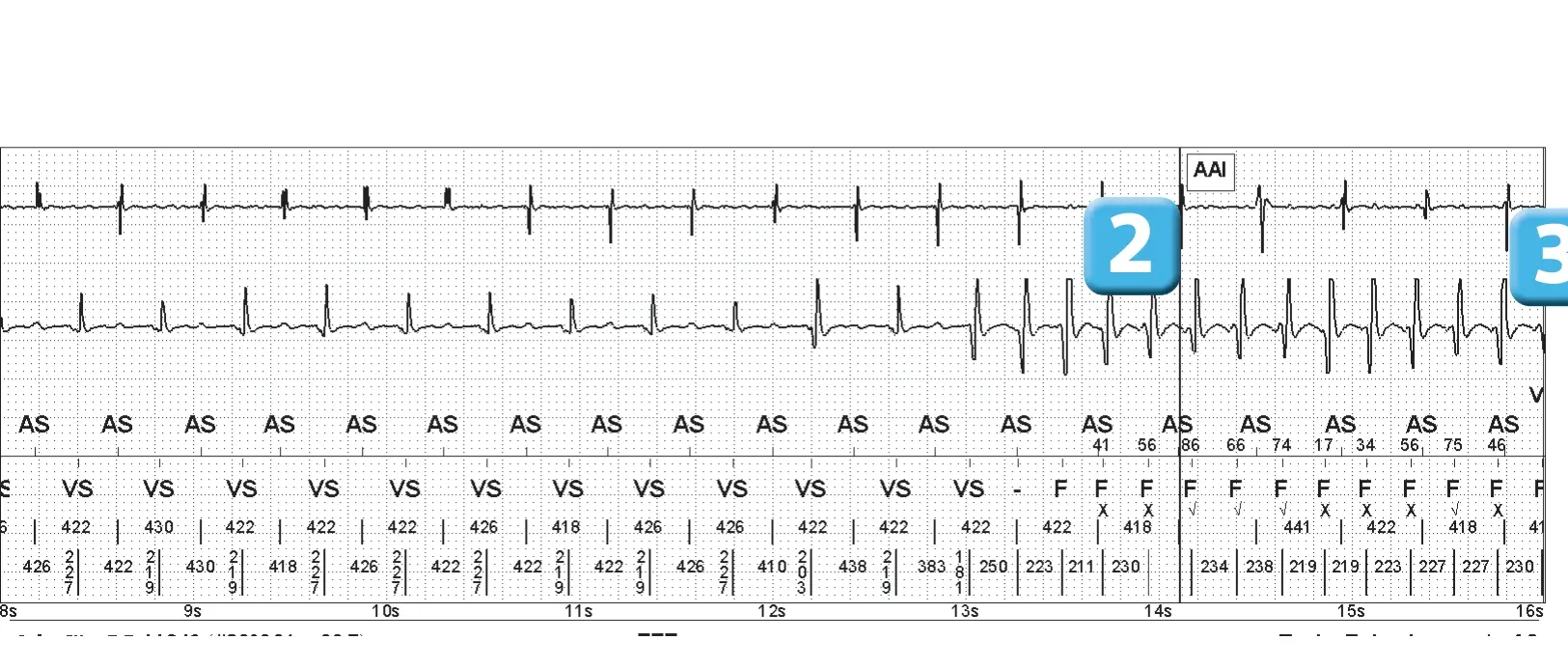
- Conducted sinus tachycardia (AS-VS)
- Regular monomorphic tachycardia with intervals in the VF zone; after 3 cycles classified as F: episode mode (AAI)
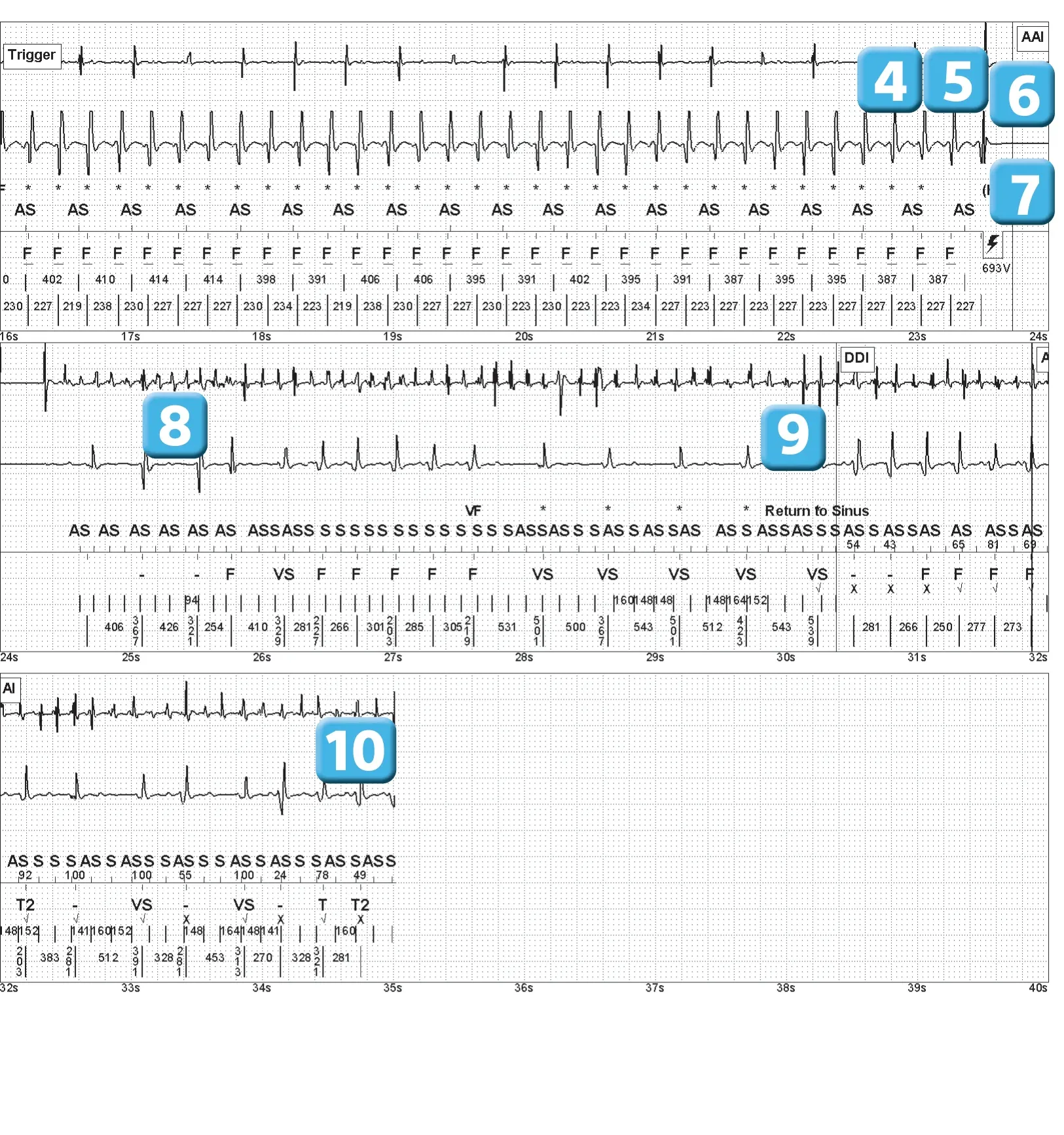
- VF detected after 12 cycles classified as F and start of capacitor charging (*)
- End of charging
- confirmation before shock (shock on the second cycle whose instantaneous interval and averaged interval are in the VF zone)
- 25 jouless electric shock; the electric shock occurs during the vulnerable period because 150 ms after atrial detection (no synchronization with atrial activity)
- 1-second blanking after shock
- reduction of ventricular arrhythmia but induction of AF with atrioventricular conduction ventricular conduction (good baseline AV conduction + effect of catecholamines during exercise); after 6 cycles classified as F, VF redetection and new capacitor charge
- slowing of atrioventricular conduction and diagnosis of sinus return after 5 consecutive VS cycles; the diagnosis of sinus return reflects a slowing of the heart rate and not a differentiation between sinus rhythm and AF; interruption of capacitor charging
- persistence of AF
Points to remember
- This trace was recorded on an older model (Atlas) and shows the evolution of recommendations; many episodes diagnosed as VF by the defibrillator at their rapid frequency correspond to rapid monomorphic VT. Anti-tachycardia pacing is painless, reduces power consumption and thus saves battery life, and should therefore be the first-line treatment for organized ventricular arrhythmias, even when they are very rapid.
- This trace illustrates the possible dual effect of an electric shock: positive, as it reduces ventricular arrhythmia, but also negative, as it induces an episode of AF.
- Electric shocks delivered for VT or VF are synchronized with the detection of ventricular activity regardless of the phase of the atrial cycles. In this example, we can see that the shock is delivered during the vulnerable period of the atrium, which induces an episode of AF.
- Although the exact incidence of this proarrhythmic effect is not well known, various studies have shown that the risk of AF induction appears to be higher for low-energy shocks, particularly when one of the coils is located in the right atrium (dual-coil shock).
- Induced AF episodes are generally relatively short, although more sustained episodes may occur in patients with pathological atrial substrate
Practice out loud
Just describe the tracing. What do you think is going on? Describing the numbers can help.
00:00
0%
—
From Implantable Cardioverter Defibrillator — clinical cases based on tracings by P. Bordachar, M. Strik, A. Thiyagarajah, S. Ploux. Published by Cardiocases. Every numbered marker on a recording is explained in the list beneath it; tap a marker on the trace or an entry in the list.