
Chapter 1 · Counters · Case 4
Change of detection zone
Patient and episode
Patient
- Male with ischemic cardiomyopathy; implanted with Momentum triple-chamber defibrillator
Summary
- Episode initially classified in the VT zone then in the VF zone
- A burst of ATP delivered followed by a 41 Joule shock
The recording
Tap a number on the trace, or an entry in the list below
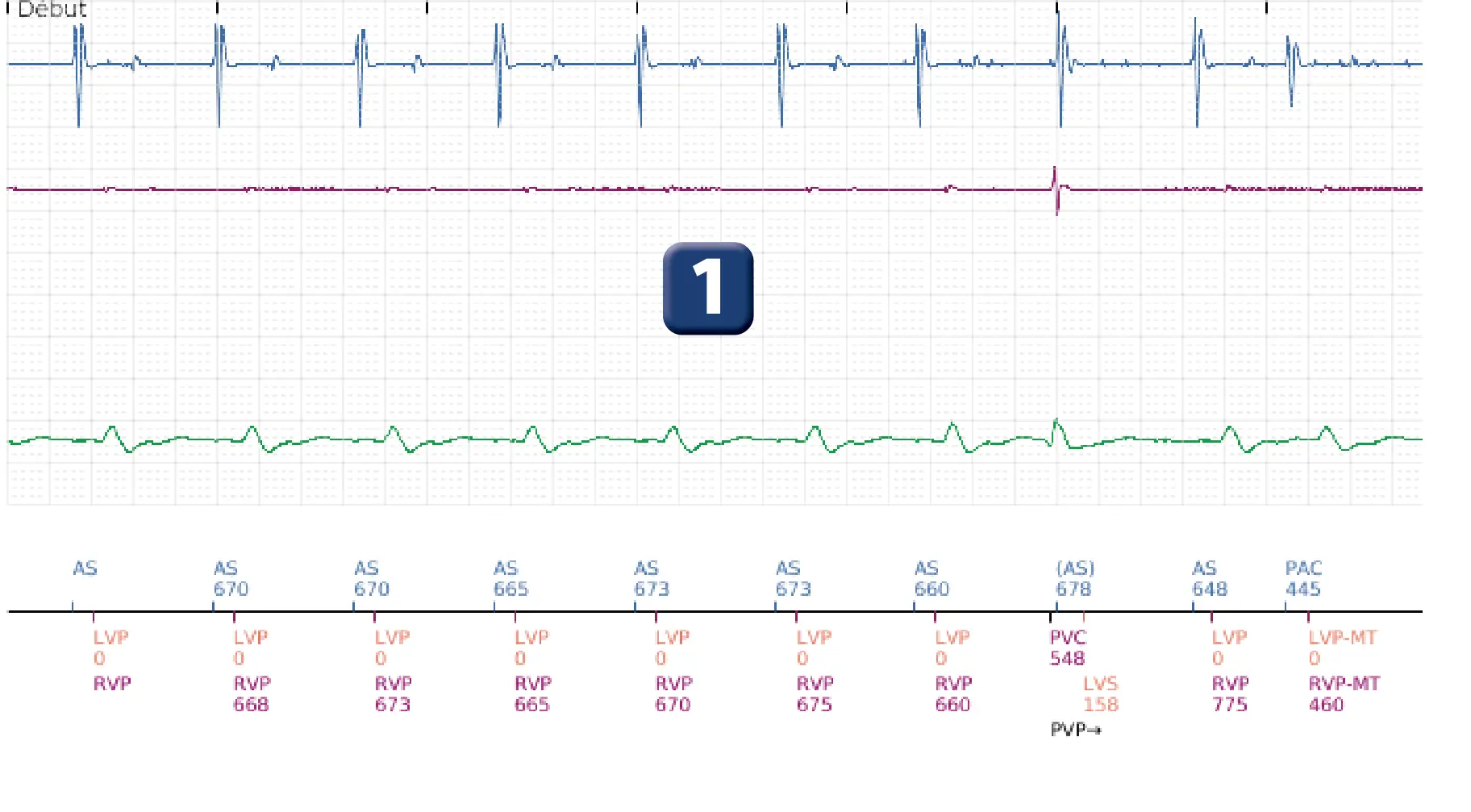
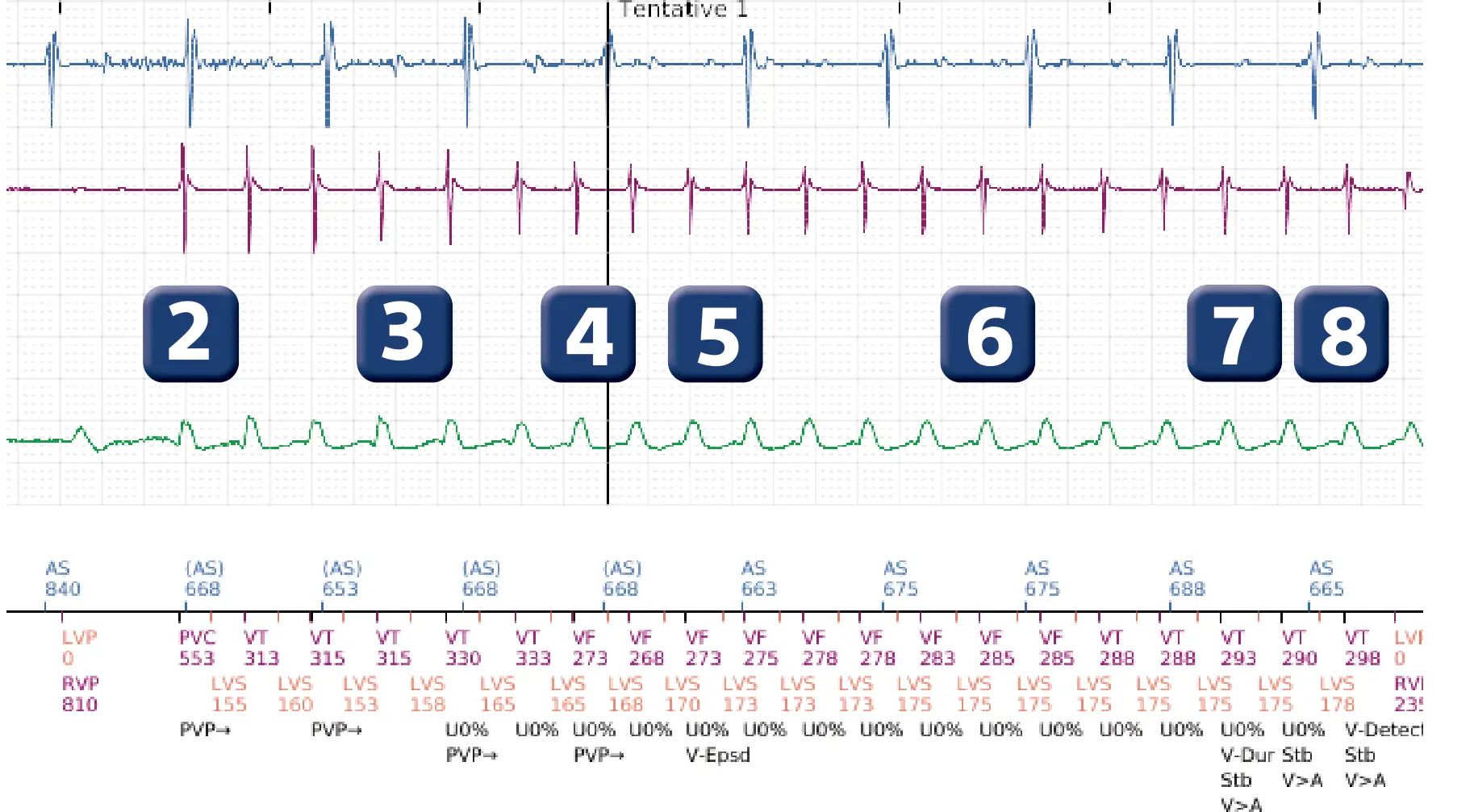
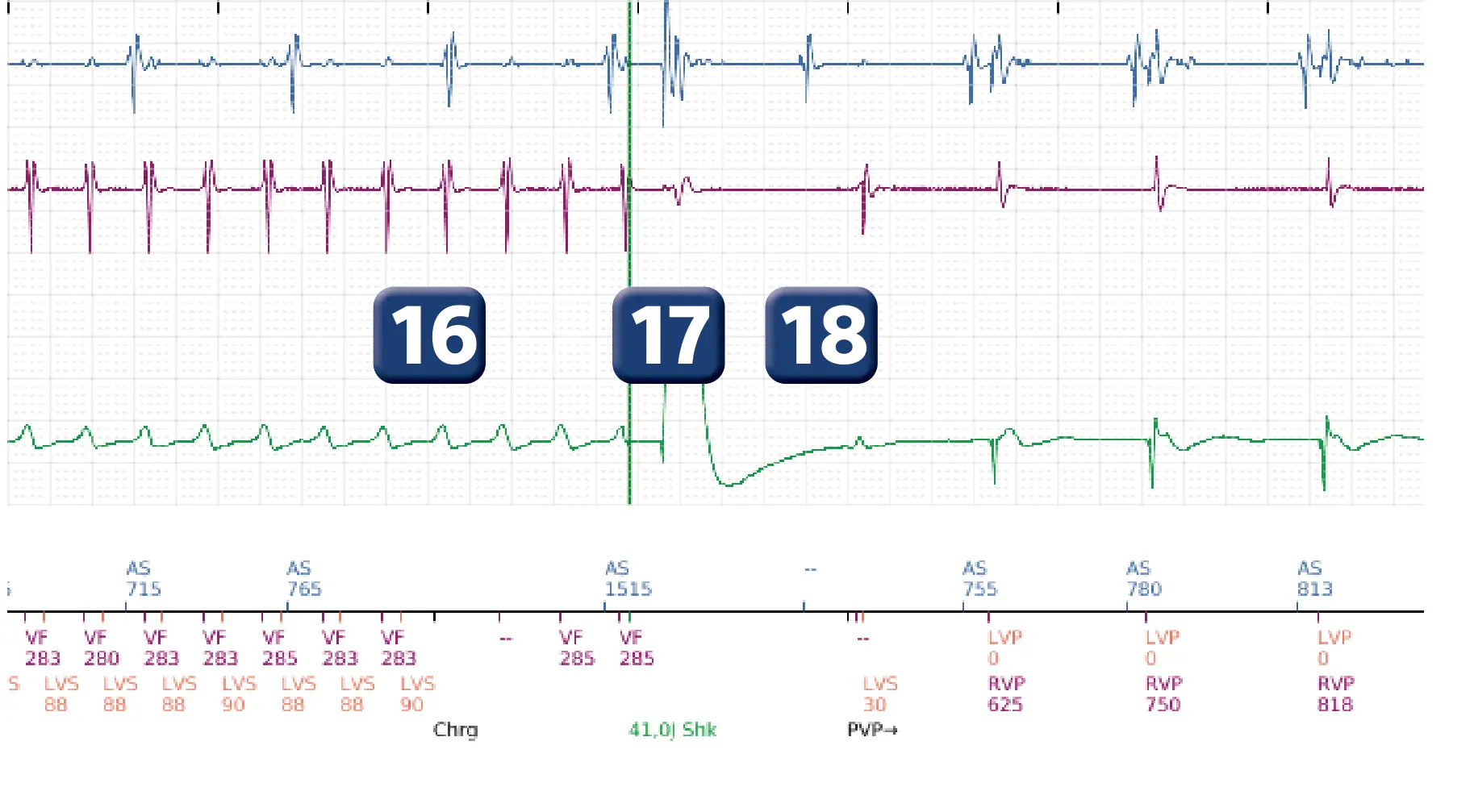
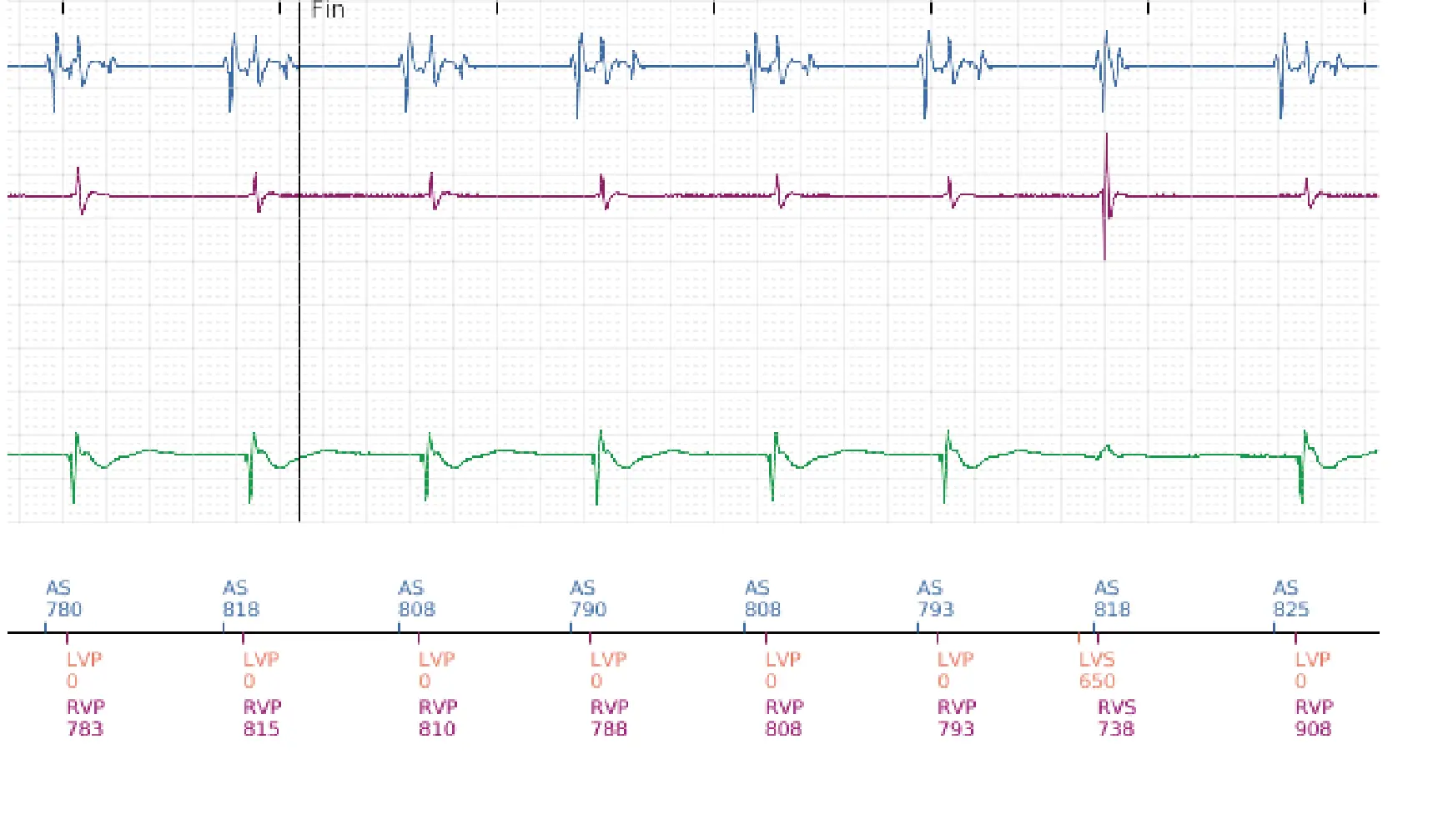
- Spontaneous rhythm in the atrium and biventricular pacing
- Onset of ventricular tachycardia (regular, monomorphic, with atrioventricular dissociation)
- Cycles initially classified in the VT zone
- Cycles classified as VF
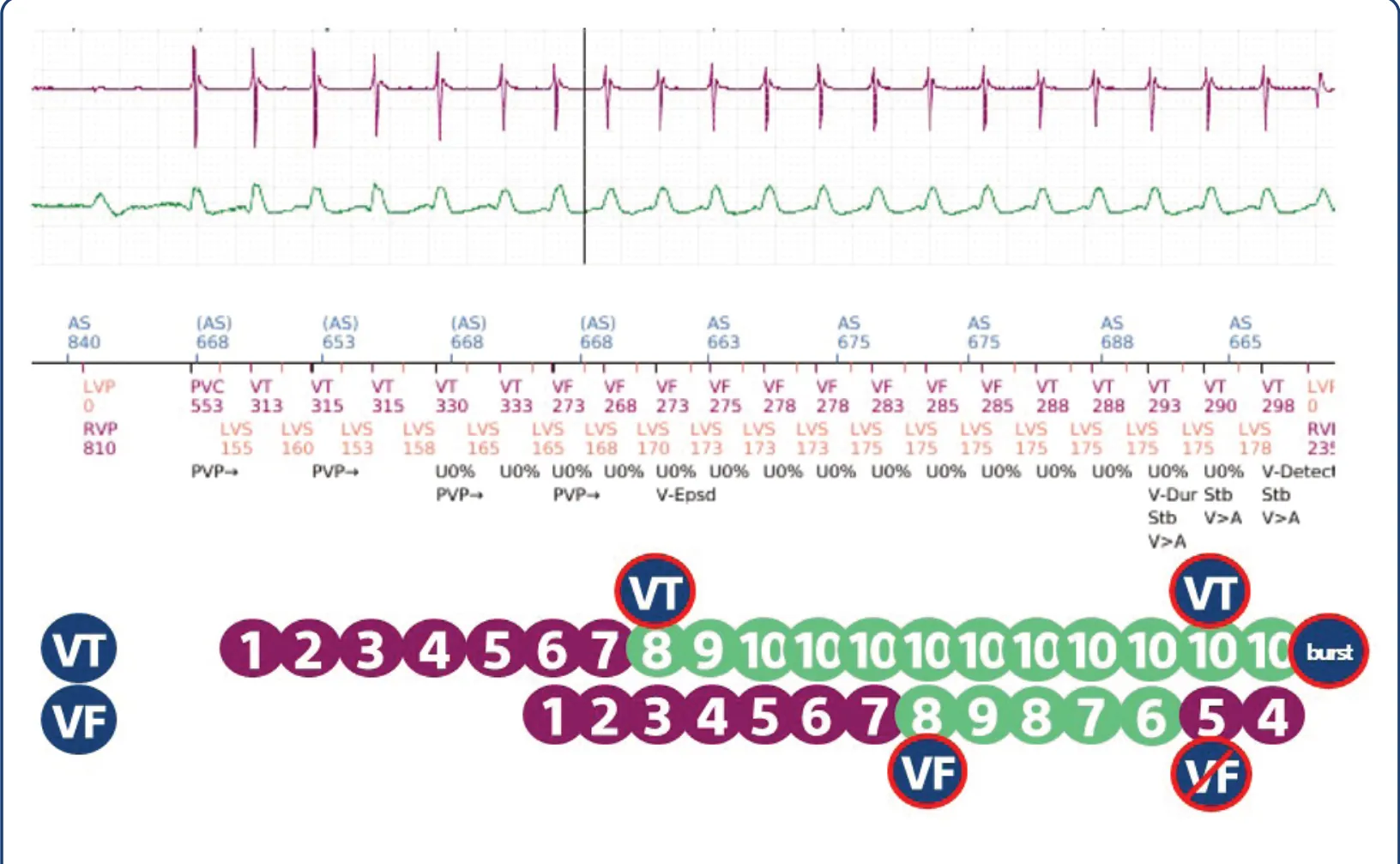
- V-epsd marker for VT zone (5 cycles in VT zone + 3 cycles in VF zone); start of initial duration for VT zone (2.5 seconds)
- After 8 cycles in the VF zone, criterion 8/10 verified for the VF zone; start of initial duration of VF zone
- End of duration for the VT zone (V-Dur) but criterion 6/10 is still valid for the VF zone; VT zone therapies are therefore not delivered.
- After 5 consecutive cycles classified as VT, the 6/10 criterion is no longer met for the VF zone; the first VT zone therapy can be delivered
- Burst
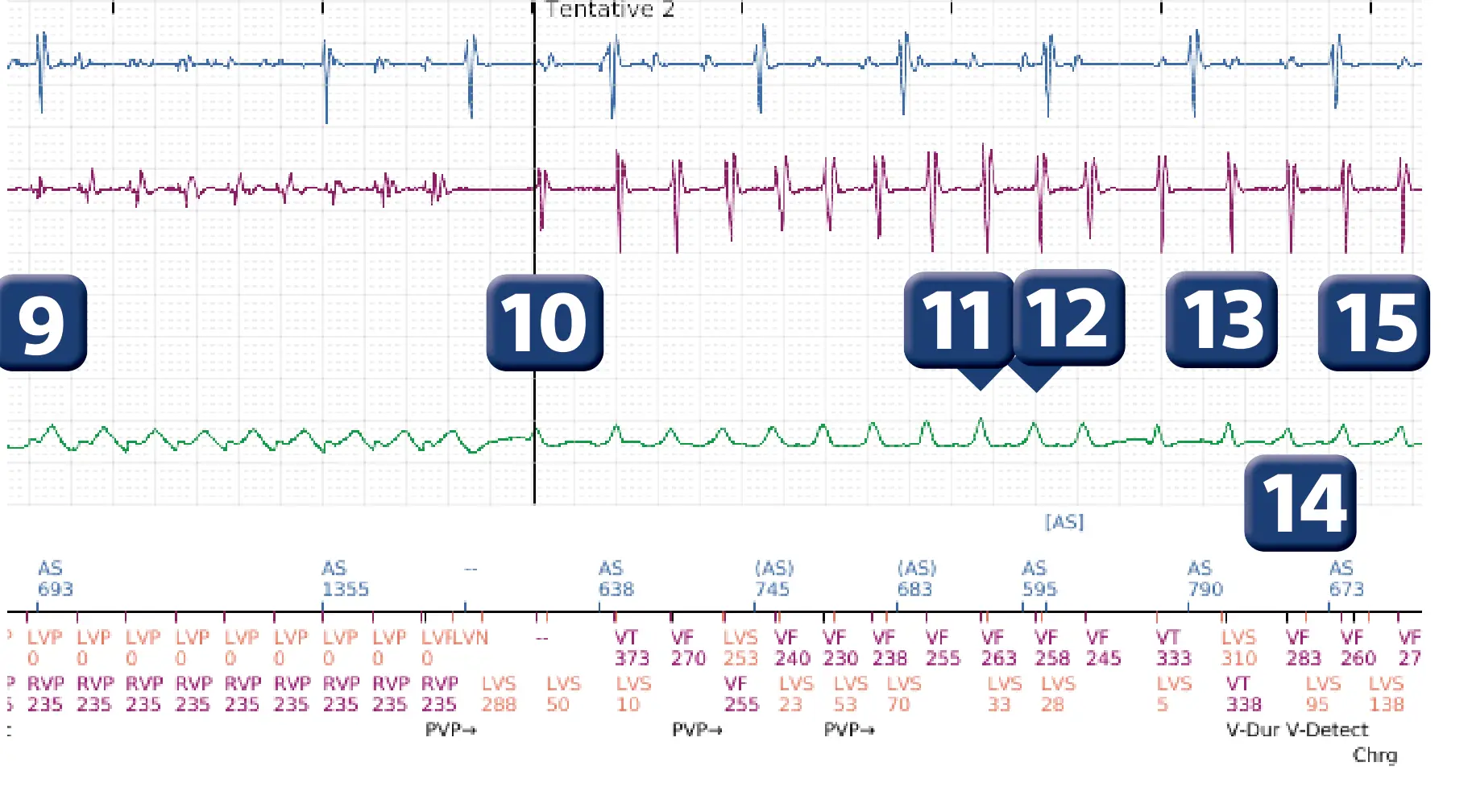
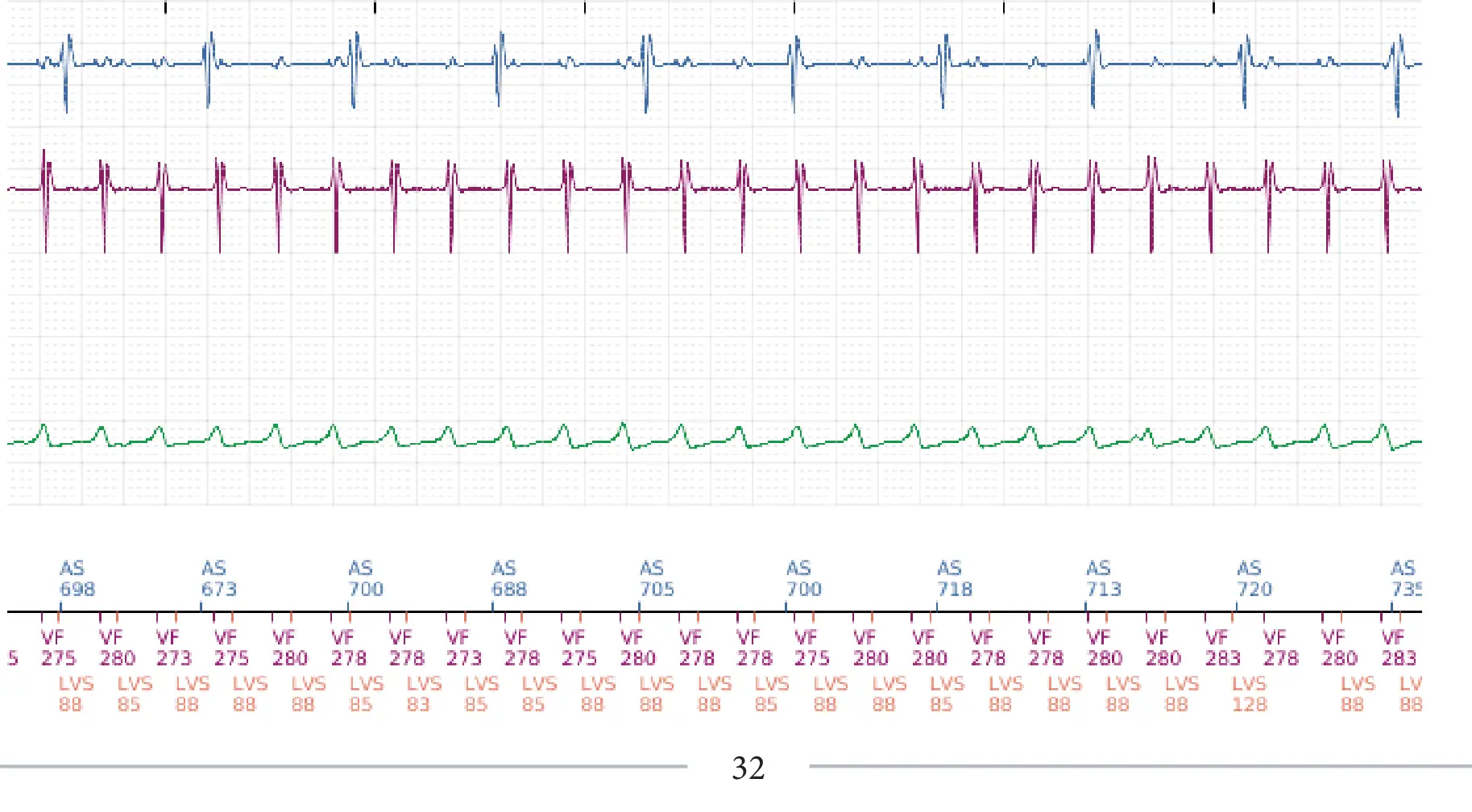
- Ineffective burst and ongoing arrhythmia
- On this cycle, the 8/10 criterion for redetection is fulfilled for the VT zone (1 VT cycle and 7 VF cycles); start of post-redetection duration for the VT zone (1 second).
- On this cycle, the 8/10 redetection criterion is validated for the VF zone (8 VF cycles); start of post-redetection duration for the VF zone (1 second).
- End of post-redetection duration for VT zone (V-Dur) but VF zone duration is still active
- End of VF zone duration (switches to VF zone detection with therapies corresponding to this zone)
- Start of capacitor charging
- End of charge and start of diversion window
- Shock delivered on the second rapid cycle
- Effective shock
From the interrogation
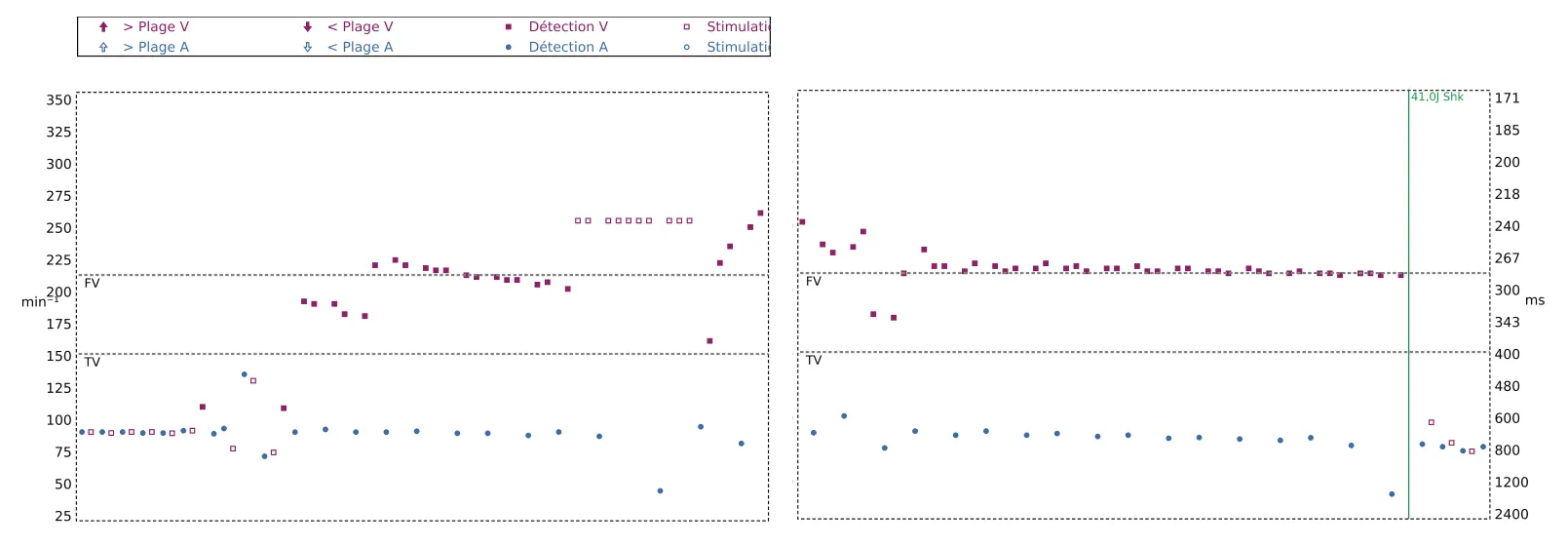
Points to remember
- In a Boston Scientific defibrillator, 1, 2 or 3 detection zones can be programmed; the rate thresholds of adjacent zones must differ by at least 20 beats/minute ; in a double- or triple-chamber defibrillator, the rate threshold of the VT zones must be at least 5 beats/minute higher than the maximal tracking rate (MT) and the sensor indicated rate (FMC); in a single-chamber defibrillator, the rate threshold of the VT zones must be at least 15 beats/minute higher than the lower rate limit (Fmin).
- If several detection zones are programmed, each zone has its own detection window; a cycle in a faster zone (VF for VT, for example) increments its zone counter (VF) as well as that of the slower zone (VT and VT-1); when the 8 fast cycles/10 criterion is met for one of the zones, the initial detection criterion is met
- Different durations can be programmed for each detection zone; the duration of each zone ends independently of the others; the duration of the faster zones must be shorter than (or equal to) those of the slower zones; if criterion 8/10 is met for the VT zone first and then for the VF zone, the 2 durations continue in parallel; if the VT zone duration ends while the VF zone duration is in progress (criterion 6/10 met in the VF zone), no therapy is delivered before the end of the VF zone duration; if criterion 6/10 is no longer met for the VF zone, as in this example, the VT zone therapies are delivered.
- If the device diagnoses a VT episode and delivers an ATP sequence, and if criterion 8/10 is then verified for the VF zone (acceleration of arrhythmia), the redetection time (1 second in VF zone) of the VF zone and not the initial time (often programmed at a longer interval) is applied so as to not delay the onset of therapies
Practice out loud
Just describe the tracing. What do you think is going on? Describing the numbers can help.
00:00
0%
—
From Boston Scientific ICD — clinical cases by P. Bordachar, M. Strik, A. Thiyagarajah, S. Ploux. Published by Cardiocases. Every numbered marker on a recording is explained in the list beneath it; tap a marker on the trace or an entry in the list.
Order hardcopyon Amazon