
Chapter 4 · Oversensing · Case 6
Oversensing of atrial activity by the defibrillation lead during an episode of atrial arrhythmia
Patient and episode
Patient
- 53-year-old male implanted with a Teligen dual-chamber defibrillator for dilated cardiomyopathy and complete atrioventricular block with an integrated bipolar ventricular lead (the anode of the sensing circuit is the defibrillation coil of the RV lead); repeated sensation of presyncope; alert received via telemedicine (Latitude).
The recording
Tap a number on the trace, or an entry in the list below
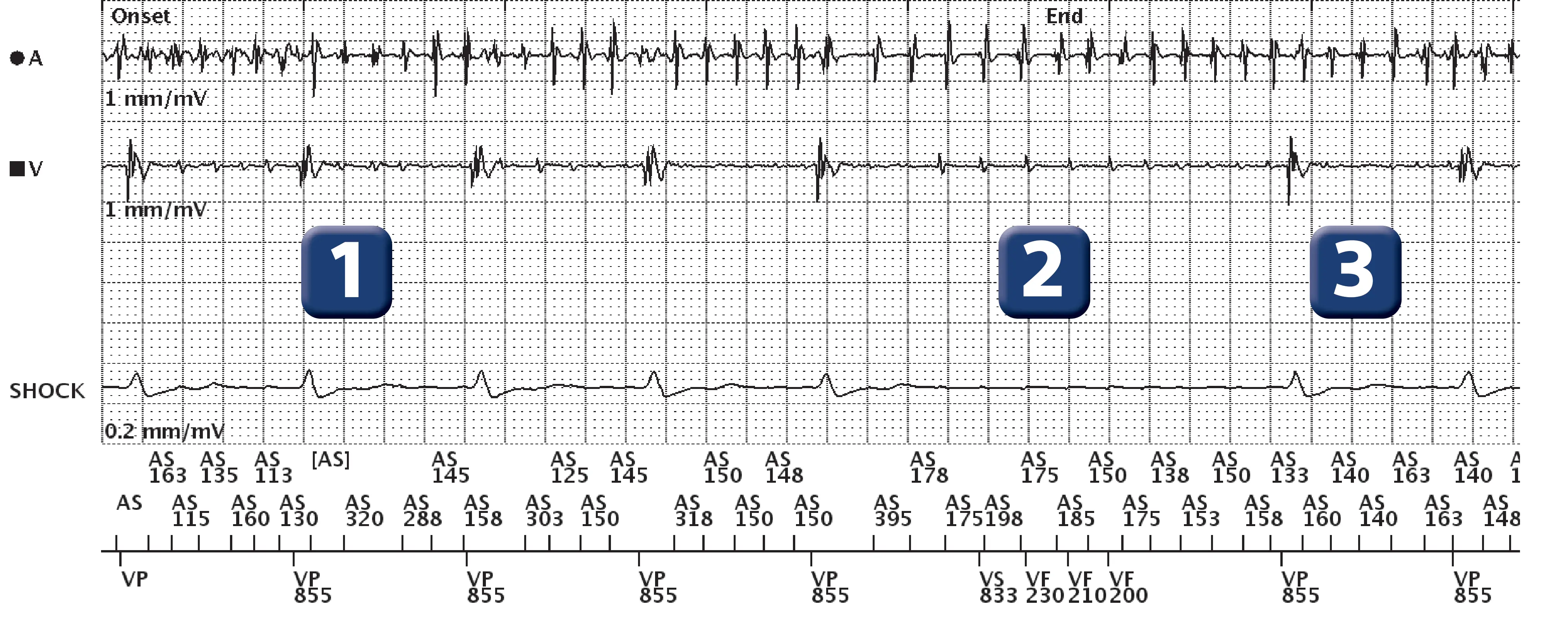
- Atrial fibrillation correctly detected by the defibrillator with ventricular pacing (VP-Sr) at the sensor indicated rate in this pacing-dependent patient; the defibrillator has mode-switched into VDIR mode
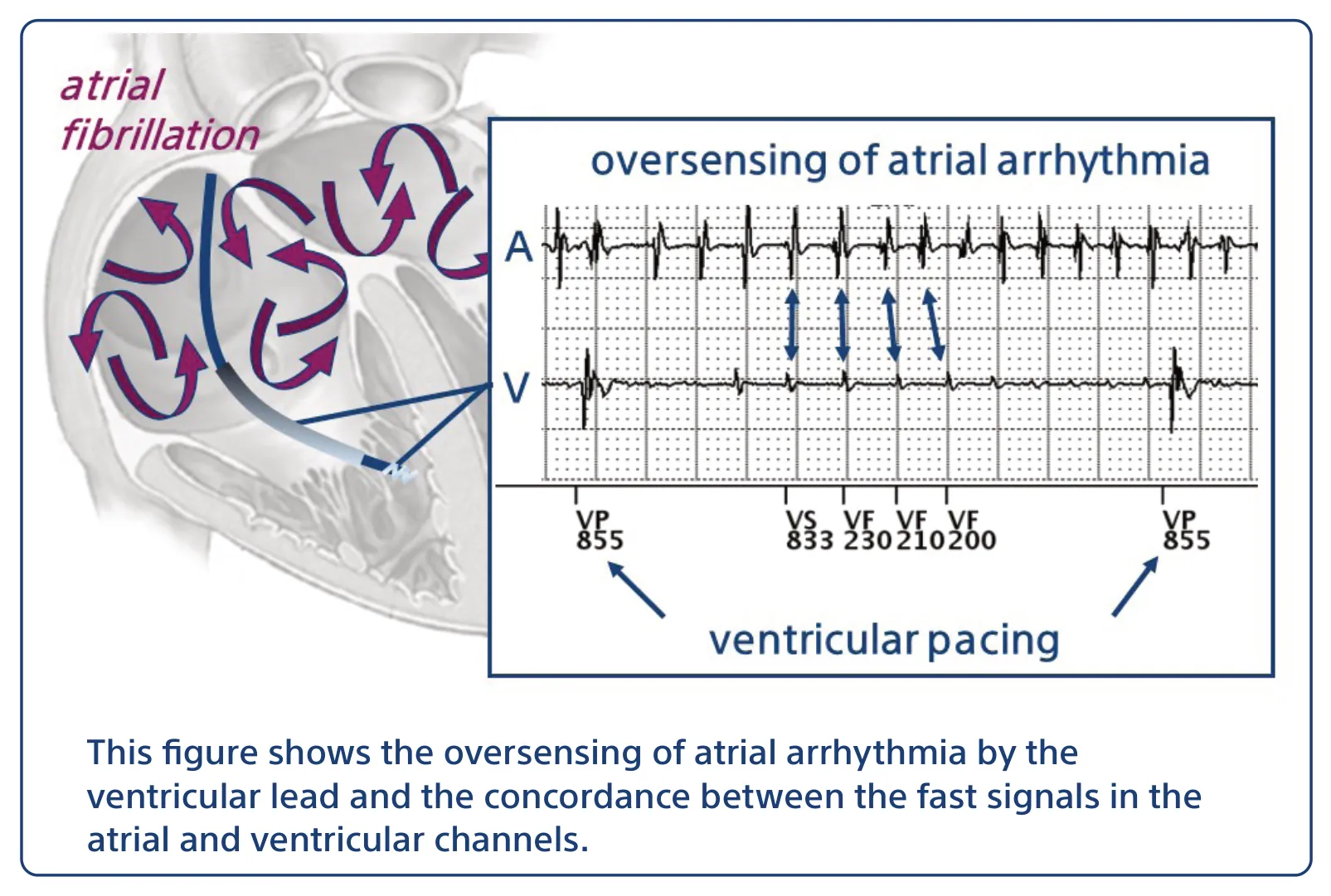
- Oversensing on the ventricular sensing channel; the shock channel confirms that this is not a ventricular arrhythmia; oversensing of rapid atrial activity results in a pause of just under 3 seconds which is responsible for the symptoms described.
- End of oversensing
Points to remember
- This patient initially presented with complete atrioventricular block; oversensing of atrial arrhythmia by the ventricular sensing channel was responsible for a pause, the oversensed rapid rhythm inhibiting ventricular pacing; as a result, the patient developed recurrent presyncope in association with these types of episodes
- Problems of oversensing are of particular concern in dependent patients, as they can lead to ventricular pauses and oversensing can be prolonged in the absence of spontaneous QRS complexes, with the level of sensitivity remaining at a maximum and adapted to the amplitude of the oversensed atrial signals, which is often low
- Oversensing of an atrial arrhythmia can lead to both inappropriate therapy and asystole if the patient is pacing-dependent
Practice out loud
Just describe the tracing. What do you think is going on? Describing the numbers can help.
00:00
0%
—
From Boston Scientific ICD — clinical cases by P. Bordachar, M. Strik, A. Thiyagarajah, S. Ploux. Published by Cardiocases. Every numbered marker on a recording is explained in the list beneath it; tap a marker on the trace or an entry in the list.
Order hardcopyon Amazon