
Chapter 4 · Oversensing · Case 5
Oversensing of the P wave by the defibrillation lead
Patient and episode
Patient
- Male implanted with a triple-chamber defibrillator; recording of a NSVT trace
The recording
Tap a number on the trace, or an entry in the list below
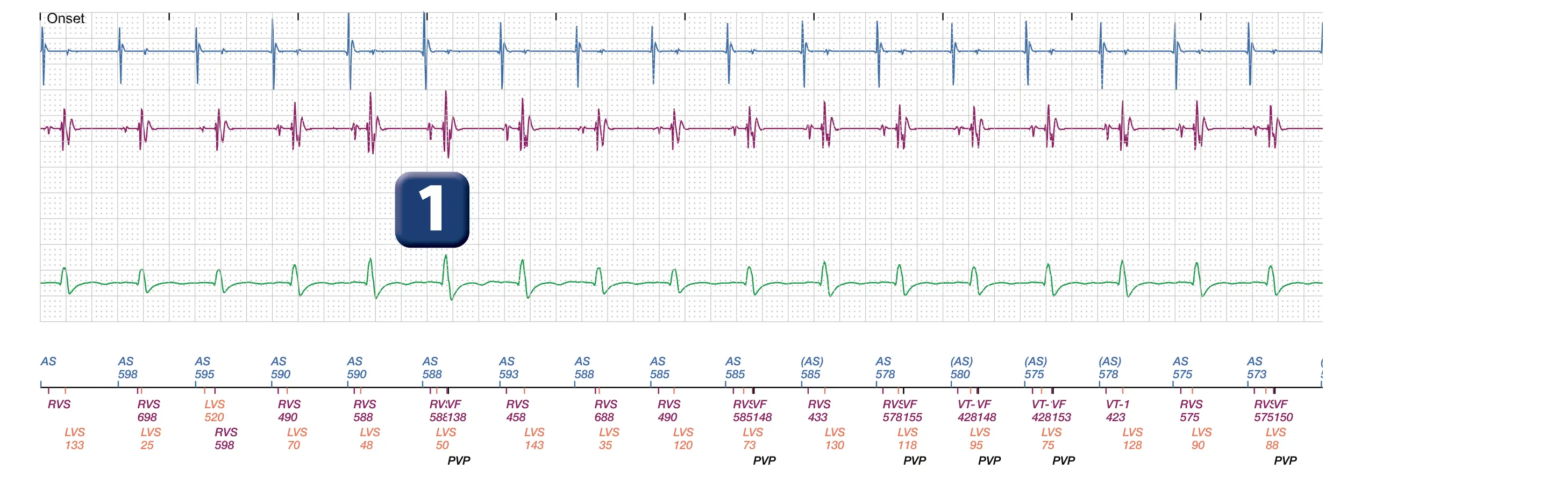
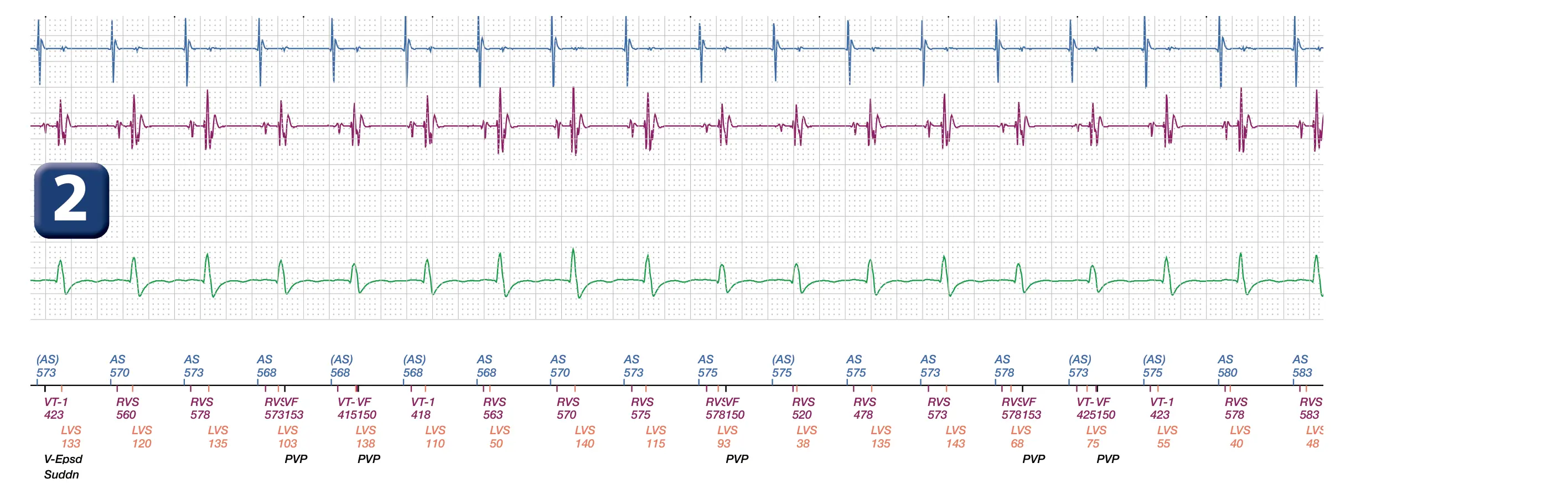
- Intermittent oversensing of atrial activity by the right ventricular lead (clearly visible on the atrial channel); some cycles classified as VS, VT-1, VT or VF
- 8/10 criterion fulfilled for the VT-1 zone
Points to remember
- This trace shows sinus tachycardia with intermittent oversensing of atrial activity by the defibrillation lead
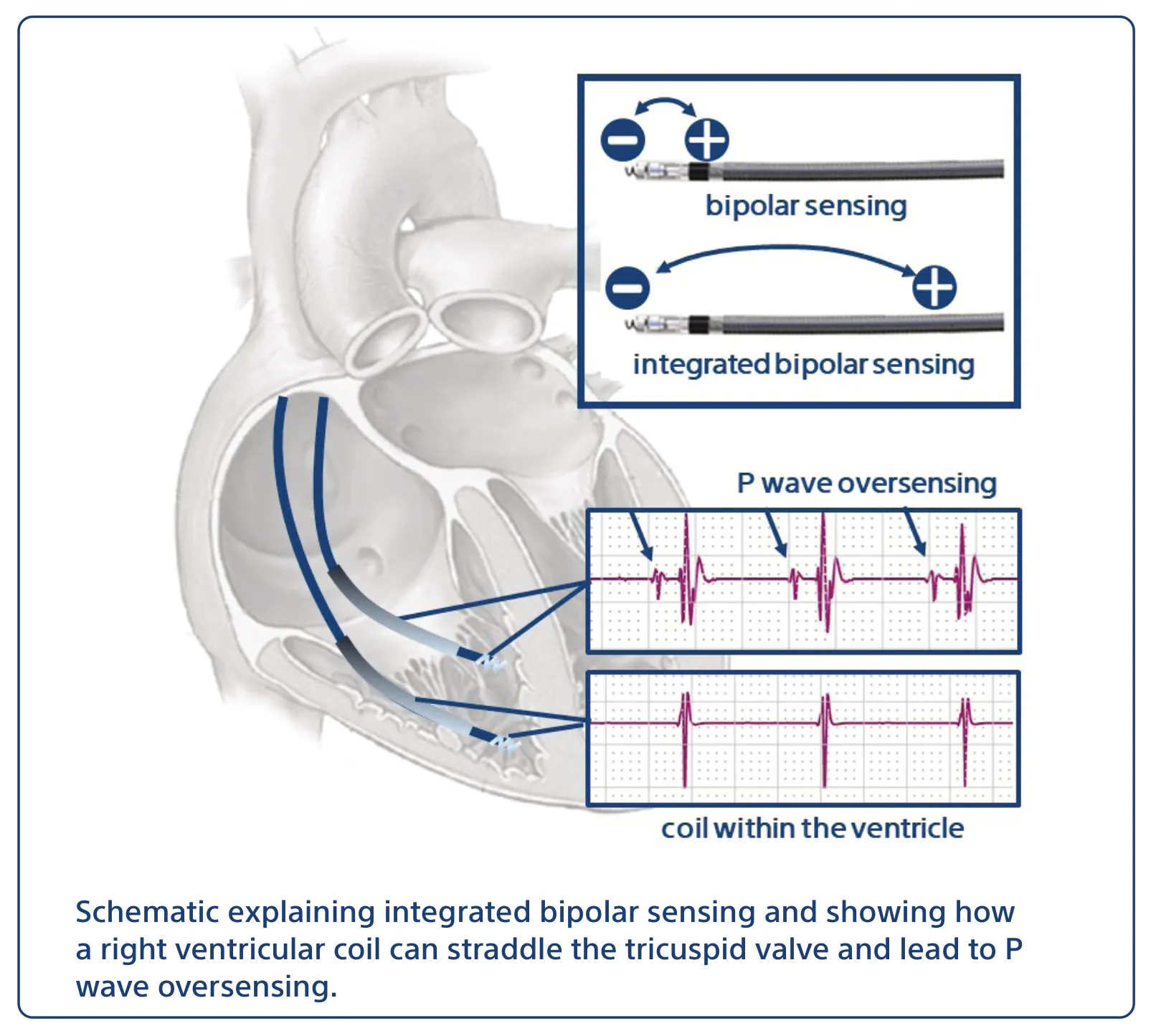
- Oversensing of atrial signals by the ventricular lead tends to occur in 2 situations: 1) displacement of the right ventricular lead at the atrio-ventricular junction (coincides with a decrease in the amplitude of the measured R wave); 2) positioning of an integrated bipolar lead close to the tricuspid annulus, with the distal coil straddling the valve (coincides with a preserved amplitude of the R wave); Boston Scientific devices are potentially more prone to this type of problem insofar as they are frequently connected to an integrated bipolar lead.
- Atrial oversensing can also occur under more exceptional circumstances: 1) unintentional placement of a right ventricular lead in the coronary sinus; 2) insulation defect in the atrial portion of the ventricular lead leading to oversensing of atrial activity; 3) interaction between the atrial lead and the right ventricular lead, the atrial lead coming into contact with the ventricular lead and generating a signal at the moment of atrial systole.
- Several solutions can be implemented to solve the problem and avoid the occurrence of inappropriate therapies or ventricular pauses in pacing-dependent patients with P wave oversensing: 1) reduce the ventricular sensitivity so as to eliminate the supernumerary signal linked to the oversensing of atrial activity; since this programming change is accompanied by an increased risk of under- sensing VF, an induction can then be undertaken to check that the induced VF is correctly sensed with this new sensitivity value; 2) in a significant number of cases, oversensing of atrial activity requires the defibrillation lead to be repositioned (new defibrillation lead for a DF4 system or addition of a pace/sense lead for a DF1 system).
Practice out loud
Just describe the tracing. What do you think is going on? Describing the numbers can help.
00:00
0%
—
From Boston Scientific ICD — clinical cases by P. Bordachar, M. Strik, A. Thiyagarajah, S. Ploux. Published by Cardiocases. Every numbered marker on a recording is explained in the list beneath it; tap a marker on the trace or an entry in the list.
Order hardcopyon Amazon