
Chapter 1 · Counters · Case 2
Counting in the VT zone
Patient
- A 61-year-old male was implanted with a dual-chamber device for dilated coronary heart disease with compensated heart failure and an ejection fraction between 30 and 35%. The patient consults for a systematic follow-up control.
Overview screen
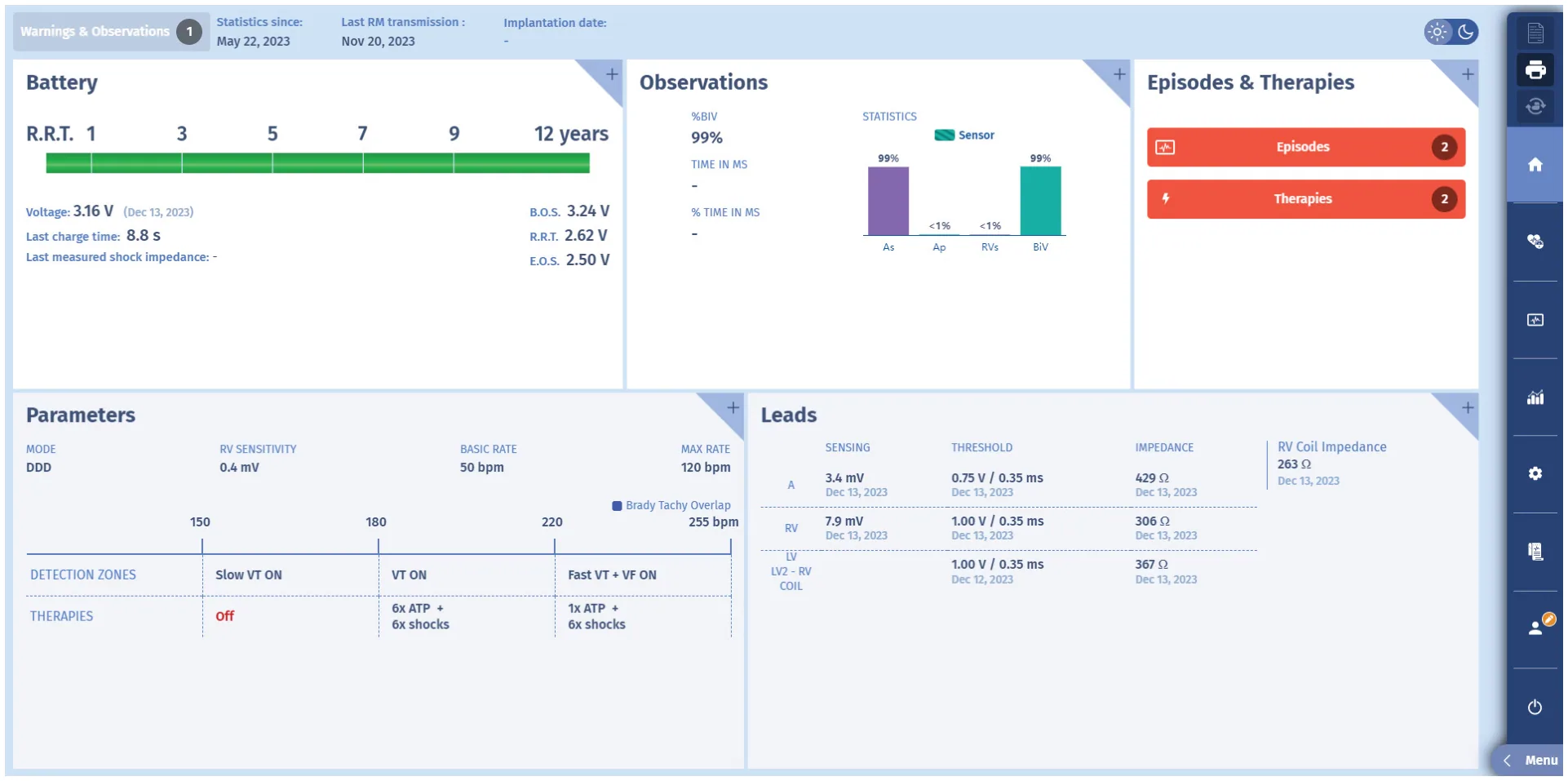
Programming
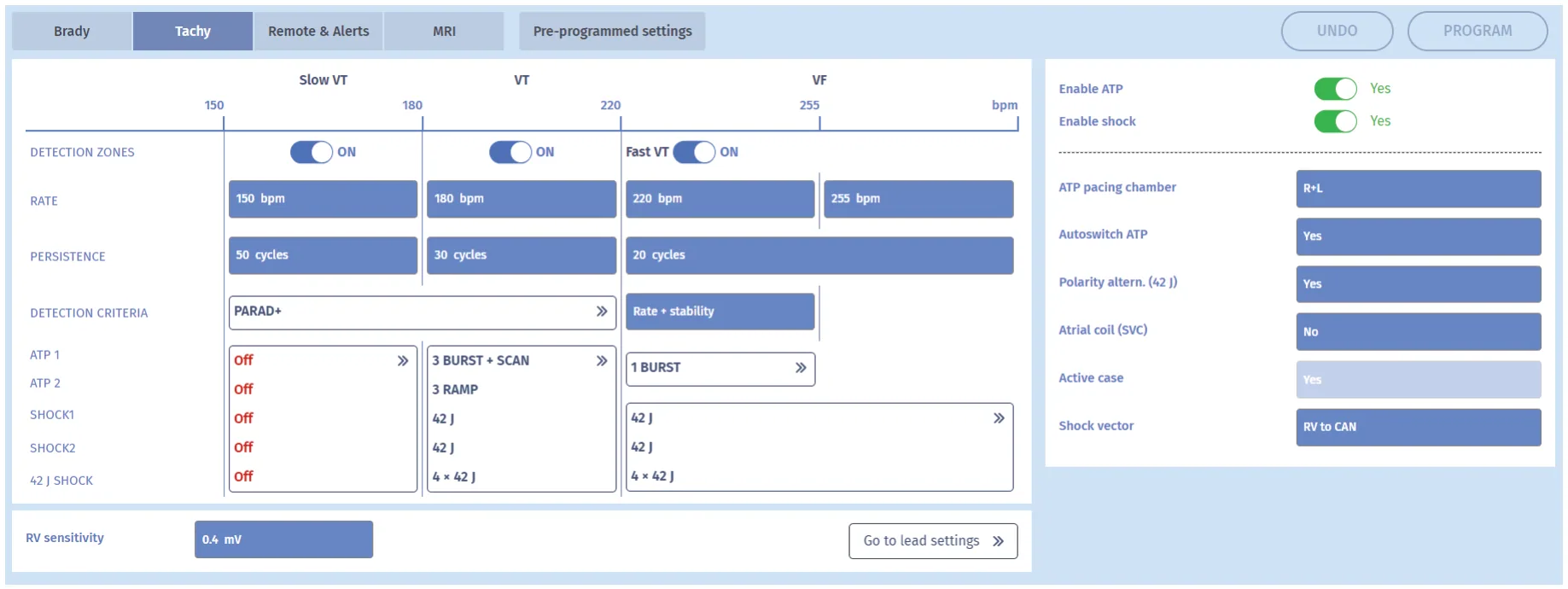
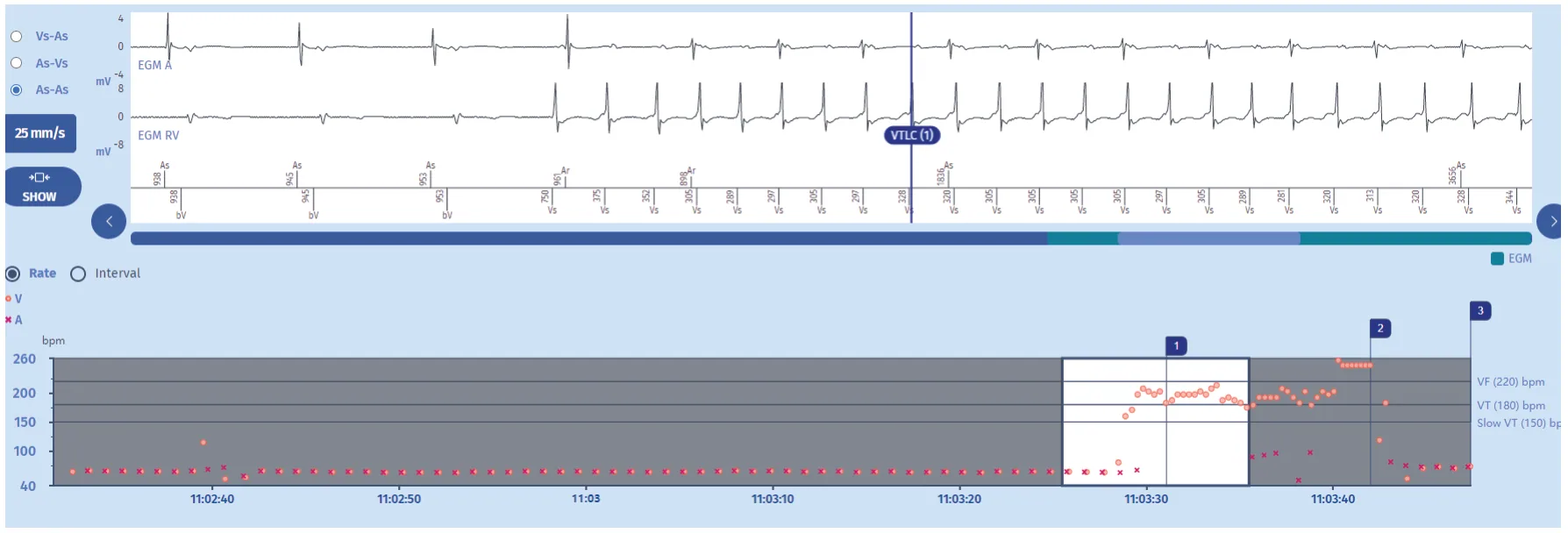
Episode (first screen)
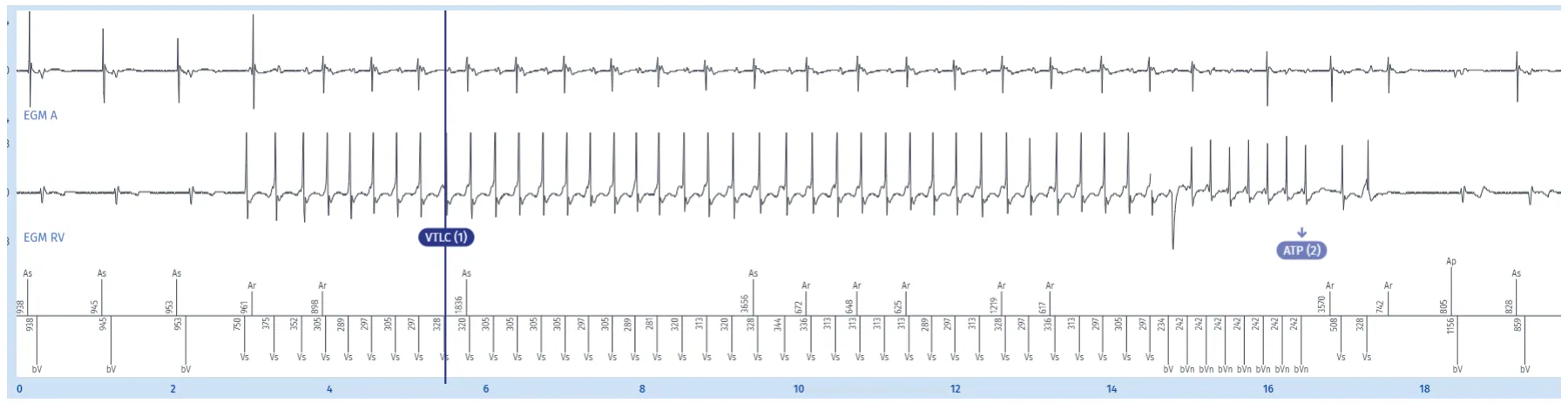
Overview of the full EGM
Tracings: The tracing at the top is the atrial electrogram, underneath, the ventricular electrogram, and lastly, at the bottom, the atrial markers above the line and ventricular markers below, along with the time intervals.
Your turn
What is your diagnosis ?
- Ventricular tachycardia diagnosed in the VT zone
- VT diagnosed in the Slow VT zone
- The antitachycardia pacing is a ramp
- The antitachycardia pacing terminates the tachycardia.
Interval plot
- The rhythm is sinus with biventricular resynchronization.
- Ventricular tachycardia begins in the VT zone (orange dots), while the atrial rate remains slow (purple crosses (x)).
- An ATP is delivered with a return to sinus rhythm in the Slow zone.
EGM
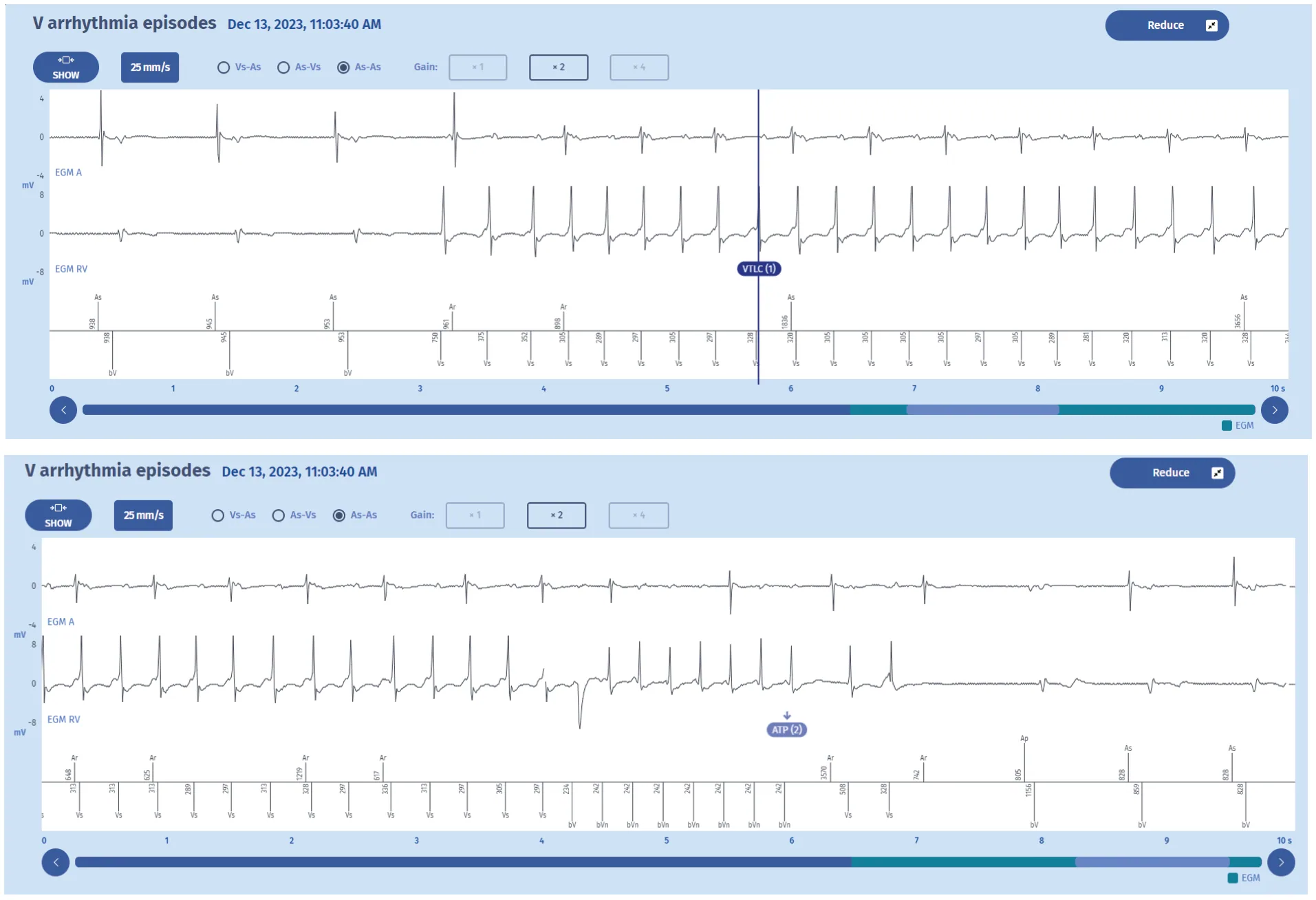
- The rhythm is sinus with synchronized biventricular pacing
- Ventricular tachycardia begins. The first tachycardia cycle (750 ms) is outside the tachycardia zone (400 ms). For the defibrillator, the tachycardia begins at the next cycles which are in the VT zone (375 ms, 352 ms < 400 ms). In the VT zone, the first 2 cycles are excluded. The next 6 cycles are all in the VT zone and count towards the majority. The rate is on average 200/min so well within the VT zone (>180/min). The 6 out of 8 cycles in the VT zone criterion is fulfilled. The ventricular rhythm is stable and there is an atrio-ventricular dissociation (more ventricular than atrial signals). The marker is: VTLC (1). The persistence phase begins.
- After 30 persistence cycles during which all cycles are in the VT zone, an anti-tachycardia pacing burst is initiated for 8 fixed cycles (this is the first therapy programmed in this zone), shown by the second marker: ATP (2).
- The ATP is effective with termination of the tachycardia, and after 6 slow cycles (and a PVC at 328 ms), the episode is terminated (label: Slow Rhythm).
Correct answers - n° 1 and 4
Comments
- This episode shows the perfect detection of a ventricular tachycardia. The counting is carried out according to the 6 of 8 cycles rule: 75% of cycles in a programmed VT zone triggers a persistence phase that is programmable in cycles (in this instance 30) during which the cycles must validate a majority rhythm (6 out of 8 cycles) in a VT zone and are analysed for diagnosis. If a Slow cycle (excluding VT zones) is detected, it does not reset the persistence counting to zero. The VT persistence counting is set to zero if a majority of Slow cycles is detected or a majority of SVT/ST rhythm. In addition, there is no distinction between VT and Slow VT during the counting of VT persistence: it is only at the end of the VT persistence (the shortest) that the device calculates the averaged rate of the last 4 cycles to determine if the rhythm is in the VT zone or in the Slow VT zone. In the present example, all of the cycles are in the VT zone. If the cycles enter in VF, the diagnosis of VF is made if the majority rate (6/8) is VF.
- The averaged rate of the last 4 cycles in the Tachy/VF zone calculated at the time of persistence determines the type of therapy that will be initiated after the persistence phase. The first therapy programmed in the VT zone of our patient is therefore launched (an 8-cycle burst with a pacing interval equal to 80% of the average coupling interval of the tachycardia). In this case the average RR interval was 305 ms (197/min) resulting in an ATP of 242 ms (248/min).
- Note: not all atrial events are sensed given that, due to atrio-ventricular dissociation, some fall into the post-ventricular atrial blanking period; during the ATP, the ventriculograms are only captured completely from the 2nd cycle of the burst.
- The therapy was effective, and thus the programming will not be changed.
Take-home-messages
- The counting follows the rules of the majority rhythm. At least 6 out of 8 cycles must be in a programmed zone for an initial diagnosis to be made.
- The persistence phase must be completed to establish a final diagnosis and is recommended at 30 cycles.
- In the VT or Slow VT zone, the last 4 persistence cycles determine the type of therapy of the tachycardia zone that will be applied.
Practice out loud
Just describe the tracing. What do you think is going on? Describing the numbers can help.
00:00
0%
—
From Implantable Cardioverter Defibrillator — Clinical cases from patients with MicroPort™ ICDs by M. Strik, A. Thiyagarajah, S. Ploux, P. Bordachar, P. Ritter. Published by Cardiocases. Each case is a question on real device interrogations: pick your answer, check it, then read the authors’ interpretation. Tap any figure to open it full screen.