
Chapter 1 · Counters · Case 4
Competition between diffrent detection counters
Patient and episode
Patient
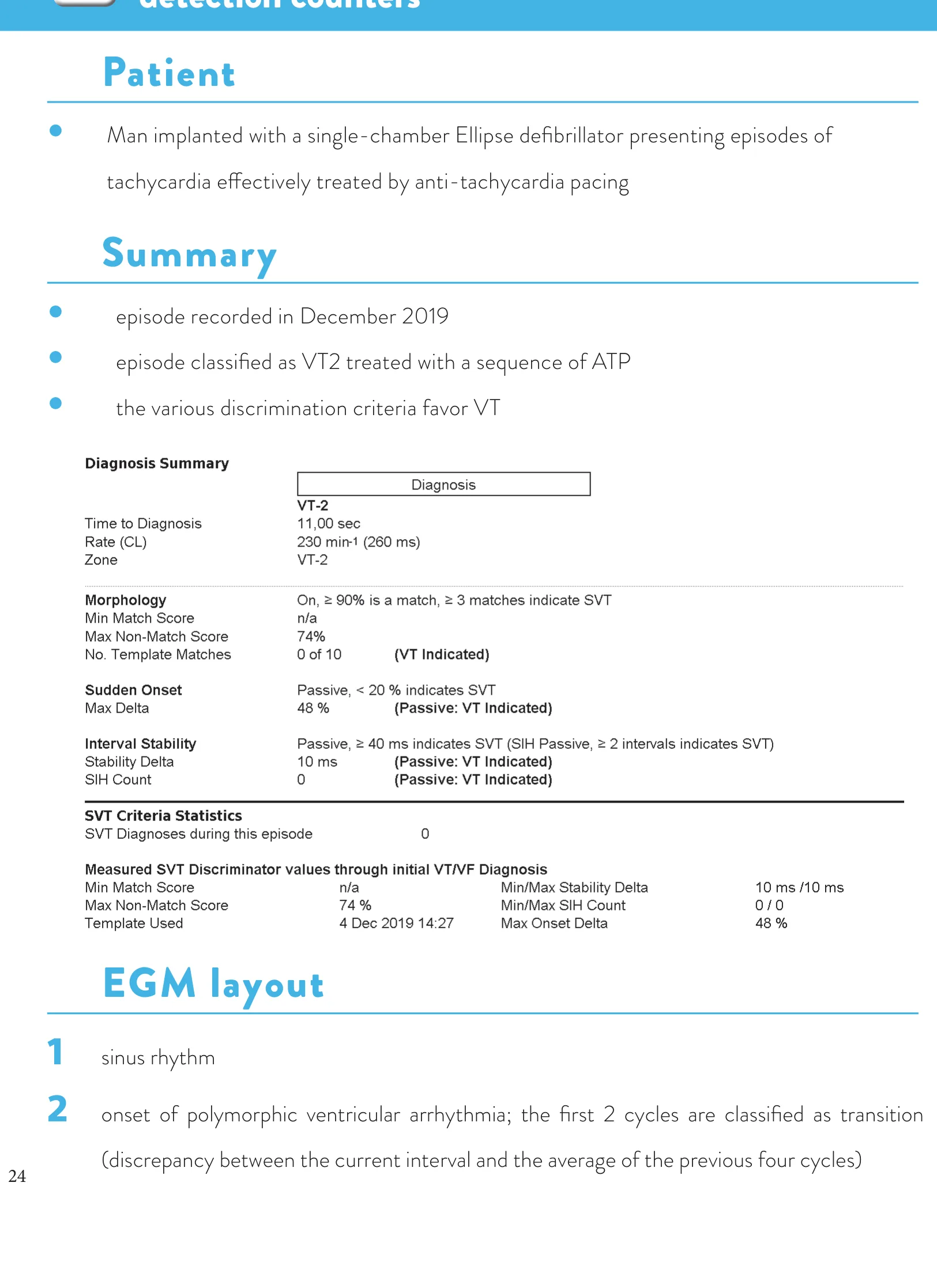
- Man implanted with a single-chamber Ellipse defibrillator presenting episodes of tachycardia effectively treated by anti-tachycardia pacing
Summary
- episode recorded in December 2019 episode classified as VT2 treated with a sequence of ATP the various discrimination criteria favor VT
The recording
Tap a number on the trace, or an entry in the list below
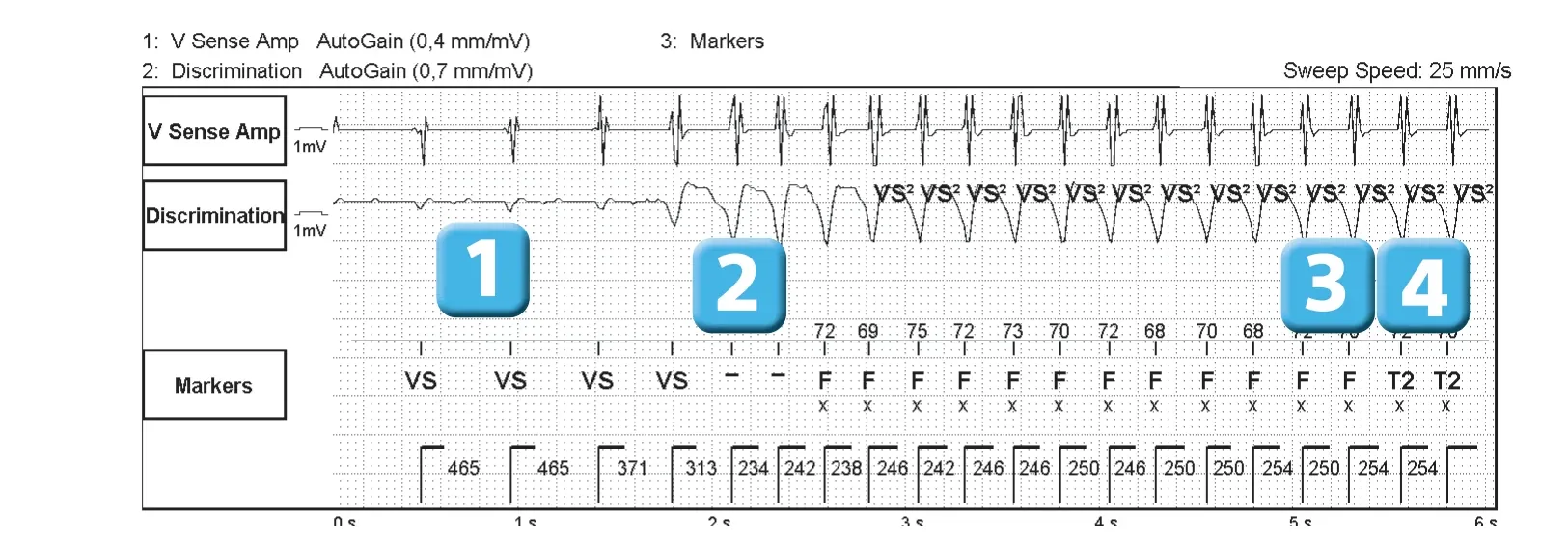
- sinus rhythm
- onset of polymorphic ventricular arrhythmia; the first 2 cycles are classified as transition (discrepancy between the current interval and the average of the previous four cycles)
- on this cycle, the PV counter is at 12 (less than the number of cycles needed to complete the PV counter)
- first cycle classified as T2 (current interval and averaged interval correspond to the VT2 zone)
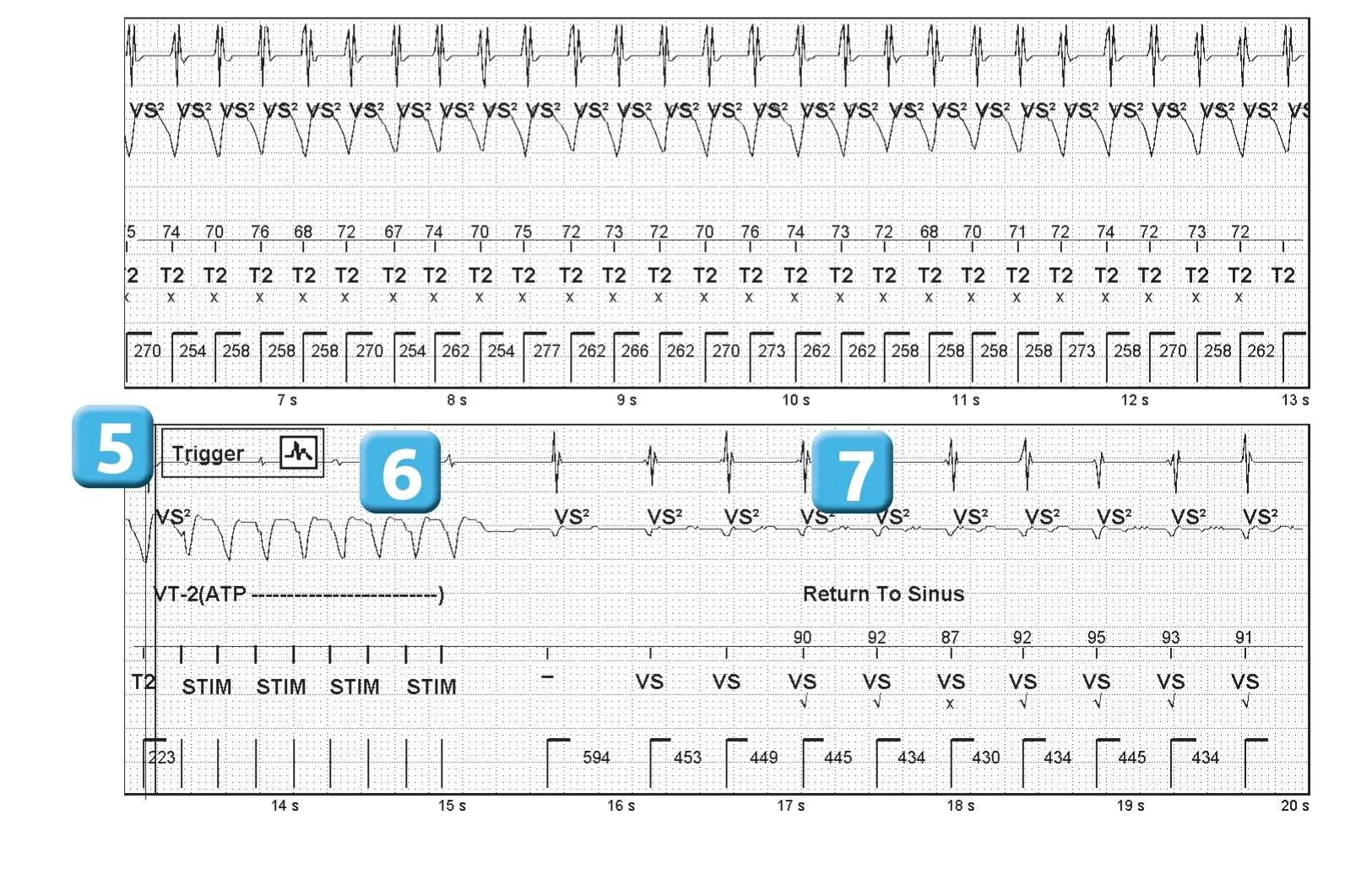
- the VT2 counter is complete (30 cycles) while the VF counter is still at 12; diagnosis of VT2
- first therapy in the VT2 zone (burst of 8 stimuli)
- effective burst and diagnosis of sinus return
From the interrogation
Points to remember
- In this example, tachycardia is initially detected in the VF zone (increment of this counter) and then stabilizes in the VT2 zone; when the number of cycles required for VT2 is reached, the device diagnoses VT2 and delivers the corresponding therapy or therapies.
- This trace illustrates the specific features of the counters in an Abbott defibrillator; the various tachycardia counters (T1, T2, VF) compete with each other and with the sinus return counter (called the end-of-episode counter in the new platforms).
- Cycles are classified solely on the basis of heart rate; thus, a cycle is classified as F if it is very fast, T2 or T1 if it is slightly less fast, with no differentiation between organized VT and VF, which by definition corresponds to a polymorphic, anarchic rhythm disorder; thus, rapid VT (stable and monomorphic) can be detected in the VF zone; this justifies offering anti-tachycardia pacing as first-line therapy, including in the VF zone (however, with a very rapid heart rate that must not be exceeded); Conversely, a polymorphic ventricular rhythm disorder can be detected in the VT zone if the VT zone limit is high (250 beats/minute, for example) and the quality of ventricular sensing is imperfect.
- The VT1, VT2, and VF counters operate identically; the counters can be incremented but cannot be decremented; however, each counter can be reset to 0.
- When a tachycardia counter is completed (VT1, for example), the other tachycardia counters (VT2 and VF in this example) and the sinus return counter are reset to 0
- When the sinus return counter is completed, the tachycardia counters are also reset to 0.
- The counters are competitive and operate independently in parallel; a cycle detected in a fast zone (e.g., VF) implements the VF counter but does not implement the counter for a slower zone (VT1 or VT2); a cycle detected in a slower zone does not decrement the counter for a faster zone.
- For the counter to be implemented, it is not necessary for the cycles detected in this zone to be consecutive; thus, at the end of a sequence T1, T1, T2, F, VS, F, T2, T1: the VT1 counter is at 3, the VT2 counter at 2, the VF counter at 1, and the sinus return counter at 0
- Cycles in transition (marker -) are ignored and do not affect any of the tachycardia or sinus return counters
- The sinus return counter works in a specific way and must be perfectly understood; a cycle classified as T1, T2, or F resets this counter to 0; if sinus return is programmed to 3, after a sequence of T1, VS, -, VS, -, VS, the sinus return counter is completed and all tachycardia counters are reset to 0; after a sequence T1, T1, T1, T1, VS, VS, -, T1, the last T1 cycle resets the sinus return counter to 0; the VT1 counter is then at 5
Practice out loud
Just describe the tracing. What do you think is going on? Describing the numbers can help.
00:00
0%
—
From Implantable Cardioverter Defibrillator — clinical cases based on tracings by P. Bordachar, M. Strik, A. Thiyagarajah, S. Ploux. Published by Cardiocases. Every numbered marker on a recording is explained in the list beneath it; tap a marker on the trace or an entry in the list.