
Chapter 2 · Therapies · Case 7
Sequence of therapies in the VT zone
Patient and episode
Patient
- Patient implanted with a single-chamber Ellipse defibrillator for ischemic cardiomyopathy with repeated episodes of VT
Summary
- VT2 episode processed by a burst (10 cycles at a fixed frequency) discrimination criteria in favor of a VT
- VT2 episode processed by three bursts with frequency increment between each burst discrimination criteria in favor of a VT
- VT2 episode processed by 4 bursts with frequency increment between each burst + 30 joules electric shock criteria for discrimination in favor of a VT
The recording
Tap a number on the trace, or an entry in the list below
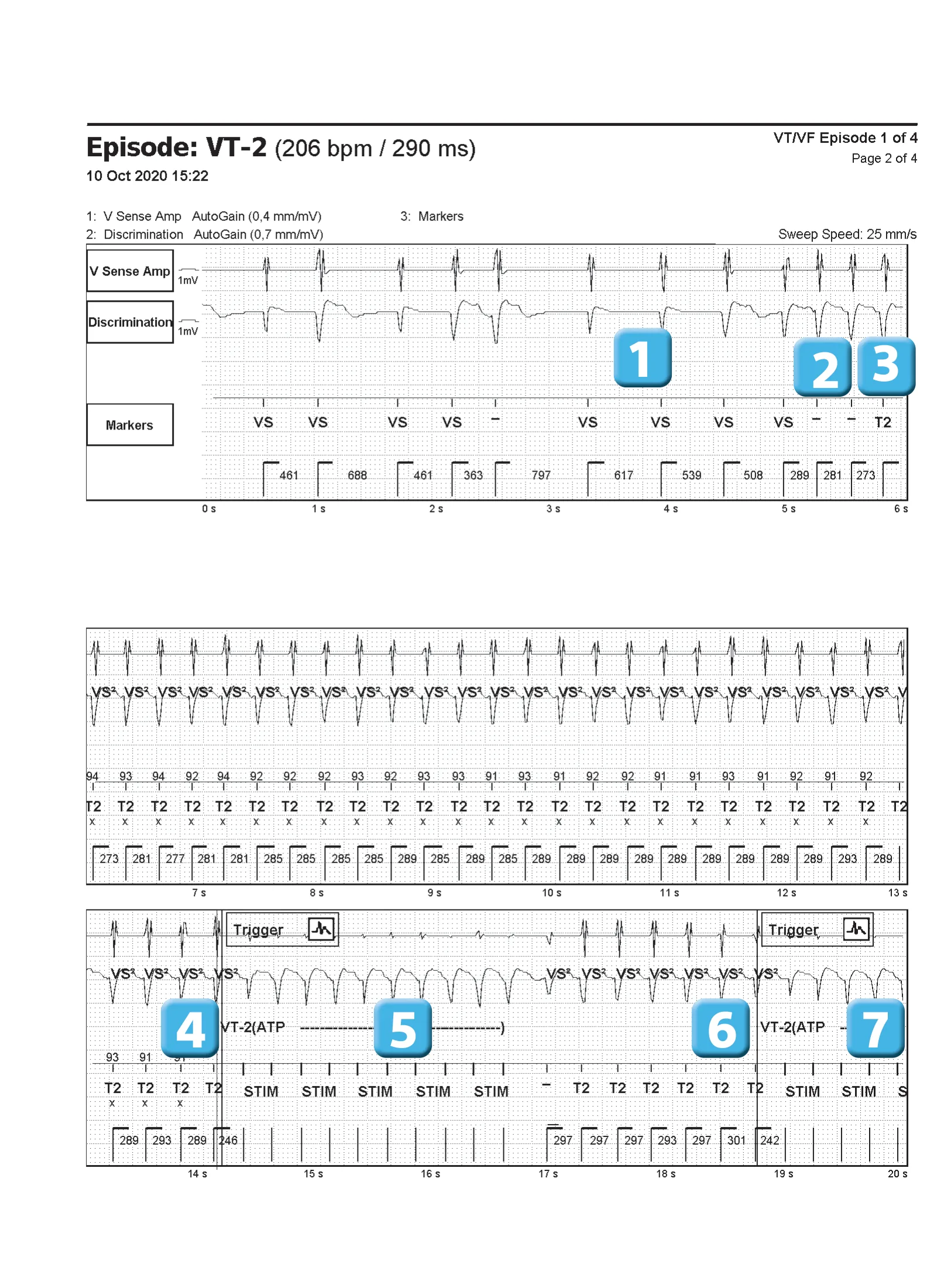
Episode 1

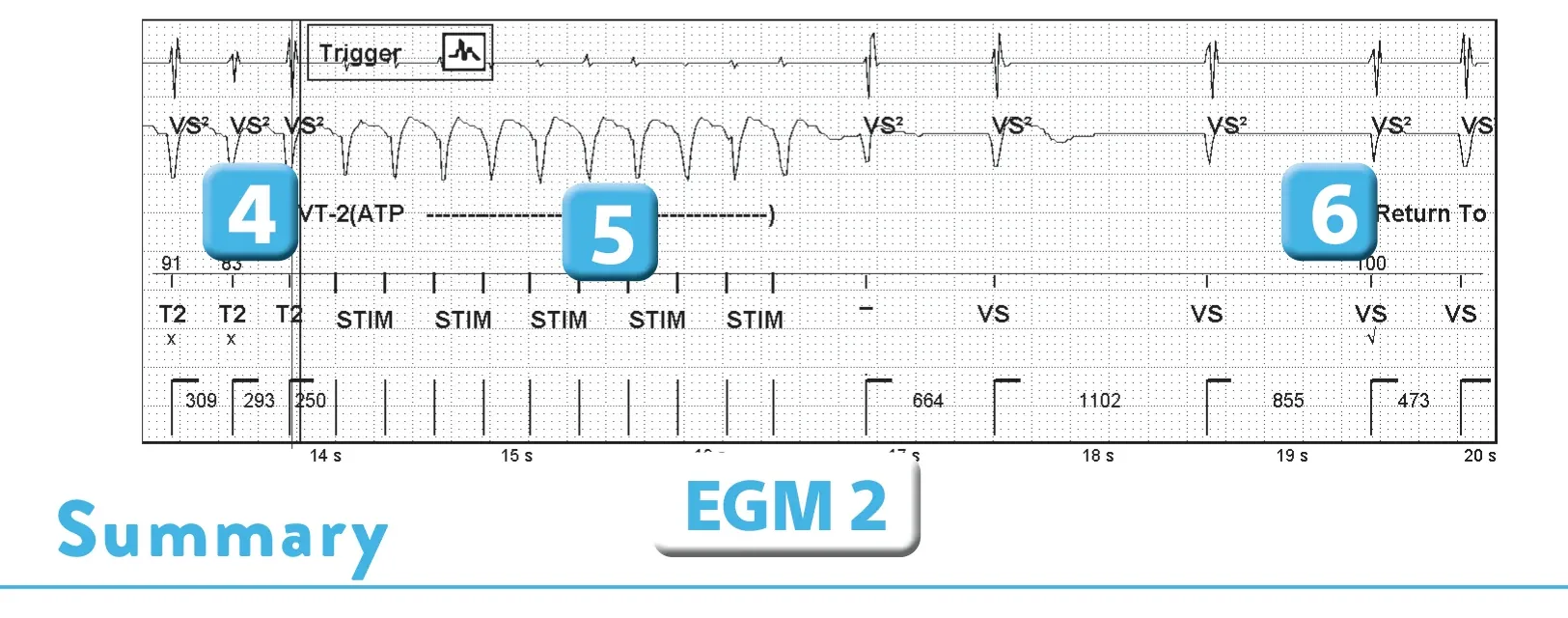
- sinus rhythm
- onset of monomorphic and regular arrhythmia; the first two cycles are classified as transitional (discrepancy between the current interval and the average of the previous four cycles)
- first cycle classified as T2 (concordance between the current cycle and the averaged cycle)
- after 30 cycles classified as T2, detection of a VT2 episode (VT2 counter completed)
- burst of 10 complexes
- effective burst and diagnosis of sinus return after 3 cycles classified as VS
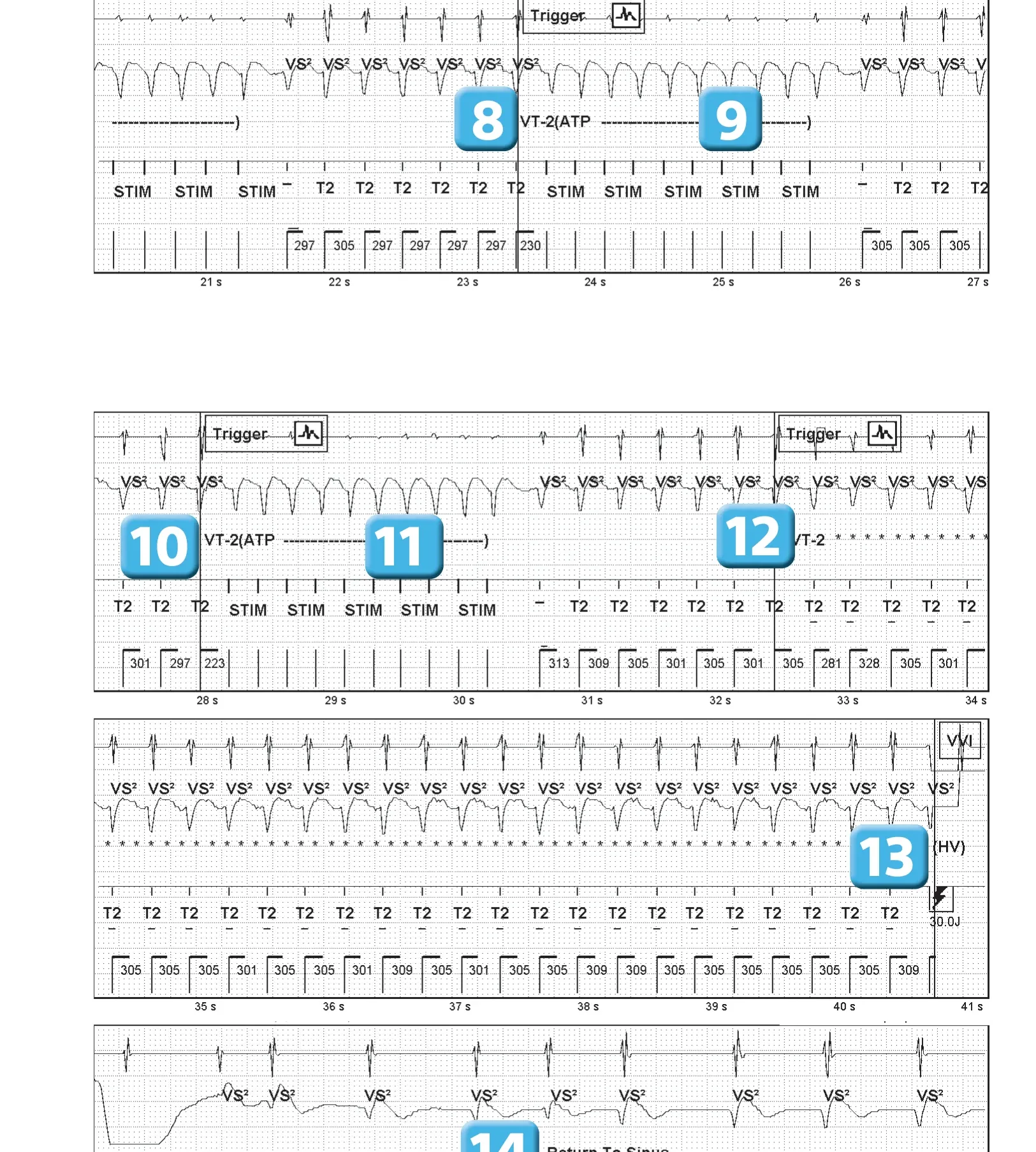
Episode 2
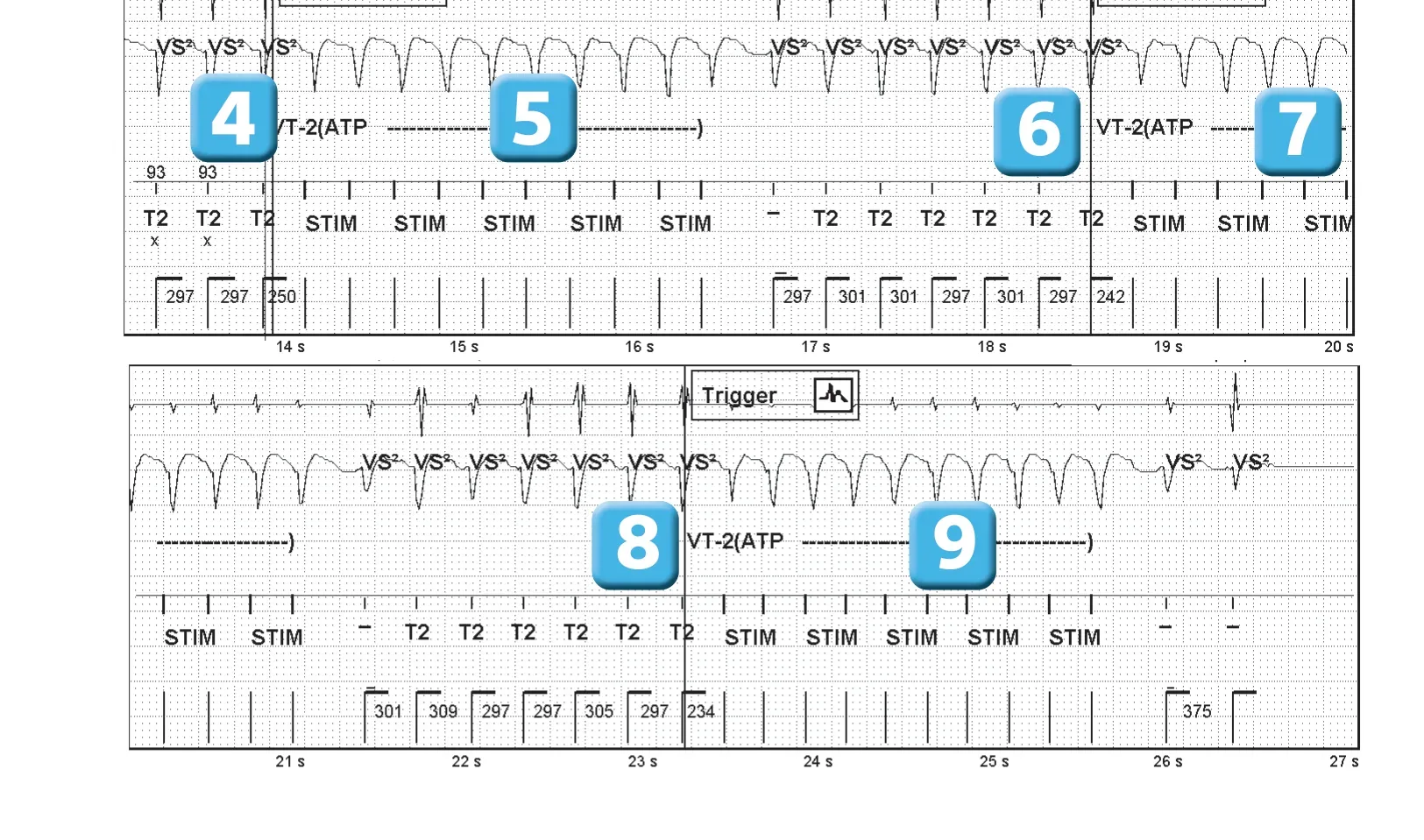

- sinus rhythm
- onset of a monomorphic and regular arrhythmia; the first 3 cycles are classified as transition (discordance between the current interval and the average of the previous 4 cycles)
- first cycle classified as T2 (concordance between the current cycle and the averaged cycle)
- after 30 cycles classified as T2, detection of a VT2 episode (VT2 counter completed)
- burst of 10 complexes
- ineffective burst and redetection after 6 cycles classified as T2
- second burst
- ineffective burst and redetection after 6 cycles classified as T2
- third burst
- effective burst and diagnosis of sinus return after 3 cycles classified as VS
Episode 3
- sinus rhythm
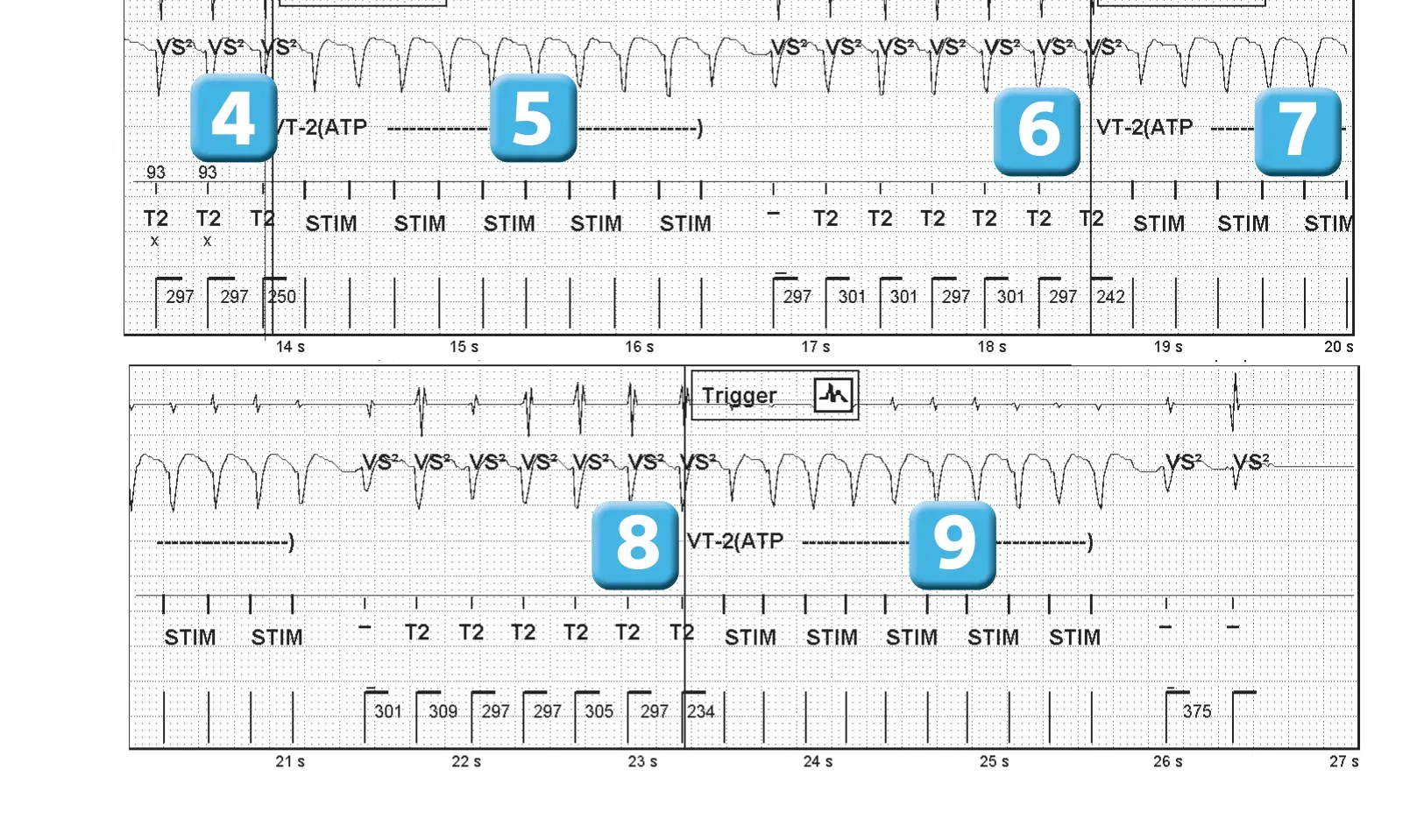
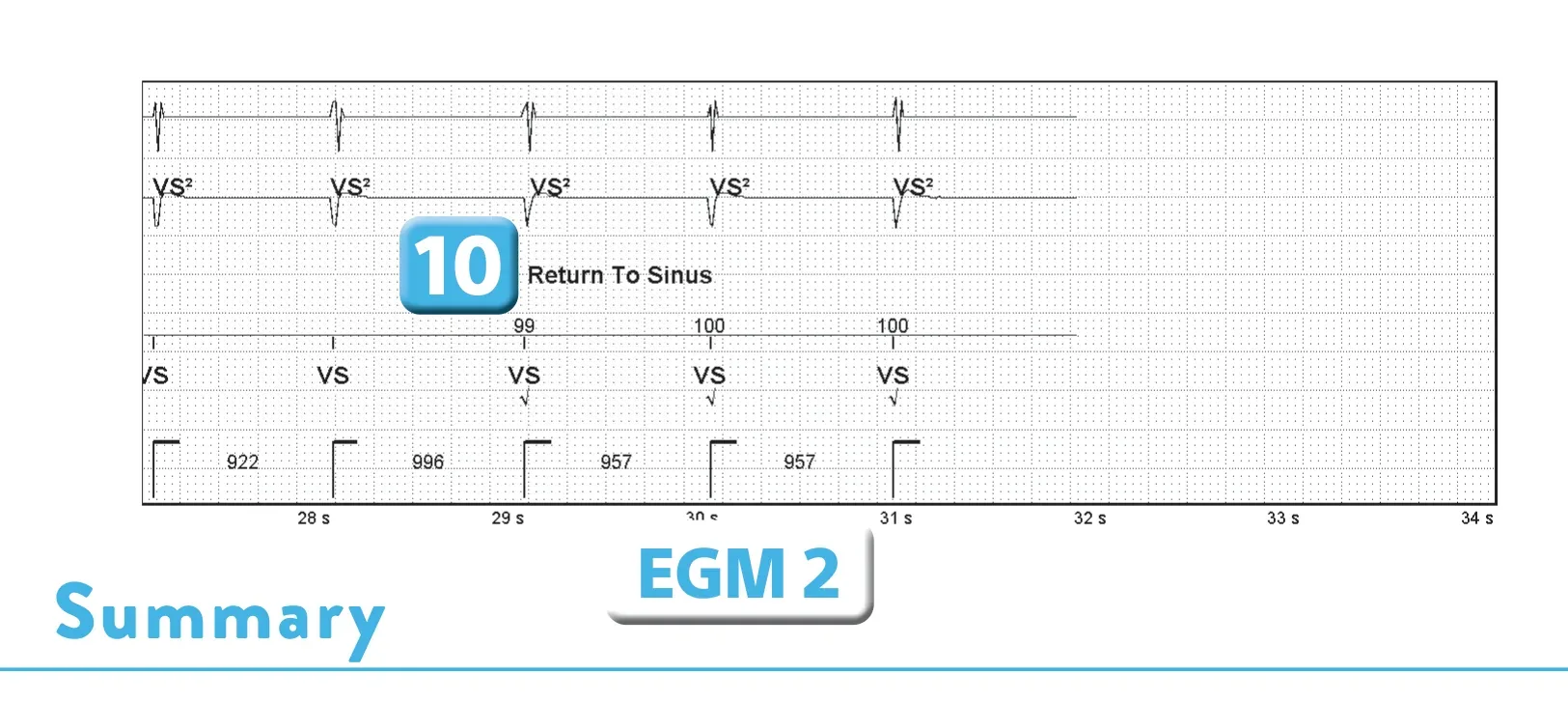
- onset of a monomorphic and regular arrhythmia; the first 2 cycles are classified as transition (discrepancy between the current interval and the average of the previous 4 cycles)
- first cycle classified as T2 (concordance between the current cycle and the averaged cycle)
- after 30 cycles classified as T2, detection of a VT2 episode (VT2 counter completed)
- burst of 10 complexes
- ineffective burst and redetection after 6 cycles classified as T2
- second burst
- ineffective burst and redetection after 6 cycles classified as T2
- third burst
- ineffective burst and redetection after 6 cycles classified as T2
- fourth burst
- ineffective burst and redetection after 6 cycles classified as T2; start of capacitor charging
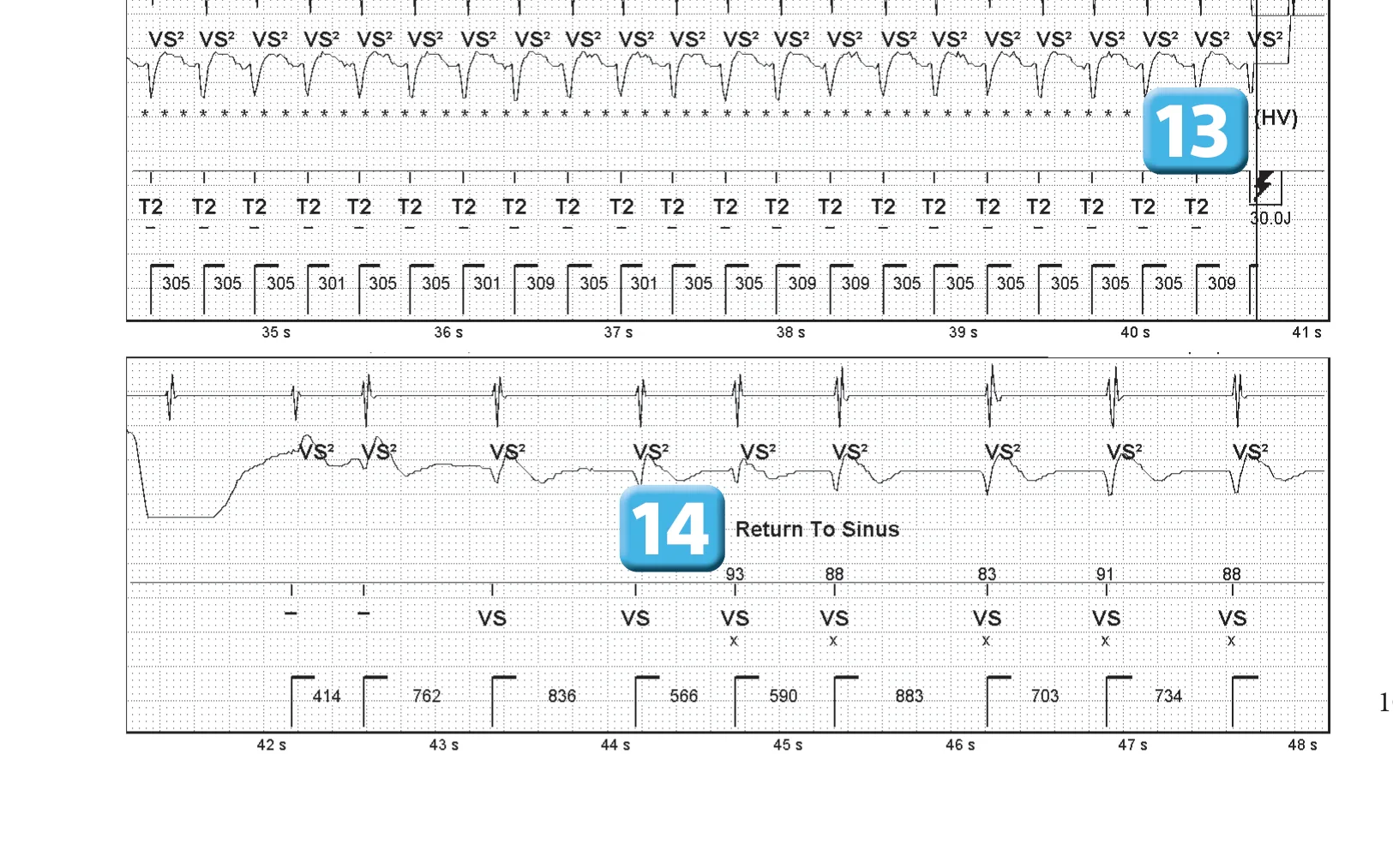
- 30 joules electric shock
- effective shock and diagnosis of sinus return after 3 cycles classified as VS
From the interrogation
Points to remember
- A priority when programming an implantable defibrillator is to reduce the number of shocks delivered as much as possible without compromising patient safety. The ideal scenario is to terminate the tachycardia using the least aggressive and least painful therapy possible. Anti-tachycardia pacing is therefore the preferred first-line therapy for organized reentrant tachycardias, as it is less painful than electric shocks and limits battery consumption and wear.
- The basic principle of anti-tachycardia pacing is based on the existence of an excitation window in a reentrant circuit during which rapid pacing can generate a new activation front that collides with the tachycardia circuit and can interrupt it; the ventricle must therefore be paced at a higher frequency than that of the tachycardia.
- The effectiveness of this type of therapy has been demonstrated for a wide range of ventricular tachycardia frequencies up to 240 beats/minute. Anti-tachycardia pacing reduces approximately 90% of ventricular tachycardias with a frequency below 200 beats/minute, with a moderate risk of acceleration of around 1 to 5%.
- These observations have repositioned the implantable «defibrillator» as a first-line treatment for arrhythmias using rapid pacing, with defibrillation only as a «backup» option.
- One or more ATP sequences can be programmed empirically without the need for prior testing of efficacy during electrophysiological exploration.
- This patient had numerous episodes of VT that were effectively treated with anti-tachycardic pacing anti-tachycardia pacing; rapid and effective treatment with pacing allowed the patient to remain asymptomatic with preserved quality of life while preserving battery life.
- To optimize the effectiveness of anti-tachycardia pacing, various parameters can be programmed: 1) the type of sequence: in a burst, the duration of the intervals is constant throughout a sequence (no change in frequency from one stimulus to another); in a ramp, the interval is reduced from one stimulus to the next by a programmable decrement value; 2) the number of programmed bursts/ramps varies the frequency of the tachycardia; in a slow VT zone (< 150 beats/minute), it is possible to program a large number of bursts and/or ramps in order to delay as long as possible the delivery of a shock for tachycardia that does not generally threaten short-term survival; it is also possible not to program an electric shock in this slow VT zone; for tachycardia between 150 and 200 beats/minute, it is customary to program 2 to 6 bursts/ramps, even though the success rate beyond 3 or 4 bursts is very limited; 3) Number of pulses per sequence: on average, 5 to 15 consecutive stimulations are programmed in each burst; if the number is insufficient, the stimulation sequence may not penetrate the tachycardia circuit and the burst will be ineffective; on the other hand, if the number is too high, there is a risk of reducing and then re- inducing the tachycardia; an additional stimulus can be added systematically from one sequence to the next; according to the recommendations, a minimum of 8 stimuli per sequence must be programmed;4) the value of coupling and stimulation intervals: the shorter the couplings, the more aggressive the therapy and the greater the risk of accelerating tachycardia; according to the recommendations, for a burst, a coupling of 85% relative to the tachycardia frequency should be programmed; the percentage is calculated based on the average of the four intervals preceding the therapy; 5) minimum coupling limits the aggressiveness of a stimulation sequence; There is a programmable frequency limit above which, regardless of the programming, the device does not deliver stimulation. When, during a ramp for example, the minimum coupling is reached, the following cycles are stimulated with this minimum coupling without further decrement. 6) The stimulation amplitude and pulse duration can be programmed to promote effective capture during tachycardia
- The amplitude of the first shock in the VT zone can be programmed to maximum energy or to a lower amplitude (around 10 to 15 joules).
- There are a number of advantages to programming a first shock with moderate amplitude (10-15 joules): 1) this amplitude is very often sufficient to reduce a VT episode; 2) the charge time for this amplitude is very short, even if the few seconds of difference compared to maximum amplitude are not clinically significant when the shock occurs after 3 sequences bursts of approximately 3 ramp sequences (more than one minute of arrhythmia); 3) consumption is lower for a 10-joules shock versus a 36-40-joules shock, even though battery wear is minimally affected if the number of shocks delivered is limited; 4) even though most of the time during a VT episode, the electric shock is delivered while the patient is still conscious, the painful nature of the shock has little bearing on the decision regarding the amplitude of the first shock, as it is difficult to demonstrate a direct relationship between the amplitude of the shock delivered and the amplitude of the pain caused; 5) Various studies have demonstrated the harmful nature of electric shocks and their association with a worsened prognosis; it therefore seems logical to assume that a 10-joules shock will have fewer negative consequences than a 40-joules shock, and it seem desirable to choose the least traumatic therapy possible.
- Programming an initial shock with maximum amplitude empirically, as in this example, reduces the risk of proarrhythmic effects, increases the probability of reducing VT on the first attempt, thereby minimizing the number of shocks delivered, and increases the probability of reducing AF if the shock is inappropriate.
Practice out loud
Just describe the tracing. What do you think is going on? Describing the numbers can help.
00:00
0%
—
From Implantable Cardioverter Defibrillator — clinical cases based on tracings by P. Bordachar, M. Strik, A. Thiyagarajah, S. Ploux. Published by Cardiocases. Every numbered marker on a recording is explained in the list beneath it; tap a marker on the trace or an entry in the list.